

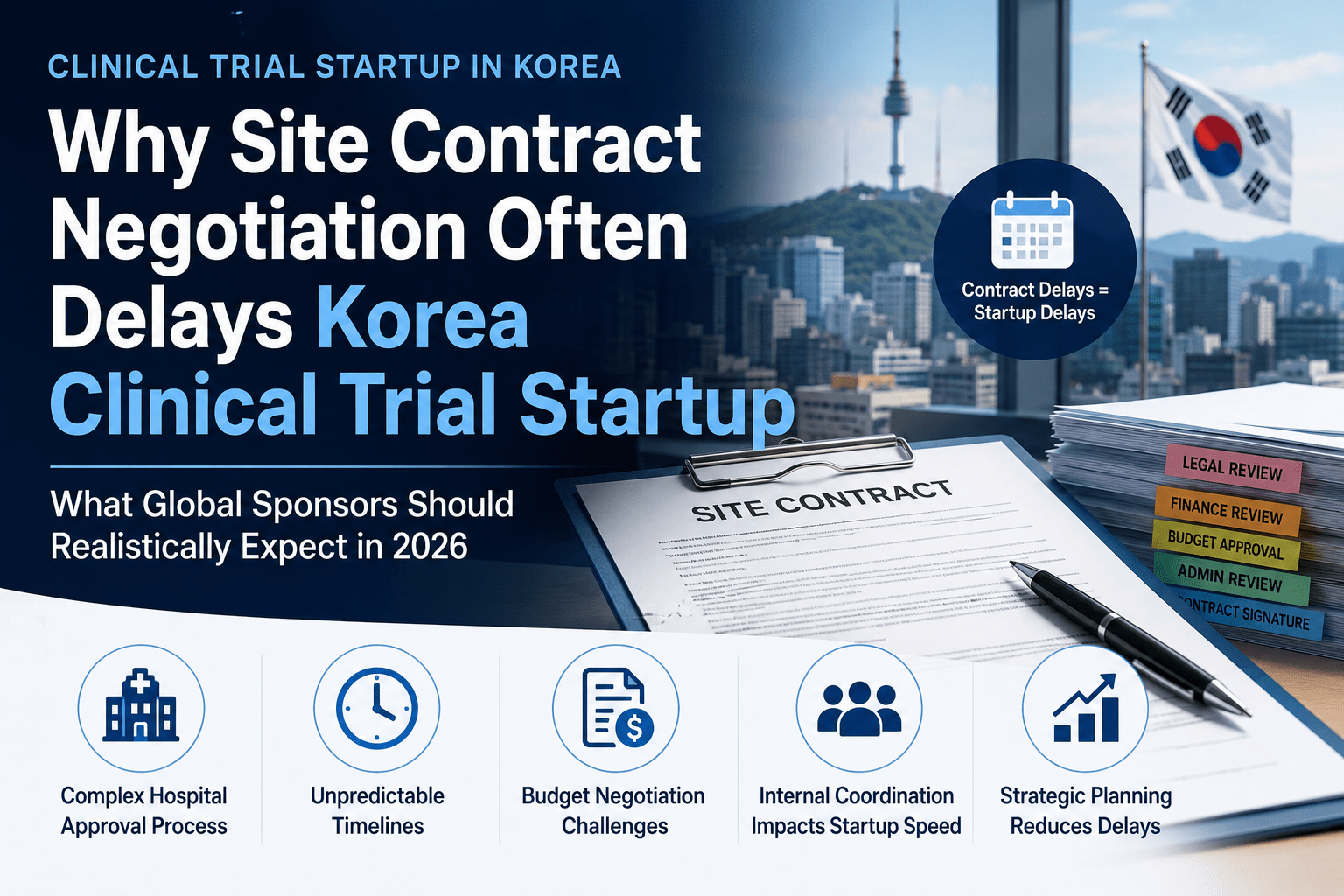
What Global Sponsors Should Realistically Expect
As Korea continues to grow as a major global clinical trial market, more international sponsors are recognizing that successful study execution depends on far more than regulatory approval alone.
In many cases, one of the most underestimated challenges in Korea clinical trial startup is site contract negotiation.
Many global biotech and pharmaceutical companies initially assume that once MFDS approval is completed, site activation and patient enrollment can proceed quickly. However, actual startup timelines in Korea are often heavily influenced by hospital contract discussions, internal administrative review processes, budget negotiations, and operational coordination.
Particularly in oncology, ADC, cell and gene therapy, and complex global studies, contract negotiation has become one of the most important operational bottlenecks during startup planning.
As Korea’s clinical trial ecosystem becomes increasingly competitive and operationally complex, understanding how Korean hospitals handle contract negotiation is becoming critical for realistic startup planning.
Why Korea Hospital Contract Processes Are Different From Many Global Markets
One of the biggest surprises for many global sponsors is how structurally complex Korean hospital systems can be.
In many countries, sponsors often view site contracts primarily as legal agreements between the sponsor and the institution. In Korea, however, hospital contract processes frequently involve multiple internal departments simultaneously.
Depending on the institution, contract review may involve the clinical trial center, legal department, finance department, budgeting teams, pharmacy teams, hospital administration, and additional operational stakeholders.
Importantly, these reviews are not always conducted in parallel.
As a result, even when investigators are highly interested in participating in a study, the actual contract finalization process may still require extensive internal coordination before execution can proceed.
For sponsors unfamiliar with Korean hospital structures, this operational reality can significantly impact startup expectations.
Why Contract Timelines in Korea Can Be Difficult to Predict
Many global sponsors attempt to build Korea startup timelines based primarily on regulatory assumptions.
However, actual startup timelines are often influenced more heavily by hospital administrative processes than by regulatory review itself.
Even when sponsor-side preparation is completed early, contract negotiation may still be delayed due to internal hospital review queues, legal revision cycles, budget discussions, administrative approval procedures, or competing institutional priorities.
At large tertiary hospitals, contract teams are often managing multiple global studies simultaneously, particularly in high-demand therapeutic areas such as oncology and rare disease research.
As study complexity increases, contract review timelines can become increasingly difficult to predict.
This is one reason why many Korea clinical trial startups experience delays after regulatory approval has already been completed.
Increasingly, sponsors are learning that Korea startup planning requires operational flexibility rather than purely timeline-based assumptions.
Why Budget Negotiation Is Becoming More Complex in Oncology and ADC Studies
Contract negotiation complexity becomes even more visible in oncology and ADC studies.
These programs often involve highly specialized operational requirements, including biomarker testing, imaging review, safety monitoring, complex pharmacy handling procedures, intensive patient assessments, and multidisciplinary coordination.
As a result, site budget discussions are frequently far more detailed than sponsors initially expect.
At the same time, major Korean hospitals are now managing increasing volumes of global oncology trials. This growing competition for institutional resources has made hospitals more cautious about workload allocation, staffing availability, and operational capacity.
In some cases, sponsors may find that budget negotiations are influenced not only by study requirements themselves, but also by broader hospital workload considerations.
For global sponsors entering Korea for the first time, this operational environment can be difficult to anticipate without local experience.
Why Internal Hospital Coordination Often Determines Startup Speed
One of the most important realities in Korea clinical trial startup is that contract negotiation rarely operates as an isolated administrative process.
In practice, contract execution is closely connected to multiple parallel startup activities, including IRB scheduling, vendor coordination, pharmacy preparation, system setup, essential document collection, and site activation planning.
When contract discussions are delayed, these downstream operational activities may also become delayed.
This creates a chain-reaction effect that can significantly impact overall startup timelines.
For this reason, startup speed in Korea often depends less on a single approval milestone and more on how effectively multiple operational workflows are coordinated simultaneously.
Sponsors that underestimate these operational interdependencies may experience far greater delays than originally anticipated.
Why Global Sponsors Are Becoming More Focused on Startup Execution Strategy
Historically, many sponsors viewed Korea primarily as a fast-enrollment market.
While Korea continues to offer strong recruitment potential in many therapeutic areas, sponsors are now becoming increasingly focused on operational execution quality and startup stability.
This shift is especially visible in oncology, ADC, cell and gene therapy, and early-phase programs, where protocol complexity and operational coordination requirements continue to increase.
Today, many sponsors are no longer asking only:
“How quickly can we open sites?”
Instead, they are increasingly asking:
“How realistically can this study execute within Korea’s operational environment?”
This shift reflects a broader industry trend in which operational readiness is becoming just as important as regulatory readiness.
How Sponsors Can Reduce Contract-Related Startup Delays in Korea
Reducing startup delays in Korea increasingly requires realistic operational planning from the earliest stages of study preparation.
Early communication with hospitals can help identify potential administrative bottlenecks before they become major delays later in startup.
Understanding hospital workload, internal review structures, and operational capacity can also help sponsors build more realistic expectations around contract timelines.
At the same time, sponsors that approach Korea startup planning with greater operational flexibility are often better positioned to adapt to evolving site-level circumstances during execution.
Increasingly, successful Korea startup management depends on integrating regulatory planning, contract coordination, operational sequencing, and local communication strategy together rather than treating them as separate processes.
Conclusion: Contract Negotiation Is No Longer Just an Administrative Step
As Korea becomes increasingly important in global clinical development, contract negotiation is evolving into a major strategic component of clinical trial startup planning.
Particularly in oncology, ADC, cell and gene therapy, and complex global studies, operational coordination surrounding hospital contracts can significantly influence overall startup success.
For global sponsors, understanding how Korean hospitals actually manage internal review and operational coordination is becoming increasingly important for realistic execution planning.
Today, successful Korea startup execution depends not only on regulatory approval, but also on realistic operational strategy, hospital coordination, and execution readiness from the beginning.
Planning a Clinical Trial in Korea?
NexBridge Bio supports global sponsors with Korea clinical trial startup strategy, operational feasibility assessment, hospital communication, contract coordination planning, and local execution support.
If you are evaluating Korea as part of your global development strategy, feel free to connect with the NexBridge Bio team to discuss realistic startup planning considerations.
Frequently Asked Questions (FAQ)
Q1: Why do Korea clinical trial startups often get delayed after MFDS approval?
A: Many global sponsors assume regulatory approval is the main hurdle. However, in Korea, startup timelines are often more heavily impacted by hospital contract negotiation, IRB scheduling, internal hospital reviews, pharmacy preparation, and operational coordination after approval has already been completed.
Q2: Why are Korea site contract negotiations often difficult to predict?
A: Korean hospitals usually involve multiple internal departments during contract review, including legal, finance, clinical trial centers, and administration teams. Because these reviews are not always conducted simultaneously, timelines can vary depending on hospital workload and internal processes.
Q3: Why are oncology and ADC studies more complex during contract negotiation?
A: Oncology and ADC trials often require additional biomarker testing, imaging assessments, pharmacy handling procedures, and intensive patient monitoring. These operational requirements frequently lead to more detailed budget discussions and longer internal hospital review processes.
Q4: Can contract negotiation delays affect overall study startup timelines?
A: Yes. In Korea, contract execution is closely connected to IRB review, vendor setup, site activation, and operational preparation. Delays in one area can create downstream delays across the entire startup process.
Q5: How can global sponsors reduce Korea startup delays related to contract negotiation?
A: Early hospital communication, realistic operational planning, understanding institutional workload, and strong local coordination are increasingly important. Sponsors that integrate operational strategy early in startup planning are often better positioned for smoother execution in Korea.