

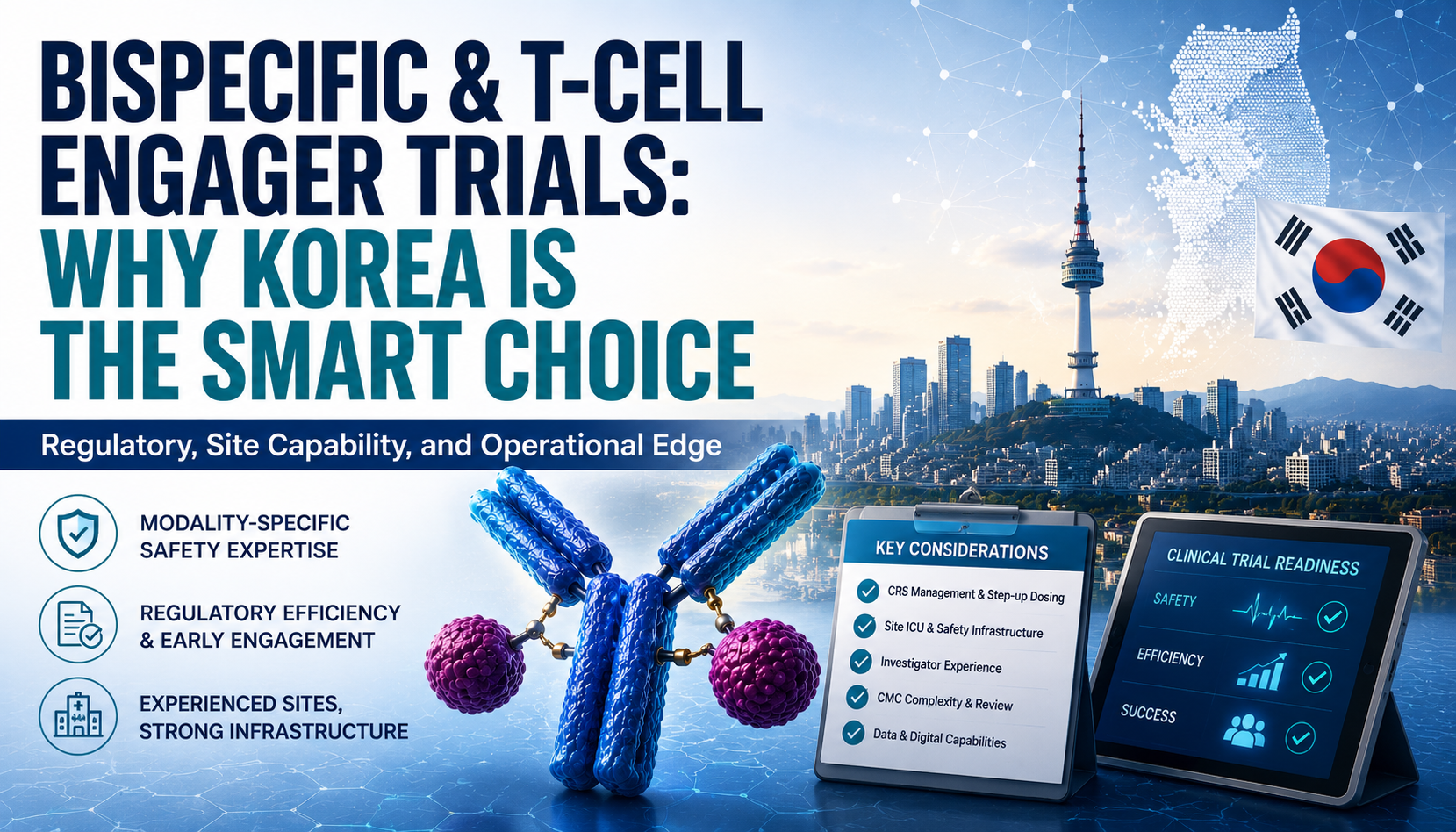
Bispecific antibodies and T-cell engagers have moved from a niche modality into one of oncology’s most active development categories, and the pipeline behind them is no longer concentrated in a handful of large biopharma companies. Mid-size and emerging biotechs are now running first-in-human and early-phase programs for these molecules, often on tighter timelines and thinner regulatory teams than their larger peers. For a sponsor weighing where to place a bispecific or T-cell engager (TCE) study, the calculus is different from a conventional monoclonal antibody or even an antibody-drug conjugate program, because the safety monitoring burden, dosing design, and site capability requirements are structurally heavier.
This is the tension every sponsor planning a bispecific or TCE trial eventually confronts: the modality that offers the most differentiated clinical upside is also the one that punishes a mismatched site or an inexperienced regulatory partner most severely. Cytokine release syndrome risk means early-phase cohorts require monitoring infrastructure that not every investigational site maintains as standard practice. Step-up and fractionated dosing schedules demand an institutional review board that has already reasoned through this class of mechanism, not one encountering it for the first time. And because manufacturing these molecules is more complex than producing a standard antibody, the chemistry, manufacturing, and controls package that accompanies an IND filing draws closer regulatory scrutiny than sponsors may be used to from earlier-generation biologics programs.
South Korea has built a track record with adjacent modality classes, including antibody-drug conjugates and cell therapies, that gives it a plausible starting position for bispecific and TCE programs. But a track record with one complex modality does not automatically transfer to another, and sponsors evaluating Korea for this specific class of molecule need to look past general regulatory speed metrics and ask more targeted questions about site-level safety infrastructure, investigator familiarity with immune-mediated toxicity management, and how the local regulatory review process actually engages with a CMC package this intricate.
This article sets out what differentiates bispecific and T-cell engager trials operationally, what Korea’s regulatory and clinical infrastructure currently offers in response, and the specific due diligence questions a sponsor should be asking before committing a program to any single country, Korea included.
Why Bispecific and T-Cell Engager Programs Carry a Different Risk Profile
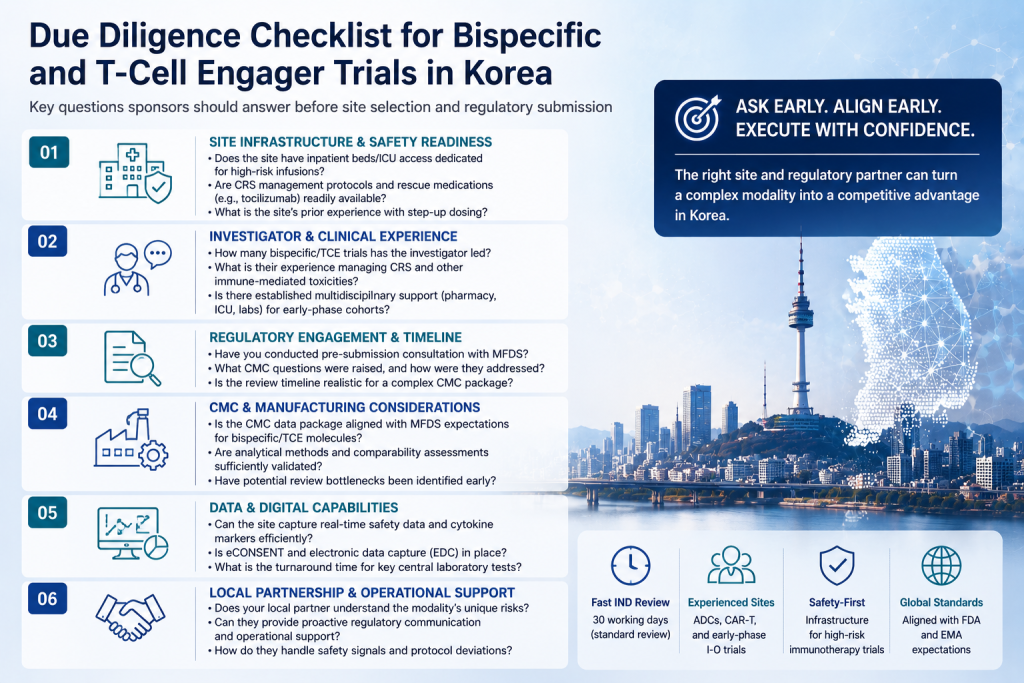
A conventional monoclonal antibody trial and a bispecific or TCE trial can look similar on paper, sharing dose-escalation designs, standard oncology endpoints, and comparable regulatory filing structures. The operational reality underneath is not similar. T-cell engagers work by physically bridging a patient’s T cells to tumor cells, which means the pharmacology that makes them effective against cancer is the same mechanism that can trigger a systemic immune activation event. Cytokine release syndrome is the dominant safety concern shaping trial design for this class, and it has pushed sponsors and regulators toward step-fractionated dosing protocols where the first doses are deliberately small and administered under close observation before escalating toward a therapeutic level.
This changes what a trial site needs to be capable of on day one of dosing. Early cohorts typically require monitoring protocols closer to what an inpatient oncology or hematology unit would use for a high-risk infusion than what a standard outpatient oncology trial site maintains. Access to interleukin-6 pathway inhibitors and corticosteroids for CRS management, rapid-turnaround cytokine panel testing, and staff experienced in recognizing early-stage cytokine release symptoms are not optional extras for this modality; they are baseline requirements. A site that runs excellent conventional oncology trials but has limited experience with T-cell engaging mechanisms represents a real execution risk, regardless of how strong its enrollment numbers look on a feasibility questionnaire.
The regulatory dimension compounds this. Because bispecific molecules require precise pairing of different protein chains during manufacturing, the chemistry, manufacturing, and controls documentation submitted alongside a clinical trial application is more analytically demanding than what a standard antibody program requires, and reviewers scrutinize it accordingly. A regulatory authority that processes routine biologics submissions quickly is not automatically equipped to process a submission of this analytical depth on the same timeline. Sponsors should treat the standard IND or CTA review-time benchmark for a given country as a reference point, not a guarantee, when the molecule in question is a bispecific or multispecific construct.
Korea’s Regulatory and Site Infrastructure for Complex Immuno-Oncology Trials
Korea’s Ministry of Food and Drug Safety has built a clinical trial application process that is procedurally fast relative to many other major trial destinations, with a formal review window measured in working days and an established pre-submission consultation option that allows sponsors to surface CMC and protocol design questions with reviewers before filing. For a molecule class where CMC documentation carries unusual weight, this consultation pathway is worth more to a bispecific or TCE sponsor than it would be to a sponsor running a conventional small-molecule study, because it creates an opportunity to resolve manufacturing and analytical questions before they become review delays.
On the clinical operations side, Korea’s hospital-based trial infrastructure has accumulated meaningful recent experience with modalities that share operational DNA with bispecifics and TCEs. Investigational sites that have run antibody-drug conjugate and early-phase cell therapy studies have already built the muscle memory for intensive early-cycle safety monitoring, rapid protocol-driven dose modification, and coordination between oncology, pharmacy, and critical care teams that a T-cell engager program also demands. This is a different and more relevant signal for a bispecific sponsor to look for than general trial volume statistics, because it points to whether a site’s standard operating procedures already assume this level of monitoring intensity rather than needing to be built from scratch for a single protocol.
Manufacturing and supply chain infrastructure in Korea has also been expanding capacity specifically oriented toward complex biologics, including bispecific antibody formats, which matters for sponsors who may eventually need in-country or regional drug product support as a program scales from first-in-human into expansion cohorts. A regulatory environment that is fast for routine filings but disconnected from the manufacturing base a sponsor actually needs creates its own friction later in a program; Korea’s positioning reduces that gap for sponsors planning to stay in the region across multiple phases.
None of this substitutes for site-specific diligence. A national-level regulatory timeline advantage and a national-level manufacturing capacity trend describe the operating environment, not any individual hospital’s actual readiness to run a specific TCE protocol. Sponsors should treat Korea’s infrastructure profile as a reason to shortlist the country seriously, not as a substitute for validating the specific sites and CRO partner they intend to work with.
What Sponsors Should Evaluate Before Committing a Bispecific or TCE Program to Korea
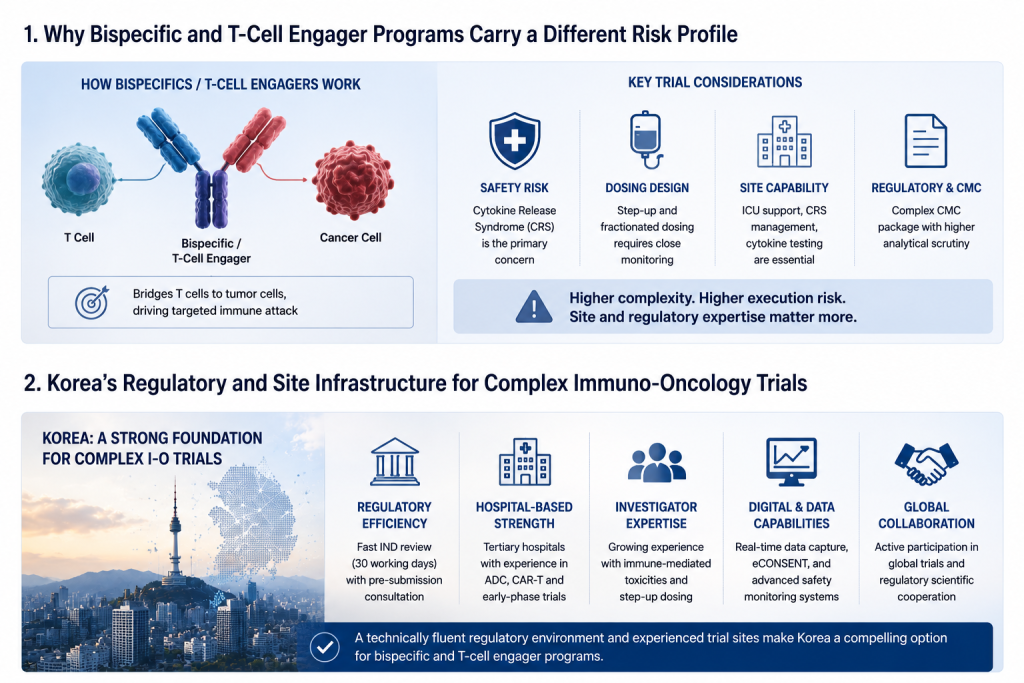
The first and most consequential question is whether a shortlisted site can demonstrate, not merely describe, its CRS management protocol. Sponsors should ask for the site’s standard operating procedure for grading and escalating cytokine release events, confirm which grade triggers ICU-level transfer, and verify realistic turnaround time for cytokine and inflammatory marker panels, since a protocol that assumes same-day results is only as good as the laboratory infrastructure behind it. A site that can produce this documentation readily, rather than assembling it in response to the question, is signaling genuine operational familiarity with the modality class.
The second question concerns institutional review board experience. An IRB that has already reviewed a T-cell engager or bispecific protocol will move through consent language, dose-escalation stopping rules, and CRS management plans with far more efficiency than one encountering the mechanism for the first time, and this difference shows up directly in site activation timelines. Sponsors should ask their CRO partner directly which IRBs in the country have prior experience with this specific mechanism class, rather than assuming general IRB efficiency metrics translate across modality types.
The third area is CMC and import logistics. Bispecific and TCE drug products often carry more demanding cold-chain and handling requirements, and the customs and import clearance process for a molecule this specialized can differ meaningfully from a standard biologic. Sponsors should confirm with their local regulatory and logistics partner how import clearance has historically performed for comparable complex biologics, and build that intelligence into the study timeline rather than assuming it will mirror a simpler drug product’s import history.
Finally, sponsors should evaluate whether their CRO or regulatory partner has direct experience managing the specific pre-submission consultation process for a complex biologic, not just general IND filing experience. The value of a pre-IND consultation option is only as real as a sponsor’s ability to use it effectively, and that requires a partner who knows how to frame CMC and protocol questions in a way that produces useful regulatory feedback rather than a procedural formality.
Taken together, these four areas of diligence separate a sponsor that treats Korea’s regulatory speed as a headline statistic from one that treats it as an operating environment to be verified in detail. For a modality where safety monitoring intensity and manufacturing scrutiny are this central, that distinction determines whether a fast regulatory timeline actually translates into a fast, well-executed trial.
Bispecific antibodies and T-cell engagers are not simply another biologics category to slot into an existing regional trial strategy. Their safety profile changes what a site needs to be capable of before the first patient is dosed, and their manufacturing complexity changes what a regulatory review process needs to be equipped to evaluate. Korea’s combination of a structured, consultation-friendly regulatory pathway and an investigational site base with recent experience in adjacent complex modalities gives sponsors a credible starting point for this class of program. Whether that starting point converts into a well-executed trial still depends on site-specific verification of CRS management capability, IRB experience with the mechanism, and a regulatory partner who can use the pre-submission consultation process to its full effect.
Sponsors who treat this diligence as a checklist item late in site selection tend to discover gaps after activation, when they are most expensive to fix. Sponsors who build it into the earliest feasibility conversations position their program to move at the pace the regulatory environment actually allows.
Ready to Assess Whether Korea Fits Your Bispecific or TCE Program?
If you are weighing Korea against other trial destinations for a bispecific antibody or T-cell engager study, a direct conversation about site-level CRS management capability, IRB experience, and CMC review pathway can clarify the picture faster than a general feasibility report.
Q: How does Korea’s MFDS regulatory review process handle the more complex CMC documentation required for bispecific antibodies?
A: MFDS offers a pre-submission consultation option that allows sponsors to raise CMC and protocol design questions with reviewers before formally filing, which is particularly valuable for a modality where chain-pairing and analytical characterization draw closer scrutiny than standard antibody submissions. Sponsors should use this consultation proactively rather than treating it as optional, since it can surface manufacturing questions before they become review delays.
Q: What site capabilities should a sponsor verify before selecting a Korean investigational site for a T-cell engager trial?
A: The site should be able to produce a concrete cytokine release syndrome management protocol, including grading criteria, ICU escalation triggers, and realistic cytokine panel turnaround times, rather than describing these capabilities in general terms. Sites with recent experience running antibody-drug conjugate or early-phase cell therapy studies typically have more directly transferable monitoring infrastructure.
Q: Does Korea’s fast IND review timeline apply equally to bispecific and multispecific molecules?
A: The standard review-time benchmark is a reference point, not a guarantee, because bispecific and multispecific molecules carry more demanding CMC packages that can affect review depth. Engaging the pre-submission consultation pathway early is the most reliable way to keep a complex biologic filing on a predictable timeline.
Q: How important is IRB experience with T-cell engager mechanisms specifically?
A: It is significant, because an IRB that has already reviewed a T-cell engager protocol moves through consent language, dose-escalation stopping rules, and safety monitoring plans more efficiently than one encountering the mechanism for the first time. Sponsors should ask their CRO which IRBs in the country have prior experience with this specific mechanism class rather than relying on general IRB efficiency metrics.
Q: What operational risks are most likely to be underestimated in a bispecific or TCE program placed in a new country?
A: Cold-chain and import logistics for complex biologics, and the assumption that a site’s general oncology trial experience automatically extends to T-cell engaging mechanisms, are the two risks most commonly underestimated. Both are addressable through direct site-level diligence conducted before site selection is finalized, rather than after activation.