

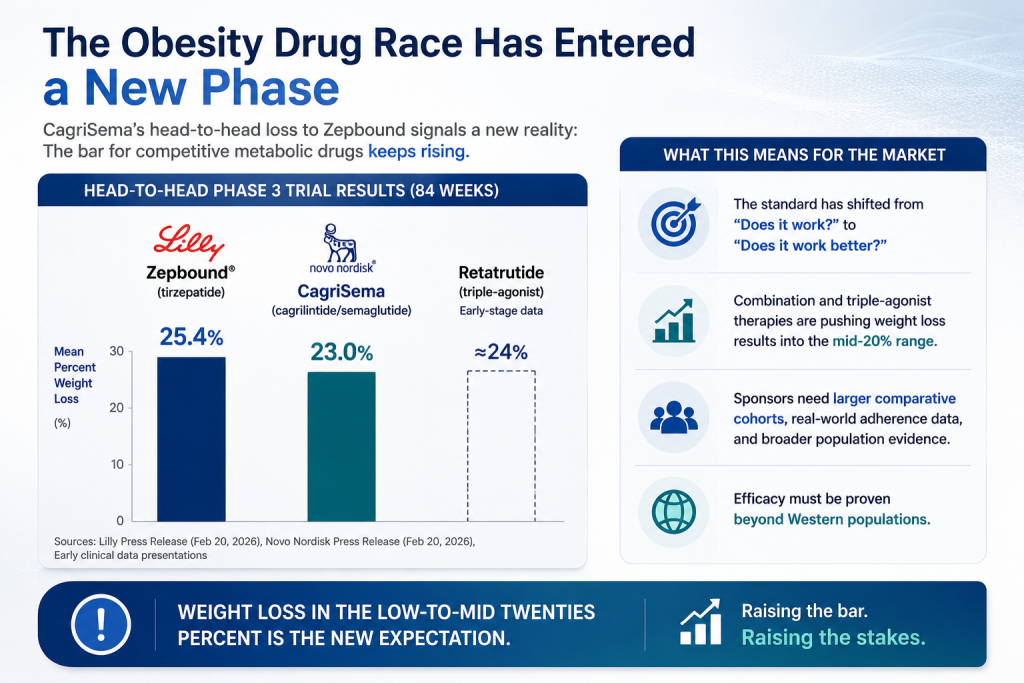
The obesity drug race entered a new phase in February 2026, when Novo Nordisk’s CagriSema failed to prove non-inferiority against Eli Lilly’s Zepbound in a head-to-head Phase 3 trial, sending Novo’s shares down 15% in a single trading session. The result did not eliminate CagriSema from the market — patients on the drug still lost 23.0% of their body weight over 84 weeks, a figure that would have been a category-leading result three years ago.
What it confirmed is that the bar for a competitive obesity or metabolic disease asset has moved from “does it work” to “does it work better than the two or three other combination therapies already generating comparable data,” and that bar keeps rising: Retatrutide’s triple-agonist data has reported weight loss approaching 24% in earlier-stage work, and Novo has already begun dosing a higher-strength CagriSema cohort for a second head-to-head readout expected in 2027.
For sponsors developing GLP-1, amylin, or multi-agonist candidates, this competitive dynamic changes what a trial needs to deliver. A single-arm efficacy readout is no longer enough to differentiate a molecule in a field where three or four programs can each report weight loss in the low-to-mid twenties percent range. Sponsors need larger comparative cohorts, real-world adherence data (the kind captured by treatment-regimen estimands rather than trial-product estimands alone), and increasingly, evidence that the molecule performs consistently outside the mostly Western populations that generated the pivotal data.
That last point is not a theoretical concern — Chinese Phase 2 data on GLP-1 candidates has already shown different weight-loss magnitudes at comparable doses, and regulators and licensing partners alike are asking where else, geographically, a molecule’s efficacy and safety profile has been tested.
Korea sits at an intersection of several of these pressures. Its regulator, the Ministry of Food and Drug Safety (MFDS, Korea’s national authority for drug and medical device approval and clinical trial oversight), has already approved a GLP-1-class molecule for weight management on the strength of bridging data rather than a dedicated Korean pivotal trial, its adult population carries a metabolic disease burden dense enough to support large comparative cohorts, and its IND (Investigational New Drug application, the dossier a sponsor files with a regulator before starting human trials) review timeline is fast enough to matter to a sponsor racing a competitor to the next data readout.
None of that makes Korea a default answer for every metabolic disease program. But for a sponsor deciding where to run the next comparative or confirmatory trial in this race, it is a site worth evaluating on the specifics rather than by reputation alone.
Why Is the Novo-Lilly Rivalry Forcing Sponsors to Rethink Trial Design?
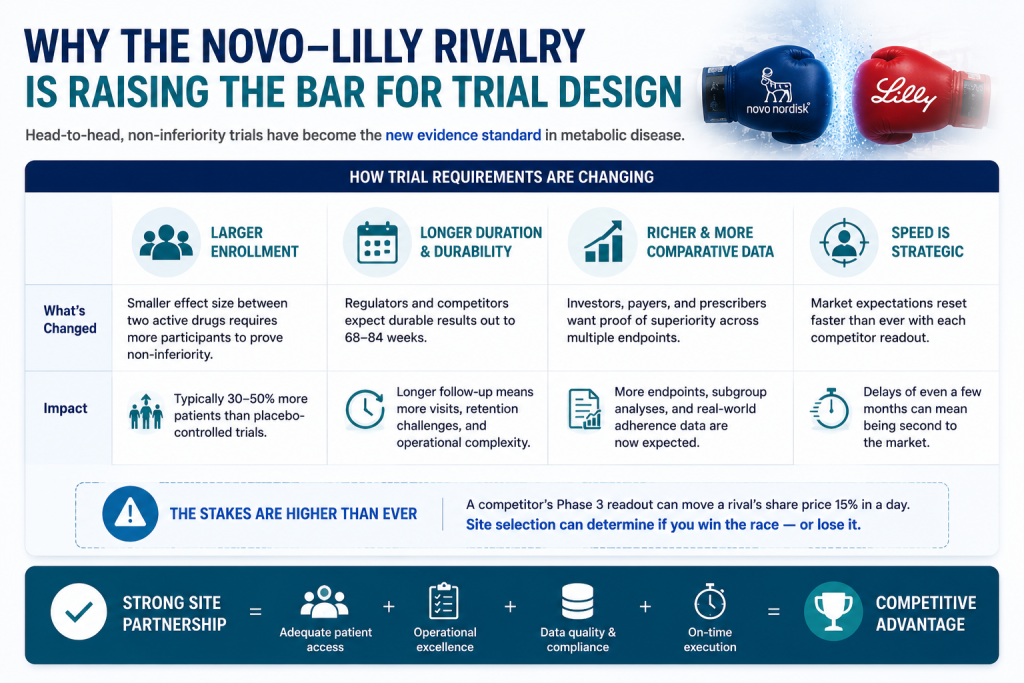
The Novo-Lilly rivalry is forcing sponsors to rethink trial design because head-to-head, non-inferiority comparisons — not placebo-controlled efficacy trials — are becoming the evidence standard the market actually responds to. When CagriSema was tested directly against Zepbound in the REDEFINE 4 trial, 809 adults with obesity and at least one weight-related comorbidity were randomized to one drug or the other, and the market reaction to a non-inferiority miss was immediate and severe, despite CagriSema still delivering substantial absolute weight loss. That reaction signals to every other sponsor in the space that a placebo-controlled trial showing a molecule “works” will increasingly be read by investors, payers, and prescribers as insufficient evidence of competitive standing.
This raises the operational bar for a metabolic disease trial considerably. Head-to-head designs require larger enrollment than placebo-controlled studies of similar statistical power, because the effect size a sponsor is trying to detect — the difference between two active, effective drugs — is inherently smaller than the difference between an active drug and placebo. They also tend to run longer, since regulators and competitors alike now expect durability data out to 68 or 84 weeks rather than the 12- or 24-week readouts that characterized earlier obesity drug trials. A sponsor planning a confirmatory or comparative metabolic disease trial in 2026 is, in practical terms, planning a larger, longer, and more operationally demanding study than the one that got the first generation of GLP-1 drugs to market.
That operational demand is precisely where site selection stops being a secondary decision and becomes a determinant of whether the trial finishes on a competitive timeline at all. A sponsor that under-resources enrollment capacity for an 800-plus-patient comparative trial is not just risking a delay — in a market where a competitor’s Phase 3 readout can move a rival’s share price 15% in a day, a delay of even a few months can mean reporting data after a competitor has already reset market expectations.
Does Korea Already Have a Regulatory Pathway for Obesity and Metabolic Disease Drugs?
Korea already has a regulatory pathway for obesity and metabolic disease drugs, evidenced by the MFDS’s approval of an expanded weight-management indication for a GLP-1-class molecule based on the same pivotal trial package — rather than a separately generated Korean dataset — that supported its approval elsewhere. That precedent matters to a sponsor evaluating Korea for the first time: it establishes that MFDS is willing to accept global pivotal data as the primary evidentiary basis for an obesity indication, provided the standard IND requirements are met.
Those requirements follow the structure MFDS applies to any investigational drug: a protocol, an investigator’s brochure, manufacturing data, and — this is the detail sponsors moving into a new therapeutic category sometimes underweight — data demonstrating the proposed dose and patient population are appropriate for Korean trial participants specifically. This is the bridging study logic that MFDS review is built around: a bridging study is a supplementary trial or dataset used to confirm that a drug’s dose-response and safety profile, established in one population, extrapolate reasonably to another.
For most established drug classes, existing regional pharmacokinetic literature can support this requirement without a dedicated new study. For next-generation obesity and metabolic disease candidates specifically, sponsors should not assume this is automatic — Asian-population dose-response data for GLP-1, amylin, and multi-agonist mechanisms has in some cases shown different efficacy magnitudes at doses considered standard in Western pivotal trials, which means the bridging conversation with MFDS is a substantive regulatory strategy question, not a formality to be resolved late in submission preparation.
Procedurally, MFDS’s IND review runs on an official timeline of approximately 30 working days, in line with Korean Good Clinical Practice standards that align with ICH-GCP (the International Council for Harmonisation’s Good Clinical Practice guideline, the global ethical and scientific quality standard for designing and conducting clinical trials). For a sponsor racing to complete a comparative trial before a competitor’s next data readout, a predictable, weeks-not-months regulatory review is a meaningful input into the overall trial timeline — but only if the sponsor has already resolved the bridging-data question well before submission, rather than treating it as a document MFDS will simply ask for during review.
Can Korea Support the Patient Volumes These Larger Comparative Trials Require?
Korea can support meaningful patient volumes for metabolic disease trials because its adult obesity and metabolic syndrome prevalence is high enough to generate a large eligible population within a national healthcare system that already tracks these conditions systematically. Obesity prevalence among Korean adults reached 38.4% in the most recent national data, split unevenly between men (49.6%) and women (27.7%), while metabolic syndrome — a cluster of conditions including abdominal obesity, elevated blood pressure, and abnormal glucose or lipid levels that frequently co-occurs with the weight-related comorbidities obesity drug trials are designed to enroll — affects 28.6% of adults, with a notably sharp increase among younger men in recent years.
This matters for trial design specifically because many of the current generation of comparative obesity trials, including REDEFINE 4, enroll patients who have obesity plus at least one weight-related comorbidity such as type 2 diabetes, rather than obesity alone. Korea’s diabetes prevalence among adults with obesity runs at roughly 17.6%, against 9.5% among adults without obesity — a comorbidity overlap that gives a well-designed Korean site meaningful reach into exactly the enrollment criteria these larger, more demanding trials specify, rather than requiring investigators to screen an unusually high number of patients to find eligible participants.
None of this substitutes for site-level feasibility work. Prevalence data describes the population; it does not describe how quickly a specific hospital network can screen, consent, and randomize patients against a specific protocol’s eligibility criteria, particularly when a comparative trial’s inclusion criteria are narrower than a placebo-controlled study’s. What the prevalence and comorbidity data does establish is that Korea is not a site where a sponsor would be fighting scarcity to find eligible metabolic disease patients — the more decision-relevant question is how efficiently a given CRO and site network can convert that population into enrolled, randomized subjects on the sponsor’s timeline.
Sponsors evaluating Korea for a metabolic disease program are, in practice, running two parallel assessments — a regulatory one, centered on whether the bridging-data question can be resolved before submission, and an operational one, centered on whether the CRO managing the trial can convert Korea’s patient population into enrollment at the pace a comparative, longer-duration study demands. NexBridge Bio works with global sponsors running clinical trials in Korea across therapeutic areas, including the regulatory and site-operational planning that a metabolic disease program’s bridging and enrollment requirements call for. Getting the regulatory strategy question resolved early, rather than mid-review, is what keeps a comparative trial’s timeline intact in a market where a few months of delay can mean reporting data into a market a competitor has already reshaped.
Considering Korea for Your Next Metabolic Disease Trial?
Before finalizing a site strategy for a comparative or confirmatory obesity or metabolic disease trial, it is worth confirming specifically how MFDS’s bridging-data expectations and Korea’s patient pool apply to your molecule’s mechanism and trial design.
Book a Free Korea Trial Consultation →
Want the full picture behind these findings? Download our 2026 Clinical Trials CRO Selection Survey Report for the complete data, red flags, and strategic recommendations.
Download the Report →
FAQ
Q1: Has Korea’s MFDS approved any obesity or weight-management drugs?
Yes — MFDS has approved an expanded weight-management indication for at least one GLP-1-class molecule, based on the same global pivotal trial data package that supported its approval in other markets, rather than requiring a separately generated Korean trial. This establishes precedent for MFDS accepting global data as the primary evidentiary basis for an obesity indication, provided standard IND and bridging requirements are met.
Q2: Does Korea require a separate bridging study for obesity and metabolic disease drugs?
Not automatically, but sponsors should not assume existing regional data is sufficient without checking. MFDS requires evidence that a drug’s dose and population are appropriate for Korean trial participants, and Asian-population dose-response data for GLP-1, amylin, and multi-agonist mechanisms has in some cases shown different efficacy magnitudes than Western pivotal data at comparable doses, making this a substantive regulatory strategy question rather than a documentation formality.
Q3: How long does MFDS take to review an IND application for a metabolic disease trial?
MFDS’s official IND review timeline runs approximately 30 working days, operating under Korean Good Clinical Practice standards aligned with ICH-GCP. This timeline only holds as an advantage if the sponsor has resolved bridging-data and dossier questions before submission, since unresolved regulatory questions typically surface as delays during the review window itself.
Q4: Can Korea support the patient enrollment volumes that head-to-head obesity drug trials require?
Korea’s adult obesity prevalence of 38.4% and metabolic syndrome prevalence of 28.6% indicate a large eligible population, and diabetes prevalence among adults with obesity (roughly 17.6%, against 9.5% in adults without obesity) supports enrollment into trials that require obesity plus a weight-related comorbidity. Converting that population into enrolled, randomized subjects on a specific timeline still depends on site-level feasibility and CRO execution, not prevalence data alone.
Q5: Why are head-to-head trial designs becoming more common in obesity drug development?
Head-to-head, non-inferiority trial designs are becoming standard because placebo-controlled efficacy data alone is no longer viewed by investors, payers, and prescribers as sufficient evidence of competitive standing when multiple effective drugs are already on the market or in late-stage development. These designs generally require larger patient cohorts and longer follow-up than placebo-controlled trials of similar statistical power, since the effect size being measured — the difference between two active treatments — is inherently smaller than the difference between an active drug and placebo.