
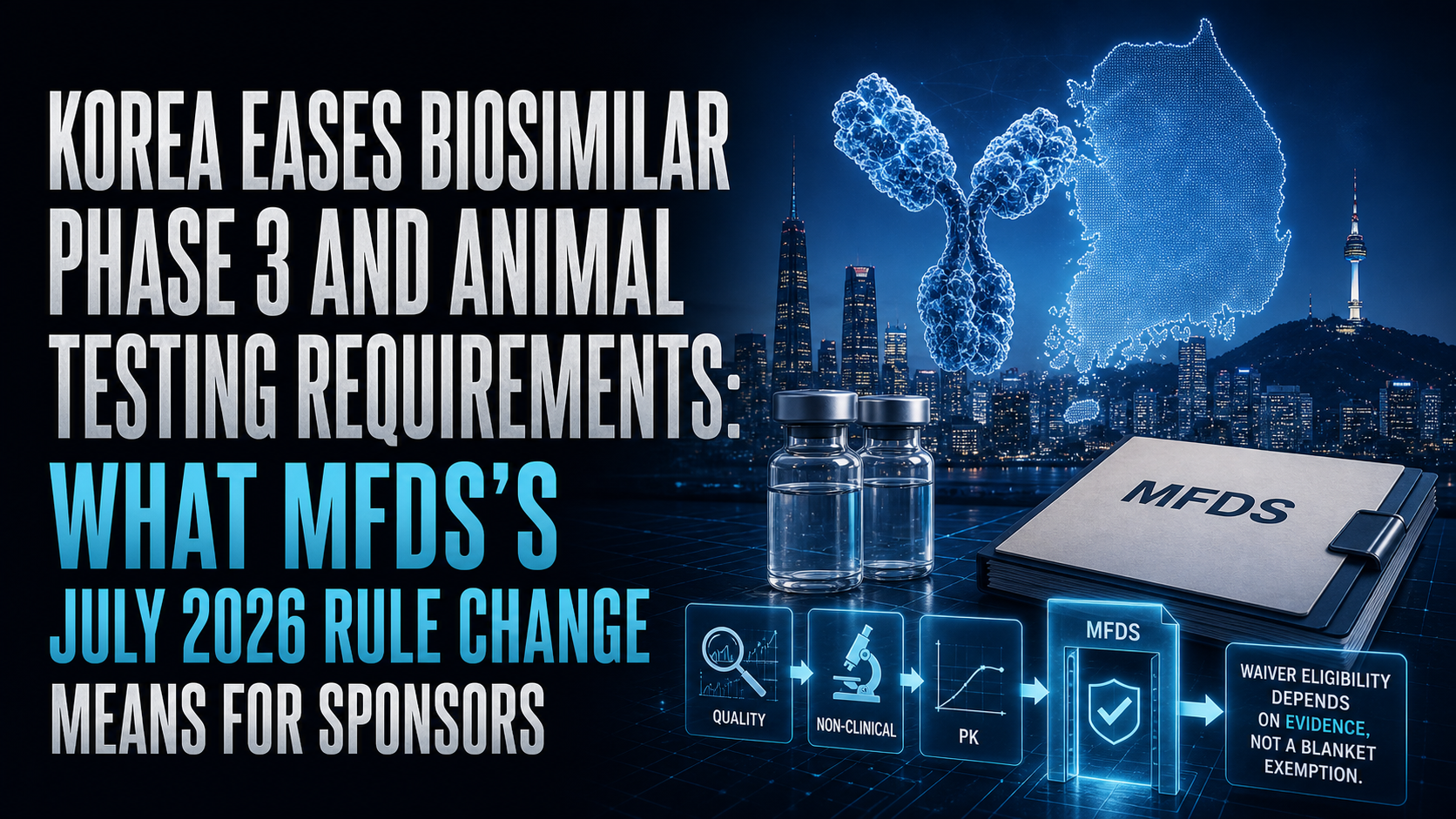
On July 14, 2026, Korea’s Ministry of Food and Drug Safety (MFDS) — the national regulator responsible for approving pharmaceuticals, biologics, and medical devices in Korea — amended its Regulation on Approval and Review of Biological Products to let biosimilar developers waive Phase 3 confirmatory clinical trial data and repeat-dose animal toxicology data when comparability with the reference product is already established through quality, non-clinical, and pharmacokinetic (PK) evidence. The amendment brings Korea’s biosimilar review framework closer to the totality-of-evidence approaches the U.S. FDA and the European Medicines Agency (EMA) have each been moving toward over the past year, and it is intended to shorten development timelines and reduce the data burden associated with bringing a biosimilar through Korean regulatory review. For sponsors already running, or planning, a biosimilar program with Korea in scope, the amendment changes both the data package that needs to be assembled and the order in which regulatory and clinical work gets sequenced.
This is not a blanket exemption. The waiver is conditional on the strength of a sponsor’s analytical and non-clinical comparability package, and MFDS retains discretion to require confirmatory clinical data where residual uncertainty about clinical performance remains. That distinction — between “Phase 3 is no longer mandatory” and “Phase 3 is no longer required for you, specifically, if your comparability data is strong enough” — is the difference sponsors need to understand before they revise a Korea development budget or timeline around this change.
The amendment was pursued as a follow-up measure to a broader domestic biosimilar-industry competitiveness push, developed through an industry-government working group that MFDS operated in the lead-up to the revision. The stated intent is to support faster biosimilar development domestically while harmonizing Korea’s requirements with the direction global regulators are already heading. What it means in practice depends on the specifics of a given molecule’s comparability data — which is where sponsors evaluating Korea now need to focus their regulatory strategy conversations.
Book a Free Korea Trial Consultation →
Want the full picture behind these findings? Download our 2026 Clinical Trials CRO Selection Survey Report for the complete data, red flags, and strategic recommendations on navigating Korea’s evolving regulatory environment.
Download the Report →
What the July 2026 Amendment to Korea’s Biologics Regulation Actually Changes
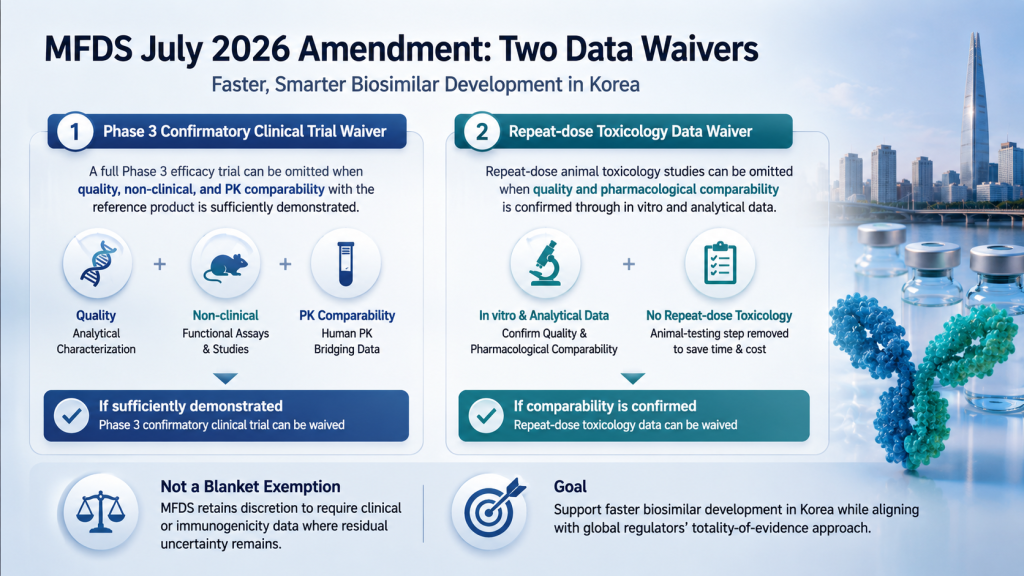
MFDS’s amendment to the Regulation on Approval and Review of Biological Products gives biosimilar sponsors two specific, separately-conditioned data waivers. The first: a full Phase 3 confirmatory clinical efficacy trial can be omitted when quality, non-clinical, and pharmacokinetic comparability with the reference biologic is sufficiently demonstrated — meaning the analytical characterization, functional assays, and human PK bridging data leave no clinically meaningful open question about how the biosimilar will perform relative to the originator. The second: repeat-dose toxicology data generated in animal studies can be omitted when quality and pharmacological comparability between the biosimilar and reference product is already confirmed through in vitro and analytical work, removing an animal-testing step that previously added time and cost to a development program without, in many cases, generating information regulators found decision-relevant.
Both waivers apply at the level of the individual application rather than as a category-wide exemption. A sponsor submitting a biosimilar dossier to MFDS still assembles a full comparability package — physicochemical characterization, biological activity and functional assays, and PK data comparing the biosimilar to the reference product — and it is the strength and completeness of that package that determines whether MFDS accepts it in place of a dedicated Phase 3 trial or a repeat-dose toxicology study. In effect, the regulation moves clinical-development risk earlier in the program: instead of a late-stage Phase 3 trial serving as the primary evidence of biosimilarity, the analytical and PK-comparability work done early in development becomes the determining factor for whether later-stage clinical and non-clinical studies are even necessary.
This mirrors, directionally, what has been happening at the FDA and EMA. The EMA’s 2026 reflection paper on a tailored clinical approach to biosimilar development set out criteria under which comparative efficacy and immunogenicity studies can be waived when a biosimilar’s structural and functional properties are well characterized, and the FDA has separately signaled increased flexibility around comparative efficacy studies through updated draft guidance and has exercised waiver authority on specific biosimilar applications. MFDS’s amendment is Korea’s version of that same underlying shift: regulators in all three jurisdictions are converging on a “totality of evidence” standard, where the requirement for late-stage clinical trials is scaled to how much residual scientific uncertainty remains after analytical and non-clinical comparability work, rather than being a fixed requirement applied uniformly to every biosimilar application.
Does This Mean Every Biosimilar Sponsor Can Skip Phase 3 Trials in Korea?
No — the waiver is conditional, not automatic, and whether a given program qualifies depends entirely on how conclusive its comparability data is. MFDS’s threshold is that quality, non-clinical, and PK comparability data must be strong enough, on their own, to eliminate meaningful residual uncertainty about clinical performance; where analytical characterization cannot fully rule out clinically relevant differences, MFDS retains the authority to require confirmatory efficacy data, an immunogenicity assessment, or both.
In practice, this makes the waiver more accessible for some product classes than others. Biosimilars for well-characterized monoclonal antibodies with mature, validated analytical methods and an established history of successful biosimilar development globally are the most likely candidates for a streamlined pathway, because the analytical toolkit for demonstrating comparability on these molecules is well understood by both sponsors and regulators. Biosimilars for products with more complex structural features — variable glycosylation patterns, multi-domain fusion proteins, or a meaningful history of immunogenicity concerns in the originator — face a higher bar, because residual uncertainty is harder to close with analytical and non-clinical data alone, and MFDS is more likely to view a confirmatory clinical or immunogenicity study as necessary regardless of the new provision.
Sponsors also need to be clear that this amendment addresses the domestic Korean approval pathway specifically. It does not change global development requirements a sponsor faces from the FDA or EMA if the same product is also pursuing approval in those markets, and where a sponsor is running a single global comparability program intended to support multiple regulators, the more conservative of the applicable standards will generally end up governing what data gets generated. What the amendment does change is the calculus for programs where Korea approval matters independently — for example, a sponsor whose primary market is Korea, or a sponsor evaluating Korea as an early or standalone approval target within a broader regional strategy.
How Sponsors Should Adjust Their Korea Regulatory Strategy in Response
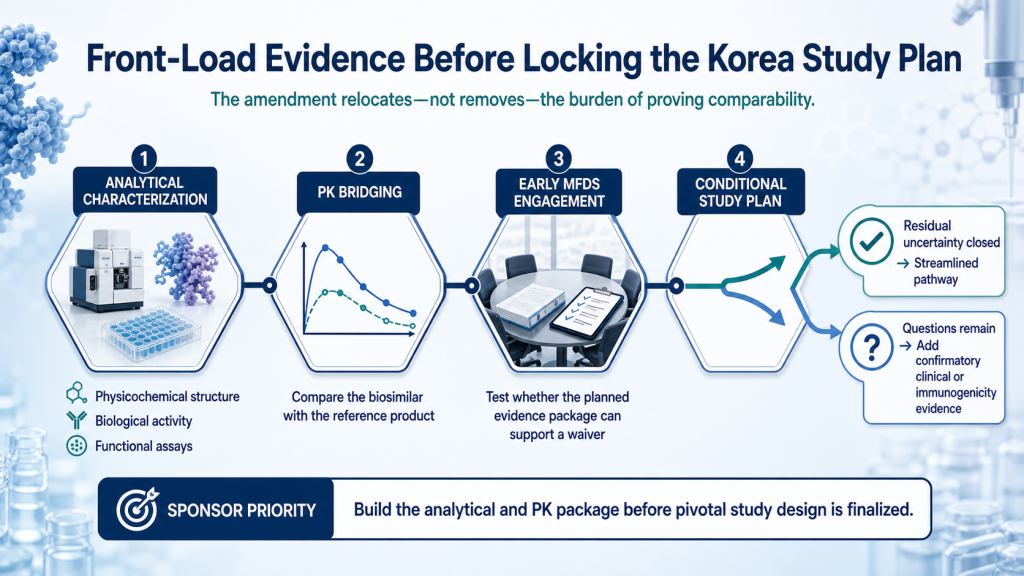
The practical adjustment is to front-load analytical and PK-comparability work and treat it as the primary determinant of Korea regulatory strategy, rather than treating Phase 3 planning as the default starting point. Because MFDS’s decision on whether a Phase 3 trial or repeat-dose toxicology study can be waived now depends on the strength of upstream comparability data, sponsors get the most value from this amendment by investing early in a rigorous analytical characterization and PK-bridging package — including engagement with MFDS before pivotal study design is finalized, to understand what level of comparability evidence the agency will consider sufficient for the specific molecule in question.
This shifts where budget and timeline risk sit in a Korea development plan. Previously, a large share of a biosimilar program’s cost and duration in Korea sat in the Phase 3 trial and its associated site, patient recruitment, and monitoring requirements. Under the amended framework, that risk moves toward the analytical and non-clinical comparability workstream: sponsors need confidence, earlier in the program, that their characterization data will hold up to MFDS review, because a comparability package assembled without that standard in mind is the most likely reason a sponsor ends up needing the confirmatory clinical trial the amendment was designed to let them avoid. This also has implications for vendor and partner selection — analytical laboratories and regulatory-strategy support with direct MFDS biosimilar review experience become more valuable relative to firms whose expertise is weighted toward late-phase clinical trial execution.
It also changes how sponsors should sequence global and Korea-specific regulatory conversations. Where a sponsor’s global comparability program is being designed to satisfy FDA and EMA’s own totality-of-evidence expectations, there is a meaningful opportunity to have an early conversation with MFDS about whether that same data package — or a defined superset of it — will support a waiver in Korea, rather than treating the Korean submission as a separate, sequential exercise once global data is finalized. NexBridge Bio, a CRO focused on clinical trial execution in Korea, works with pharmaceutical and biotech sponsors to align comparability data strategy with MFDS’s review expectations as part of Korea trial planning. Sponsors evaluating whether their specific molecule and data package are likely to qualify for the new waiver provisions are best served by raising that question directly with MFDS, or with regulatory-strategy support experienced in Korean biosimilar review, before locking in a global comparability study design.
Sponsors should also expect this framework to keep evolving. MFDS developed this amendment through ongoing consultation with industry, and the stated intent behind it — supporting faster biosimilar development while aligning with global regulatory direction — suggests further refinement is plausible as MFDS gains experience applying the new waiver criteria to actual applications. Sponsors submitting biosimilar dossiers in the near term should treat MFDS’s early waiver decisions as informative precedent for how the agency is interpreting “sufficiently demonstrated” comparability in practice, rather than assuming the criteria are fully settled.
MFDS’s July 2026 amendment removes a structural cost and timeline barrier for biosimilar sponsors, but it does not remove the underlying scientific burden of proving comparability — it relocates that burden earlier in the development timeline and raises the stakes of getting the analytical and PK-comparability package right the first time. Sponsors who treat this as license to skip rigorous comparability planning are the ones most likely to end up needing the confirmatory Phase 3 trial the amendment was meant to let them avoid; sponsors who use the new flexibility as a reason to invest more deliberately in early analytical and regulatory-strategy work are the ones positioned to actually capture the timeline and cost benefits MFDS designed the change to provide.
For sponsors with a biosimilar program that includes Korea — whether as a standalone target, an early approval market, or one piece of a broader global filing strategy — the immediate question is not whether the waiver exists, but whether a specific molecule’s comparability data is strong enough to use it, and what that implies for how the rest of the Korea development plan should be built.
Wondering Whether Your Biosimilar Program Qualifies for Korea’s New Waiver Provisions?
Determining whether a comparability package meets MFDS’s threshold for a Phase 3 or animal-testing waiver is a regulatory-strategy question best resolved before pivotal study design is finalized, not after.
Book a Free Korea Trial Consultation →
Want the full picture behind these findings? Download our 2026 Clinical Trials CRO Selection Survey Report for the complete data, red flags, and strategic recommendations on navigating Korea’s evolving regulatory environment.
Download the Report →
Q1: What did MFDS change about biosimilar clinical trial requirements in July 2026?
On July 14, 2026, MFDS amended its Regulation on Approval and Review of Biological Products to allow biosimilar sponsors to waive Phase 3 confirmatory clinical trial data and repeat-dose animal toxicology data when quality, non-clinical, and pharmacokinetic comparability with the reference product is already sufficiently demonstrated. The change applies on a per-application basis rather than as a blanket exemption for all biosimilars.
Q2: Can a biosimilar get MFDS approval in Korea without a Phase 3 trial?
Yes, but only when a sponsor’s analytical, non-clinical, and pharmacokinetic comparability data is strong enough that MFDS considers residual uncertainty about clinical performance effectively closed. Where analytical characterization cannot rule out clinically meaningful differences from the reference product, MFDS can still require a confirmatory clinical efficacy trial, an immunogenicity study, or both.
Q3: What data does a sponsor need to qualify for MFDS’s biosimilar data waiver?
A sponsor needs a comparability package covering physicochemical and structural characterization, functional and biological activity assays, and pharmacokinetic bridging data that together demonstrate equivalence to the reference biologic without meaningful open questions. The completeness and rigor of this early-stage data — not a separate application or request — is what determines whether MFDS accepts it in place of Phase 3 clinical or repeat-dose toxicology data.
Q4: How does Korea’s biosimilar waiver compare to FDA and EMA approaches?
Korea’s amendment follows the same directional shift already underway at the FDA and EMA, both of which have moved toward a totality-of-evidence standard that scales clinical data requirements to the level of residual uncertainty remaining after analytical and non-clinical review. The EMA’s 2026 reflection paper on tailored clinical approaches and the FDA’s updated draft guidance and recent waiver decisions reflect the same underlying logic MFDS’s amendment now applies in Korea, though each agency’s specific evidentiary thresholds are evaluated independently.
Q5: What should sponsors do now to prepare for Korea’s new biosimilar review requirements?
Sponsors should prioritize building a rigorous analytical and pharmacokinetic comparability package early in development and engage MFDS directly to understand what level of evidence the agency will consider sufficient for their specific molecule before finalizing pivotal study design. Sponsors running a global comparability program for FDA or EMA submission should also assess early whether that same data — or a defined superset — can support a parallel waiver request in Korea, rather than treating the Korean filing as a separate, later-sequenced exercise.