

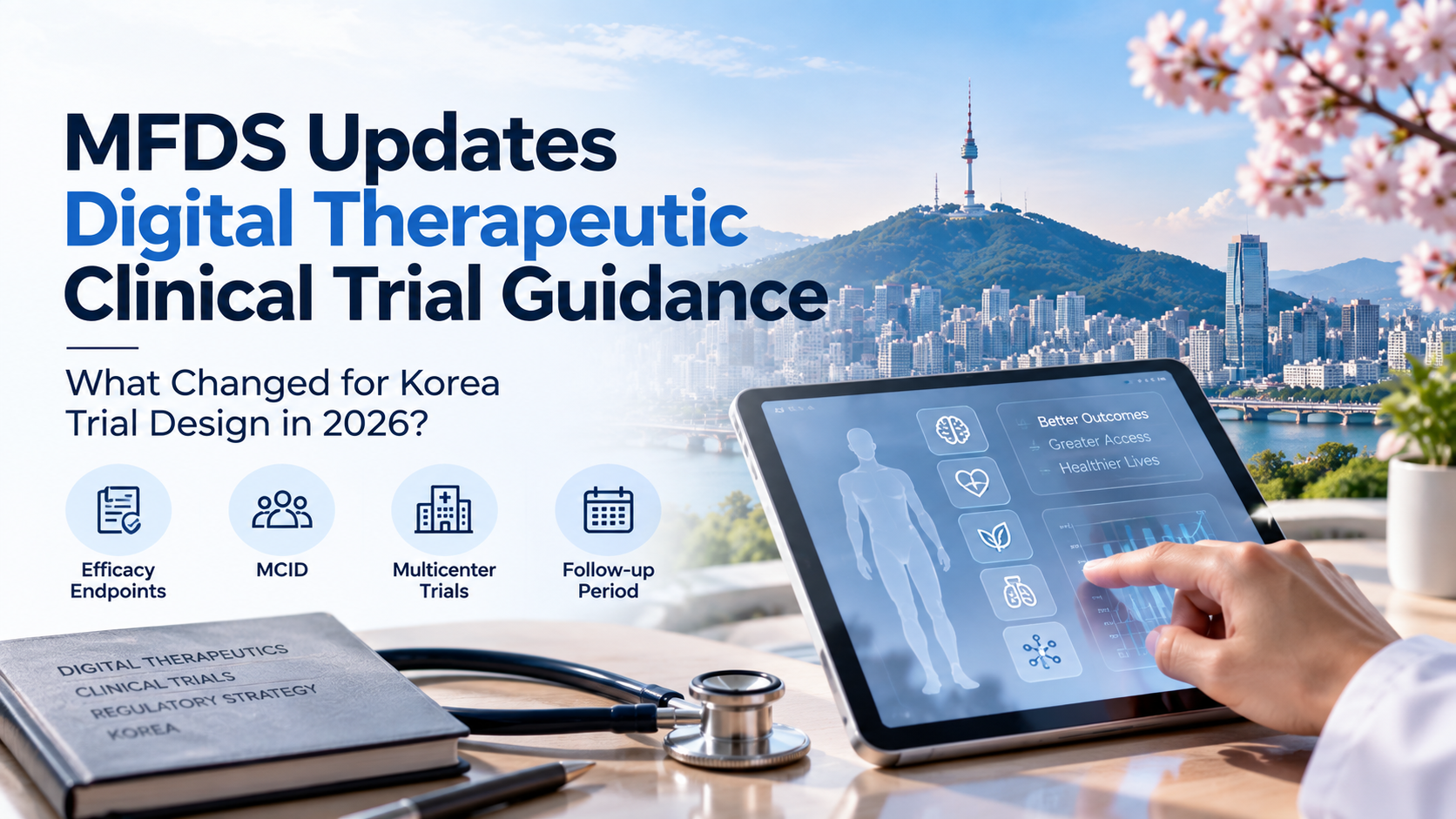
Korea has just made its expectations for digital therapeutic clinical trials more explicit.
On September 10, 2026, the Ministry of Food and Drug Safety (MFDS) updated its clinical trial protocol guidance for digital therapeutic devices across seven indications. The revisions incorporate review experience accumulated after implementation of Korea’s Digital Medical Products Act and reflect recent international regulatory and clinical-development trends.
The practical implication is not simply that digital therapeutic trials in Korea can now move faster. The more important change is that MFDS has clarified what it expects sponsors and developers to justify earlier in trial design, particularly around efficacy endpoints, minimally clinically important difference, multicenter evidence, and follow-up duration. For development teams, this can reduce regulatory uncertainty, but only when those expectations are incorporated before the protocol is finalized.
The revised guidance applies to digital therapeutics targeting nicotine use disorder, alcohol use disorder, panic disorder, depressive disorder, eating disorders, attention-deficit/hyperactivity disorder (ADHD), and mild cognitive impairment. MFDS stated that the revisions are intended to reduce development trial-and-error and shorten clinical trial preparation by giving developers clearer, more practical review criteria.
Book a Free Korea Trial Consultation →
Want the full picture behind these findings? Download our 2026 Clinical Trials CRO Selection Survey Report for the complete data, red flags, and strategic recommendations.
What Did MFDS Change in Its 2026 Digital Therapeutic Clinical Trial Guidance?
The 2026 MFDS update moves Korea’s digital therapeutic guidance toward more explicit expectations for demonstrating clinically meaningful efficacy and generating reliable evidence.
Digital therapeutics are software-based medical interventions designed to prevent, manage, or treat a disease or disorder. In Korea, these products fall within the country’s digital medical product regulatory framework, meaning their clinical evidence must support not only statistical performance but also the intended therapeutic use of the product.
The September update is important because it was not developed in isolation. MFDS said the revised guidance incorporates clinical trial protocol review experience accumulated following implementation of the Digital Medical Products Act as well as recent international trends. In other words, the document reflects issues regulators have actually encountered while reviewing digital therapeutic development programs, rather than functioning only as a theoretical design manual.
One of the clearest changes is greater emphasis on scientifically justified efficacy endpoints.
Selecting an endpoint in a digital therapeutic trial can be more complicated than selecting a measurable software-performance metric. A digital intervention may generate extensive engagement, behavioral, or symptom data, but regulatory evidence still needs to demonstrate that the observed change represents a meaningful therapeutic effect for the intended patient population.
MFDS therefore incorporated updated review criteria concerning efficacy endpoints and the use of a minimally clinically important difference, or MCID.
MCID refers to the smallest change in an outcome that represents a meaningful improvement from the patient’s perspective rather than merely a statistically detectable difference. This distinction matters because a trial can produce a statistically significant result without necessarily demonstrating a change that is meaningful in clinical practice.
For developers, the regulatory question therefore moves upstream. It is no longer sufficient to ask whether the selected endpoint can produce a measurable difference between study groups. The protocol needs a scientifically defensible rationale for why the endpoint captures the intended therapeutic effect and, where relevant, how the threshold for clinically meaningful improvement was determined.
This has implications for statistical planning as well. Endpoint definition, expected treatment effect, clinically meaningful thresholds, and sample-size assumptions are interconnected. If the clinical meaning of the primary endpoint is not sufficiently justified during protocol development, addressing the issue later can affect more than the statistical analysis plan; it may require reconsideration of the underlying trial design.
The update applies across seven indications, but that does not mean one endpoint strategy can simply be transferred between them. Depression, ADHD, mild cognitive impairment, eating disorders, panic disorder, and substance-use disorders involve different clinical constructs, patient populations, assessment instruments, and treatment objectives.
The regulatory principle is becoming clearer while the indication-specific evidence strategy remains critical.
How Do Multicenter Trials and Follow-Up Change Korea Digital Therapeutic Trial Design?
MFDS has also strengthened the guidance by adding examples related to multicenter clinical trials and follow-up periods, signaling greater attention to whether digital therapeutic effects are reproducible and durable beyond a narrowly controlled study environment.
This is particularly relevant for software-based therapeutic interventions.
A conventional assumption might be that digital therapeutics are inherently less site-dependent because patients interact with software rather than receiving a procedure that depends heavily on an individual investigator. In practice, however, site-level factors can still influence recruitment, onboarding, patient education, adherence, clinical assessments, concomitant treatment, and the handling of protocol deviations.
A single-center result may therefore raise questions about whether the observed effect can be reproduced across different clinical environments.
By adding multicenter examples to the revised guidance, MFDS is giving developers a clearer signal that evidence reliability is not determined solely by the number of patients enrolled. The context in which those patients are recruited, assessed, and followed can also matter.
For global developers considering Korea, this makes site strategy part of regulatory strategy rather than simply an operational decision.
The appropriate number and type of sites will still depend on the product, indication, development stage, and protocol. The updated guidance should not be interpreted as a universal requirement that every digital therapeutic study must follow the same multicenter structure. Rather, it provides a stronger framework for considering when broader site participation can improve the credibility of the evidence.
Follow-up duration introduces a similar issue.
Digital interventions may show an effect while patients are actively engaging with the product, but regulators may also need to understand what happens after the core treatment period. Depending on the intended therapeutic claim, the durability of improvement can become an important component of the benefit assessment.
MFDS has therefore added examples concerning follow-up periods as part of its effort to strengthen clinical trial reliability.
This does not create a single standard follow-up duration across all seven indications. The appropriate period needs to be linked to the disease, therapeutic mechanism, expected treatment effect, and clinical objective.
For development teams, however, the planning consequence is straightforward: follow-up should not be treated as a secondary operational detail that can be finalized after the primary treatment phase has already been designed.
It can affect patient retention strategy, site workload, assessment scheduling, data collection, protocol duration, and the overall timeline required to generate a complete clinical evidence package.
The combination of clearer endpoint expectations, MCID considerations, multicenter examples, and follow-up guidance points toward a broader regulatory direction. MFDS is asking digital therapeutic developers to demonstrate not simply that their software produces a measurable effect, but that the effect is clinically interpretable, sufficiently reliable, and supported by an evidence structure appropriate to the intended therapeutic claim.
What Should Global Developers Change Before Starting a Digital Therapeutic Trial in Korea?
Global developers planning a Korean digital therapeutic trial should now treat endpoint justification, clinical meaningfulness, site strategy, and follow-up design as early regulatory planning decisions rather than downstream protocol details.
The first step is to determine whether the product and intended indication fall within the scope addressed by the revised MFDS guidance and how the indication-specific recommendations interact with the broader Digital Medical Products Act framework.
For products targeting one of the seven covered indications, the updated guidance provides a more concrete reference point for protocol development. However, a guidance document should not be treated as a substitute for product-specific regulatory analysis. Differences in software functionality, intended use, target population, intervention period, comparator, and clinical claim can materially change the appropriate evidence strategy.
Endpoint selection deserves particular attention.
A development team entering Korea with a protocol originally designed for another market should verify whether the efficacy endpoint and its interpretation can be justified under current MFDS expectations. That does not necessarily mean Korea requires an entirely separate endpoint strategy. It means that the rationale supporting the chosen endpoint needs to remain persuasive within the Korean regulatory context.
The same applies to MCID.
If the development program relies on a threshold for clinically meaningful change, the basis for that threshold should be established before submission rather than reconstructed in response to a regulatory question. The evidence supporting an MCID may therefore become an important part of protocol preparation and regulatory documentation.
Multicenter planning should also be considered earlier.
Site selection for a digital therapeutic trial is sometimes approached primarily through recruitment potential. Under the revised framework, developers should also consider whether the selected site structure supports evidence generalizability and consistency.
This can influence feasibility assessment. A site may have access to the relevant patient population but still require evaluation of its ability to support digital onboarding, protocol-specific assessments, patient engagement, follow-up, and consistent data collection.
For international companies, localization introduces another layer. Patient-facing software, instructions, assessments, and trial workflows need to function appropriately in the Korean clinical environment. The regulatory evidence strategy and the operational implementation of the trial therefore need to be aligned rather than developed independently.
NexBridge Bio supports global pharmaceutical and biotech companies in translating Korea-specific regulatory requirements into operational clinical trial planning and execution.
The revised guidance may ultimately make trial preparation more predictable. MFDS itself has stated that the purpose of the update is to improve developers’ understanding of current review standards, increase the completeness of trial design, reduce trial-and-error, and shorten preparation time.
But clearer guidance does not automatically mean a shorter study.
A protocol that incorporates the new expectations from the beginning may encounter fewer avoidable design questions during review. A protocol that treats the update as an administrative change rather than a clinical evidence change may gain little from the additional clarity.
This distinction is important for global development planning.
Regulatory efficiency often comes not from a regulator removing evidence requirements, but from making those requirements sufficiently clear that developers can address them before submission. The September 2026 update fits that pattern. MFDS is not lowering the evidentiary standard for digital therapeutics; it is making parts of that standard more explicit.
For companies deciding whether to include Korea in a global or Asia-Pacific digital therapeutic development program, that can be strategically useful. Earlier visibility into endpoint expectations, meaningful clinical change, site structure, and follow-up requirements makes it easier to assess whether a global protocol can support Korea or whether adjustments should be made before country activation.
The most important planning question is therefore not whether Korea has become “easier” for digital therapeutics.
It is whether the development program has been designed around the evidence questions MFDS is now making clearer.
Conclusion
MFDS’s September 2026 update represents a meaningful refinement of Korea’s digital therapeutic clinical trial framework. The revised guidance covers seven indications and incorporates current review experience, international trends, scientifically justified efficacy endpoints, MCID considerations, multicenter trial examples, and follow-up considerations.
For developers, the benefit is greater regulatory visibility rather than reduced evidentiary responsibility. The guidance can help shorten preparation and reduce avoidable trial-and-error when its expectations are incorporated during protocol design.
That makes early planning increasingly important. Endpoint selection, clinically meaningful change, site strategy, follow-up, and Korea-specific operational feasibility should be considered together before the clinical trial protocol reaches its final form.
Planning a Digital Therapeutic Clinical Trial in Korea?
Before finalizing a Korea digital therapeutic protocol, confirm that the endpoint strategy, MCID rationale, multicenter approach, and follow-up plan reflect the latest MFDS guidance and the intended therapeutic claim.
Book a Free Korea Trial Consultation →
Want the full picture behind these findings? Download our 2026 Clinical Trials CRO Selection Survey Report for the complete data, red flags, and strategic recommendations.
FAQ
Q1: What changed in the MFDS digital therapeutic clinical trial guidance in September 2026?
MFDS updated its guidance to reflect review experience after implementation of the Digital Medical Products Act and recent international trends. Key changes include updated criteria for scientifically justified efficacy endpoints and MCID, examples related to multicenter trials and follow-up periods, and terminology and sections aligned with current digital medical product regulations.
Q2: Which digital therapeutic indications are covered by the updated MFDS guidance?
The revised guidance covers seven indications: nicotine use disorder, alcohol use disorder, panic disorder, depressive disorder, eating disorders, attention-deficit/hyperactivity disorder (ADHD), and mild cognitive impairment. MFDS issued updated indication-specific guidance documents on September 10, 2026.
Q3: Does MFDS now require MCID in digital therapeutic clinical trials?
MFDS has incorporated MCID into its updated review guidance as part of the scientific evaluation of efficacy, but the appropriate use and justification depend on the endpoint and clinical context. MCID is the smallest change in an outcome considered clinically meaningful to the patient, rather than merely statistically significant.
Q4: Does the updated guidance mean digital therapeutic trials in Korea must be multicenter?
The update adds examples concerning multicenter clinical trials to strengthen trial reliability, but the published MFDS announcement does not establish a single universal multicenter design for every digital therapeutic study. The appropriate design should be determined according to the product, indication, development stage, and evidence requirements.
Q5: Will the new MFDS guidance make digital therapeutic clinical trials faster in Korea?
The guidance is intended to reduce preparation time and avoidable trial-and-error by making current review expectations clearer. It does not automatically shorten every clinical trial; the practical benefit depends on whether developers incorporate the updated endpoint, MCID, multicenter, follow-up, and regulatory considerations into the protocol early enough.