

Introduction
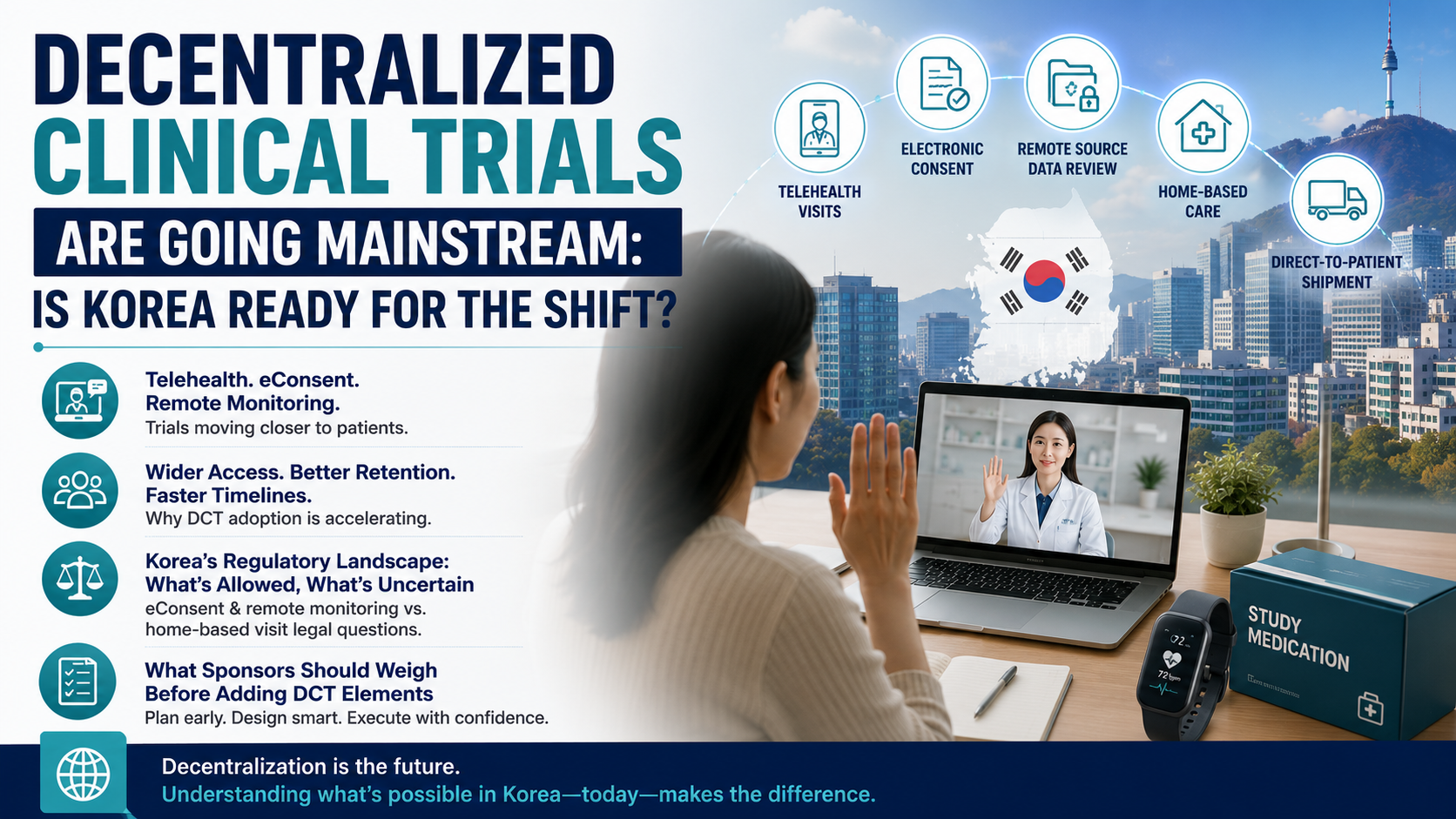
Decentralized clinical trials, or DCTs, use telehealth visits, electronic informed consent, remote source data verification, and local or home-based care to move trial activities closer to the patient instead of requiring every visit to happen at a hospital site. Global adoption has moved past the pilot stage: multiple industry analyses now place the global DCT market in the high single-digit billions of dollars, growing at a compound annual rate in the range of 13 to 15 percent through the early 2030s, driven by sponsor pressure to improve patient retention, widen enrollment beyond major metro areas, and shorten trial timelines. For sponsors evaluating Korea as a trial site, the practical question is not whether decentralization is happening globally, but how much of it Korea’s current regulatory and site infrastructure can actually absorb today.
The short answer is that Korea supports meaningful decentralized elements, particularly electronic consent and remote monitoring, but full at-home trial models still run into unresolved legal questions that sponsors need to plan around rather than assume away. The Ministry of Food and Drug Safety, Korea’s national regulator for pharmaceuticals and medical devices, has updated its electronic consent guidance and continues to align its clinical trial framework with ICH-GCP, the international ethical and scientific quality standard for clinical trials developed by the International Council for Harmonisation. At the same time, questions about whether home-based trial visits fall under home nursing care law remain a live point of ambiguity in Korea that does not yet have a settled answer.
This article lays out what decentralization actually means in practice, where Korea’s regulatory posture currently stands relative to the FDA and ICH E6(R3), and what sponsors should weigh before building remote or hybrid elements into a Korea-based protocol.
What Is a Decentralized Clinical Trial, and Why Is Adoption Accelerating Now?
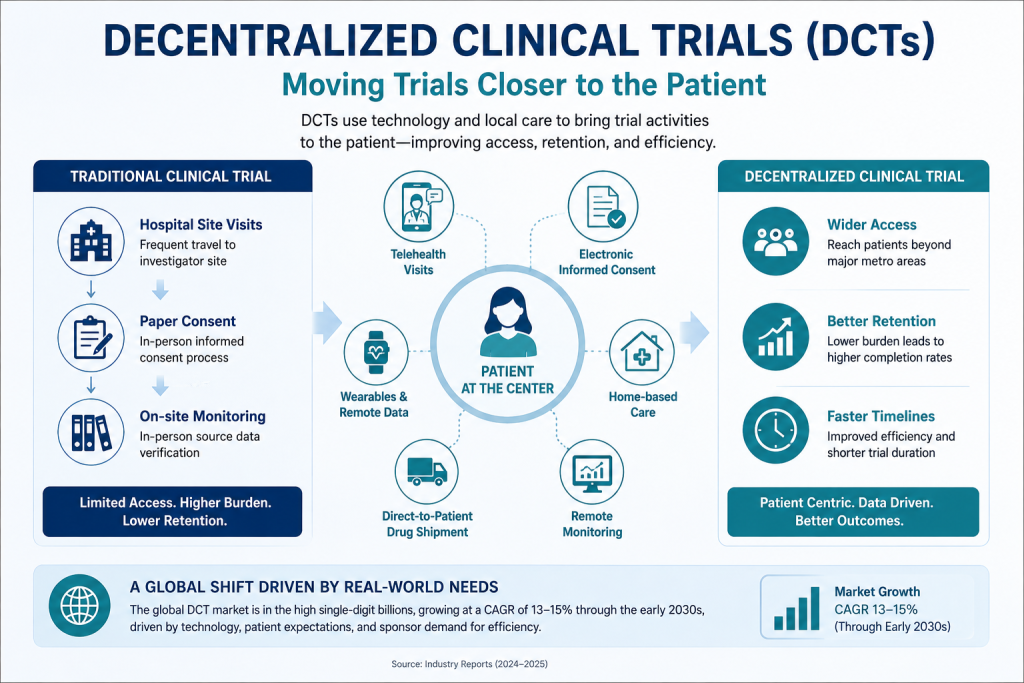
A decentralized clinical trial is one that shifts some or all trial activities away from a central investigator site and toward the patient, using tools such as telehealth visits, wearable devices, home health visits, direct-to-patient drug shipment, and electronic informed consent. Few DCTs today are fully virtual; the more common model is hybrid, where certain visits, such as screening, dosing, and safety-critical assessments, still happen on-site while routine follow-up, some monitoring, and consent processes move off-site. This hybrid framing matters for how sponsors should think about Korea specifically: the question is rarely “can this trial be decentralized,” but rather “which specific activities in this protocol can move off-site here, and which cannot.”
The pull toward this model is structural rather than a passing trend. Sponsors are under sustained pressure to recruit patients outside the small number of academic medical centers that traditionally anchor trial enrollment, since limiting a study to a handful of major hospitals narrows the eligible patient pool and slows accrual. Retention rates tend to improve when patients are not required to travel repeatedly to a hospital for routine visits, which matters most in longer-duration studies and in therapeutic areas where the patient population skews older or has mobility constraints. Post-pandemic infrastructure investment has also changed the operational baseline: remote monitoring platforms, electronic trial master file systems, and eConsent tools that were novel a few years ago are now standard offerings from clinical trial technology vendors, which lowers the cost and complexity of running a hybrid design compared to five years ago.
Regulatory catch-up has followed the same trajectory. The U.S. Food and Drug Administration finalized guidance on conducting trials with decentralized elements, and the revised ICH E6(R3) Good Clinical Practice guideline, which took effect for the FDA in April 2026, explicitly recognizes electronic data systems and digital health technologies, including telehealth, eConsent, and remote source data verification, as acceptable tools for clinical research.
ICH-GCP, the ethical and scientific quality standard for clinical trials developed by the International Council for Harmonisation, functions as the common reference point that most national regulators, including Korea’s, use to align their own domestic frameworks. Because Korea’s clinical trial framework is built on ICH-GCP alignment, this global shift in the reference standard matters directly for what the Ministry of Food and Drug Safety is likely to formalize next, even before a Korea-specific DCT guidance document exists. Sponsors who track ICH E6(R3) implementation elsewhere are, in effect, getting an early read on where Korean guidance is likely headed.
Where Korea’s Regulatory Framework Stands on Remote Trial Elements
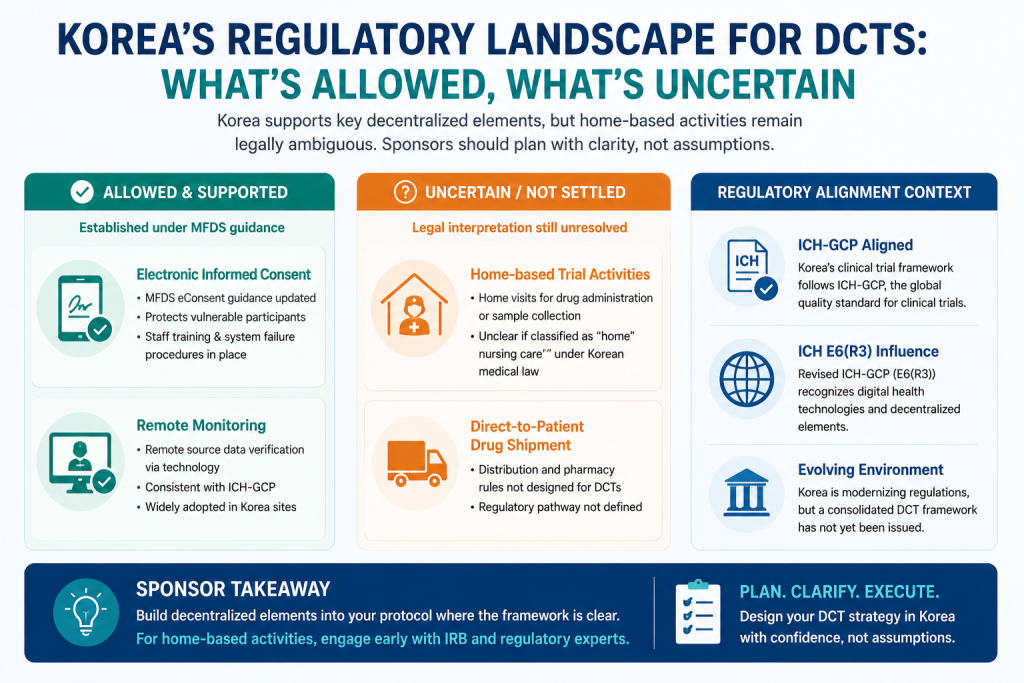
Korea currently permits electronic informed consent and supports remote monitoring within trials, but has not yet issued a single consolidated regulation governing decentralized trials as a defined category. The Ministry of Food and Drug Safety updated its electronic consent guidance to address protections for vulnerable participants, training requirements for site staff, and procedures for handling system failures, which gives sponsors a workable path to run eConsent in a Korea-based protocol today. This puts Korea roughly in line with how many other ICH-GCP-aligned markets have approached eConsent: not through a dedicated DCT law, but by updating existing consent and data-integrity guidance to explicitly accommodate electronic methods.
Remote monitoring, where clinical research associates review source data and site activity using information and communication technology rather than in-person visits, is likewise an established practice component in Korea rather than a novel request requiring special waivers. Sponsors that already run centralized or risk-based monitoring models elsewhere should be able to extend similar approaches to Korean sites without requiring a fundamentally different monitoring plan, though site-level readiness to support remote data access still varies and should be confirmed during site selection rather than assumed.
Where the framework becomes less settled is at the point where trial activities move into a participant’s home. Korean industry and regulatory commentary has flagged an unresolved classification question: whether a home visit conducted for trial purposes, such as drug administration or sample collection, falls under home nursing care as defined by Korean medical law, or whether it should be treated as a distinct clinical trial activity outside that framework. This is not a hypothetical concern for sponsors designing a protocol with home-based elements; it is an open interpretive question that affects which personnel can legally perform a home visit and under what oversight, and it has not yet been resolved through a definitive MFDS notice or amendment. Direct-to-patient investigational product shipment sits in similarly undefined territory, since Korea’s existing drug distribution and pharmacy dispensing rules were not written with decentralized trial logistics in mind.
Sponsors should also note that Korea’s recent legislative movement on telemedicine, including a new legal framework permitting remote medical consultations for foreign patients, is aimed at patient care access rather than clinical trial conduct, and should not be assumed to extend automatically to trial-related remote visits. Conflating general telemedicine liberalization with clinical trial regulatory permissiveness is a common misread among sponsors new to the Korean market, and it is worth confirming with Korean regulatory counsel or a local CRO which rules actually govern a given trial activity before including it in a protocol.
What Should Sponsors Weigh Before Adding Decentralized Elements to a Korea Trial?
Sponsors should treat decentralized elements in a Korea protocol as a design choice to be scoped site-by-site and activity-by-activity, not as a single yes-or-no decision about whether Korea “supports DCT.” Electronic consent and remote monitoring can generally be built into a Korea site plan with confidence, since both have established regulatory footing and precedent. Home-based visits, direct-to-patient drug shipment, and any activity that requires a healthcare professional to enter a participant’s home for trial purposes deserve earlier and more deliberate discussion with both the coordinating site’s institutional review board and Korean regulatory counsel, given the unresolved home nursing care classification question. Site readiness also varies meaningfully across Korea’s hospital network: major tertiary hospitals in Seoul and other metropolitan centers have generally invested further in the digital infrastructure that hybrid trials depend on, including electronic monitoring platforms and telehealth-capable investigator staff, while readiness at smaller or regional sites is less consistent. Sponsors weighing Korea against other Asia-Pacific trial destinations should factor in that decentralization decisions affect site selection twice over, first in choosing which sites can technically support hybrid elements, and second in how monitoring plans and data management systems need to be structured to satisfy both MFDS expectations and the sponsor’s own global data standards. NexBridge Bio, a contract research organization based in Korea, works with sponsors to scope which trial activities can be decentralized at a given Korean site and which require on-site execution under current regulatory guidance.
Conclusion
Decentralization is no longer an experimental add-on to clinical trial design; it is becoming a standard component of how global sponsors plan enrollment, monitoring, and patient retention, and the direction of travel in the reference ICH-GCP standard makes it likely that Korea’s regulatory framework will continue to formalize around it. For sponsors building a Korea-inclusive trial today, the practical path is neither to wait for a fully mature DCT regulation nor to assume Korea operates identically to the U.S. or EU frameworks. Electronic consent and remote monitoring are workable now, while home-based and fully virtual elements require protocol-specific regulatory scoping given the open questions in Korean law. Sponsors who build that scoping into early site selection, rather than discovering it mid-trial, are better positioned to use hybrid models to their advantage in Korea rather than being slowed down by them.
Considering Decentralized Elements for Your Next Korea Trial?
Sponsors evaluating which trial activities can move off-site in Korea should scope that decision before finalizing site selection, not after.
Book a Free Korea Trial Consultation →
FAQ
Q1: What is a decentralized clinical trial (DCT)?
A: A decentralized clinical trial is a trial design that moves some or all study activities, such as consent, monitoring, or follow-up visits, away from a central investigator site and closer to the patient using tools like telehealth, electronic consent, and remote monitoring. Most DCTs today are hybrid rather than fully virtual, combining on-site visits for safety-critical procedures with remote elements for routine activities.
Q2: Does Korea allow decentralized clinical trials?
A: Korea supports specific decentralized elements, particularly electronic informed consent and remote monitoring, under current Ministry of Food and Drug Safety guidance, but has not yet issued a single consolidated regulation defining decentralized trials as a category. Home-based trial activities remain subject to an unresolved legal classification question under Korean medical law.
Q3: Can informed consent be collected electronically in Korea?
A: Yes, the Ministry of Food and Drug Safety has updated guidance permitting electronic informed consent, covering protections for vulnerable participants, staff training requirements, and system failure procedures. Sponsors can build eConsent into a Korea trial protocol using this existing framework.
Q4: What is the biggest regulatory obstacle to running decentralized trials in Korea?
A: The main open question is whether home-based trial visits, such as drug administration or sample collection conducted in a participant’s home, are classified as home nursing care under Korean medical law or as a separate clinical trial activity. This classification question affects which personnel can perform the visit and under what oversight, and remains unresolved.
Q5: How does ICH E6(R3) affect decentralized trials in Korea?
A: ICH E6(R3) is the revised Good Clinical Practice guideline from the International Council for Harmonisation, and it explicitly recognizes electronic data systems and digital health technologies, including telehealth, eConsent, and remote source data verification, as acceptable tools for clinical research. Because Korea’s clinical trial framework aligns with ICH-GCP, this global update signals the likely direction for future MFDS guidance on decentralized elements, even before Korea issues its own consolidated DCT regulation.