

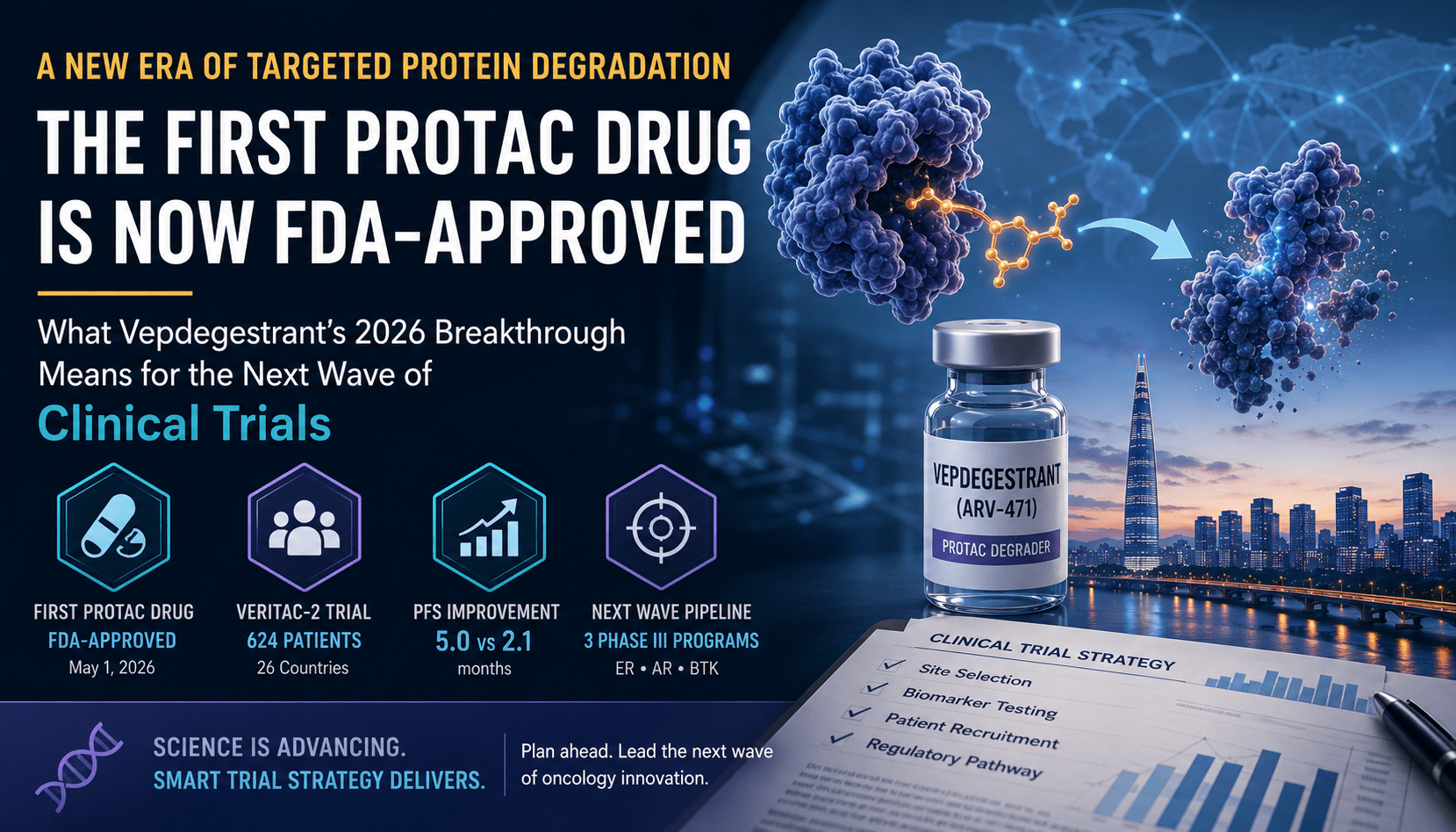
Vepdegestrant received FDA approval on May 1, 2026. This article examines its relevance to PROTAC development and discusses questions sponsors should consider when evaluating oncology trial sites, including biomarker testing, patient eligibility and study operations.
Read the FDA approval announcement.
For two and a half decades, targeted protein degradation occupied a curious position in drug development — a concept of unmistakable scientific elegance that consistently struggled to survive contact with clinical reality. The early PROTAC molecules were intellectually compelling but practically difficult: high molecular weight, poor oral bioavailability, complex manufacturing, and pharmacokinetic behaviour that resisted optimisation. The field produced a steady stream of preclinical excitement and a more modest record in the clinic. That changed on May 1, 2026, when the United States FDA approved vepdegestrant — branded as Veppanu — making it the world’s first PROTAC degrader to receive regulatory approval anywhere.
The approval was based on data from VERITAC-2, a Phase 3 randomised trial enrolling 624 patients across 26 countries. The trial targeted a well-defined and difficult population: patients with ER-positive, HER2-negative metastatic breast cancer harbouring ESR1 mutations who had progressed after at least one prior line of endocrine therapy. Against fulvestrant — the standard of care in this setting for years — vepdegestrant improved median progression-free survival to 5.0 months compared with 2.1 months. In the context of a heavily pre-treated patient population defined by acquired endocrine resistance, that separation is clinically meaningful. The FDA agreed.
The significance of this moment extends considerably beyond a single drug approval in a single tumour type. Three distinct PROTAC candidates are now operating in Phase 3 clinical development, targeting estrogen receptor in breast cancer, androgen receptor in prostate cancer, and BTK in chronic lymphocytic leukaemia. The field has demonstrated, for the first time, that a PROTAC can navigate the full arc of clinical development and reach regulatory approval. What follows is not merely more of the same — it is a wave of Phase 2 and Phase 3 degrader programmes arriving at a time when sponsors are actively making decisions about site strategy, investigator selection, and feasibility. For organisations that have not yet thought carefully about where to run degrader trials, that window is narrowing.
Why PROTAC Technology Took Twenty-Five Years to Reach Clinical Approval — and Why the Wait Shaped the Science
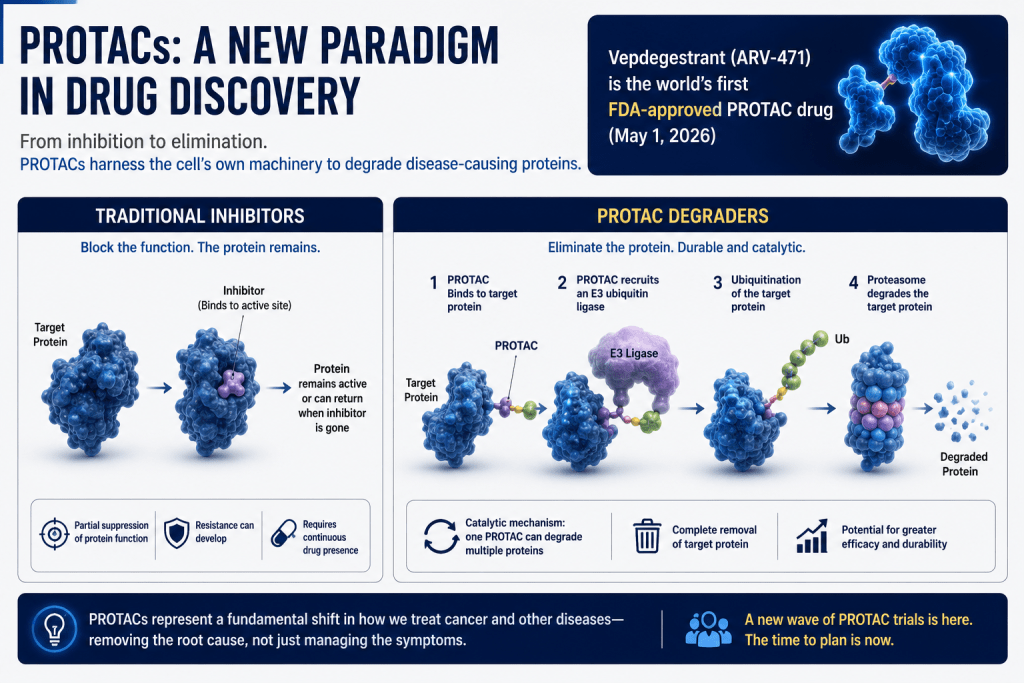
The foundational concept behind PROTACs — Proteolysis Targeting Chimeras — emerged in the late 1990s from work by Craig Crews and colleagues, building on earlier insights into the ubiquitin-proteasome system. The core idea was structurally simple and pharmacologically radical: instead of designing a molecule that blocks a protein’s active site, design a bifunctional molecule that simultaneously binds the target protein and recruits an E3 ubiquitin ligase, triggering ubiquitination of the target and its subsequent degradation by the cell’s own proteasomal machinery. Complete elimination rather than partial inhibition. Catalytic action rather than occupancy-driven suppression.
The clinical translation problem was significant. Early PROTAC molecules were large — frequently exceeding 700 daltons — in a field where oral drugs typically operate below 500. The rule-of-five chemistry that guides most small molecule development did not apply in obvious ways. Oral bioavailability was unpredictable. Manufacturing complexity increased cost and scale-up risk. The pharmacokinetic behaviour of bifunctional molecules introduced novel challenges that existing preclinical models handled imperfectly.
What made vepdegestrant different was the accumulation of structural and formulation insight across more than a decade of iterative chemistry. The molecule was designed to degrade estrogen receptor by recruiting the CRBN E3 ubiquitin ligase — a ligase with well-characterised binding partners that had already been exploited in IMiD-class drugs such as lenalidomide. Oral dosing was achieved. The ESR1 mutation target gave the molecule a specific clinical context in which degradation of ER offered mechanistic advantages over partial inhibition: ESR1 mutations, which arise frequently in patients who have received prior aromatase inhibitor therapy, produce an ER protein that is constitutively active and partially resistant to existing SERDs including fulvestrant. A degrader that eliminates the protein rather than suppressing its activity addresses that resistance mechanism directly.
The VERITAC-2 population — post-CDK4/6 inhibitor patients with confirmed ESR1 mutations — is clinically important not only for what it is but for what it represents in terms of frequency. Up to 40 percent of patients with ER-positive metastatic breast cancer who have received prior CDK4/6 inhibitor therapy harbour ESR1 mutations detectable by liquid biopsy. This is not a rare molecular subgroup. It is a substantial and growing patient segment defined by an acquired resistance mechanism that conventional endocrine therapies manage inadequately. The approval of vepdegestrant creates a new standard of care in this population and simultaneously opens a commercial and scientific logic for a generation of combination and sequencing studies.
The 2026 PROTAC Pipeline: Three Phase 3 Programs Across Three Tumour Types
The breadth of the Phase 3 PROTAC pipeline is as important as the depth of the VERITAC-2 data. The approval of vepdegestrant confirms that targeted protein degradation works in the clinic. The existence of two additional Phase 3-stage PROTAC programmes — in biologically distinct cancers driven by mechanistically unrelated proteins — suggests that VERITAC-2 is the beginning of a clinical era rather than an isolated event.
Bristol Myers Squibb’s BMS-986365, also known as gridegalutamide, is an androgen receptor-targeting PROTAC now in Phase 3 development for metastatic castration-resistant prostate cancer. Phase 1 data showed a median radiographic progression-free survival of 8.3 months at the 900 mg dose, with 32 percent of patients achieving a PSA50 response — outcomes that supported progression to the current randomised programme. The mechanistic logic mirrors what vepdegestrant accomplished in breast cancer: AR splice variants, particularly AR-V7, confer resistance to enzalutamide and apalutamide by producing truncated receptor forms that lack the ligand-binding domain and cannot be reached by conventional antagonists. A PROTAC that degrades AR regardless of splice variant composition addresses that resistance at its structural root.
BeiGene’s BGB-16673, also known as catadegbrutinib, targets BTK — Bruton’s tyrosine kinase — in patients with chronic lymphocytic leukaemia or small lymphocytic lymphoma who have been previously treated with both BTK inhibitors and BCL-2 inhibitors. This population is defined by exhausted treatment options and acquired resistance mutations in BTK’s kinase domain that prevent covalent binding by ibrutinib-class molecules. A PROTAC degrader that eliminates BTK protein rather than binding its catalytic site is not impaired by the C481S resistance mutation that defines failure of covalent BTK inhibition. The Phase 3 programme in this population reflects the same strategic rationale applied to a haematological malignancy context.
The convergence of these three programmes around the theme of resistance mutation biology is not accidental. It represents the clearest clinical articulation of what PROTAC technology offers that conventional inhibitors cannot: the ability to function against targets that have mutated away from direct drug engagement, because degradation is agnostic to the specific conformation of the binding domain. This is a durable competitive advantage, and it explains why the pipeline behind these three Phase 3 programmes — spanning AR, ER, BTK, BRD4, BCL-6, CDK, and multiple other targets — is as extensive as it is. The next wave of degrader trials will not be confined to resistance-defined populations. It will expand into earlier lines, combination settings, and first-line indications where PROTAC activity can potentially prevent resistance from emerging rather than simply addressing it after the fact.
What PROTAC Trial Design Requires — and Why Site Selection Is More Demanding Than Conventional Oncology Studies
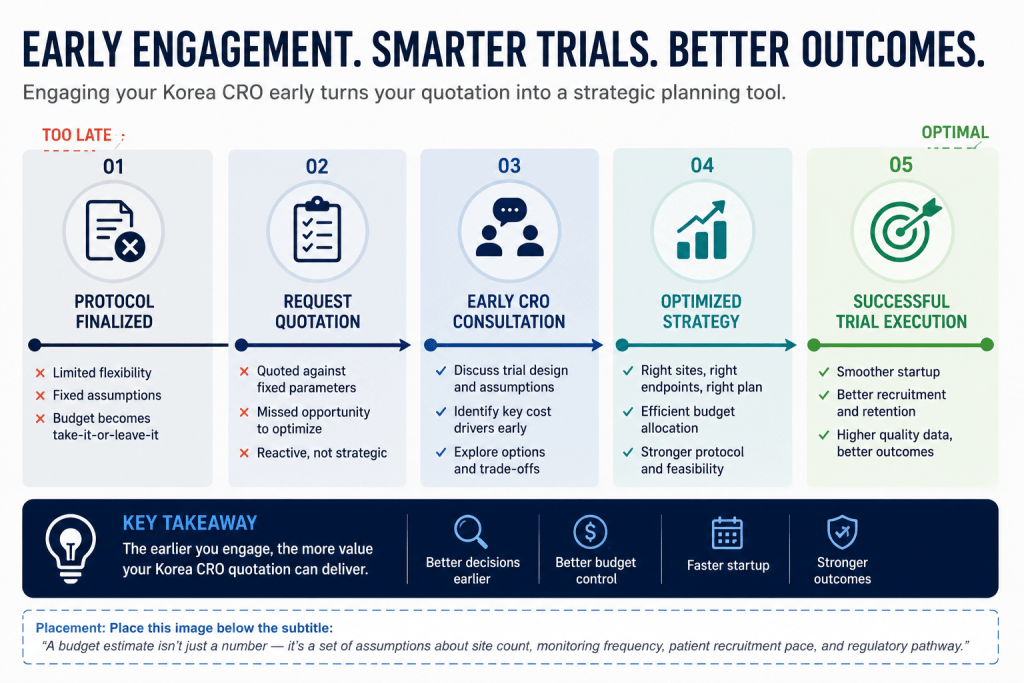
The operational requirements for running a PROTAC clinical trial are more specific than those for a conventional small molecule or even a monoclonal antibody programme, and sponsors who approach site selection using a standard oncology framework risk underestimating the gap between nominal eligibility and practical execution capacity.
The most fundamental requirement is molecular diagnostic infrastructure. PROTAC trials in the post-approval landscape are defined by biomarker-selected patient populations. For the ER+ breast cancer setting, ESR1 mutation detection by circulating tumour DNA liquid biopsy is the standard approach — liquid biopsy is more sensitive than tissue-based testing for acquired mutations that arise during treatment, and the technical validation required for using ctDNA-based ESR1 results as enrolment criteria demands laboratory capabilities that not all oncology sites maintain at the necessary level. Sites without clinical-grade molecular pathology operations — including validated ctDNA assay platforms and established turnaround standards — will struggle to screen patients efficiently regardless of the size of their breast cancer programme. For prostate cancer degrader trials, AR splice variant analysis adds a further layer of molecular complexity. For BTK degrader studies in CLL, resistance mutation profiling at the BTK locus requires NGS panel capabilities that are standard at academic comprehensive cancer centres but less consistently available at community oncology practices.
Beyond molecular diagnostics, PROTAC trials carry specific pharmacokinetic monitoring requirements. As bifunctional molecules with novel absorption and distribution profiles, vepdegestrant-class compounds require serial PK sampling schedules that place demands on clinical research staff and sample processing infrastructure. Investigator experience with oral oncology drug trials — including familiarity with diary-based adherence monitoring, dose modification algorithms, and the particular categories of adverse events associated with E3 ligase-recruiting molecules — is material to protocol execution quality in ways that site selection processes should assess explicitly.
The competitive pressure on the ESR1-mutant breast cancer patient population is also a practical consideration. Vepdegestrant’s approval has not reduced the number of active trials in this population — it has expanded it, as follow-on combination studies, sequencing studies, and competitive programmes from giredestrant and other agents compete for the same post-CDK4/6, ESR1-mutant patients at the same oncology centres. Sponsors planning new studies in this population need sites with the depth of eligible patients to sustain enrolment alongside an approved therapy in the same indication, which requires not only large programme volume but active molecular screening operations capable of identifying and pre-qualifying patients before a screen failure is generated.
Korea’s position in this context deserves specific consideration. The country’s leading comprehensive cancer centres — including Samsung Medical Center, Asan Medical Center, Severance Hospital, and Seoul National University Hospital — have established oncology trial programmes with documented experience in Phase 2 and Phase 3 registration studies across solid tumour and haematological malignancy indications. Korean investigators participated in CDK4/6 inhibitor pivotal trials, meaning the patient databases at these sites include individuals who progressed through prior endocrine-based regimens and who represent the exact population required for post-CDK4/6 degrader studies. ESR1 mutation prevalence in Korean ER-positive metastatic breast cancer is consistent with the global post-CDK4/6 data — a clinical trial registered specifically on ESR1 mutations in Asian ER-positive breast cancer patients confirms that Korean and other Asian sites are actively characterising this population. The MFDS’s IND review process, which operates on a 30 working day statutory timeline, enables sponsors to initiate Korean sites in parallel with US and European activation rather than sequentially, avoiding the late-arriving site problem that frequently distorts enrolment distribution in global trials. For prostate cancer and CLL PROTAC programmes, Korean urology oncology and haematology centres offer equivalent depth.
The combination of investigator experience in the relevant prior-line settings, molecular diagnostic infrastructure at top-tier academic centres, patient population characteristics that align with PROTAC trial enrolment criteria, and a regulatory process that supports rapid startup makes Korea a market worth evaluating early in the site selection process — not as a backup geography but as a primary contributor to a multinational enrolment plan.
The clinical validation of PROTAC technology in 2026 is not the end of a story. It is the point at which the development questions become operational. Sponsors who have been following the science are now building the trial programmes. The sites that will anchor those programmes are the ones with the molecular infrastructure, investigator depth, and regulatory access to execute without friction. In a competitive landscape where multiple degrader programmes will be recruiting from overlapping patient populations simultaneously, the advantage belongs to sponsors who have mapped their site network before the enrolment pressure arrives rather than after.
Evaluating Korean CRO Support for an Oncology Trial?
Share your indication, study phase, biomarker requirements and the support you are seeking in Korea. These details provide a starting point for discussing project scope and CRO quotations.
NexBridge Bio connects pharmaceutical companies with Korean CROs and supports quotation coordination and project discussions.
Discuss your oncology trial project
Q1: What is vepdegestrant, and what makes its FDA approval historically significant?
Vepdegestrant, marketed as Veppanu, is an oral PROTAC estrogen receptor degrader developed by Arvinas in collaboration with Pfizer. It received FDA approval on May 1, 2026, based on data from the Phase 3 VERITAC-2 trial, making it the world’s first PROTAC drug to receive regulatory approval. PROTAC technology uses bifunctional molecules to recruit the cell’s ubiquitin-proteasome system to degrade a target protein, rather than simply inhibiting its activity. The approval confirms that this mechanism — which had been in development for over two decades — can achieve the clinical and regulatory bar required for a marketed medicine.
Q2: How does PROTAC-based drug action differ from conventional receptor antagonism in clinical terms?
Conventional receptor antagonists, including earlier selective estrogen receptor degraders such as fulvestrant, work by binding to the target protein and blocking its activity. Their efficacy is limited when the target protein acquires mutations that reduce drug binding affinity — a common mechanism of acquired resistance. PROTACs work by physically eliminating the target protein through ubiquitin-mediated degradation. Because the degradation mechanism is not fully dependent on the drug’s binding affinity to a specific domain, PROTAC molecules can retain activity against resistance mutations that impair the function of conventional antagonists. In the ESR1-mutant breast cancer population, this translates to clinical benefit in patients who have already progressed on CDK4/6 inhibitor-based endocrine therapy.
Q3: Which tumour types and molecular targets currently have PROTAC degraders in Phase 3 clinical development?
As of mid-2026, three PROTAC candidates are in Phase 3 development. Vepdegestrant targets estrogen receptor in ER-positive, HER2-negative, ESR1-mutated metastatic breast cancer and has received FDA approval. BMS-986365 (gridegalutamide) targets androgen receptor in metastatic castration-resistant prostate cancer and is in a Phase 3 randomised study conducted by Bristol Myers Squibb. BGB-16673 (catadegbrutinib) targets BTK in chronic lymphocytic leukaemia and small lymphocytic lymphoma in patients who have received prior BTK and BCL-2 inhibitor therapy, developed by BeiGene. Each programme targets a distinct resistance mechanism driven by the relevant protein’s mutational escape from earlier-line therapies.
Q4: What site-level capabilities does a sponsor need when selecting clinical trial sites for a PROTAC programme?
Sites participating in PROTAC clinical trials require validated molecular diagnostic infrastructure capable of performing ctDNA-based liquid biopsy for ESR1 mutation detection, androgen receptor splice variant analysis, or BTK resistance mutation profiling depending on the indication. Clinical-grade turnaround standards for these assays are essential because enrolment eligibility depends on prospective molecular screening results. Sites also need investigator experience with the prior-line therapies that define the target population — for example, experience with CDK4/6 inhibitor-based regimens in breast cancer — and clinical research staff familiar with oral oncology drug trials, PK sampling logistics, and adverse event monitoring profiles specific to E3 ligase-recruiting compounds.
Q5: What makes Korea a relevant market for sponsors planning PROTAC or next-generation oncology clinical trials?
Korea’s top-tier academic cancer centres have participated in global Phase 2 and Phase 3 oncology trials across multiple indications, including CDK4/6 inhibitor studies that created the patient databases now relevant to post-CDK4/6 PROTAC enrolment. These centres maintain molecular pathology operations capable of supporting biomarker-driven enrolment criteria, including liquid biopsy-based ctDNA testing. ESR1 mutation prevalence in Korean ER-positive metastatic breast cancer populations is consistent with global data, and dedicated clinical research into ESR1 mutations in Asian breast cancer patients is already ongoing. The MFDS reviews IND applications within a statutory 30 working day window, enabling Korean sites to activate in parallel with US and European sites. NexBridge Bio supports foreign sponsors through the IND application process, site identification, and ongoing CRO operations for multinational programmes incorporating Korea.