


Introduction
In the span of forty-eight hours in mid-January 2026, two of the world’s most influential drug regulators published guidance that, read separately, might look like routine technical housekeeping. Read together, they describe something closer to a structural shift in how pivotal clinical trials will be designed, evaluated, and approved for the remainder of this decade. On January 12, the FDA’s Center for Drug Evaluation and Research and Center for Biologics Evaluation and Research jointly issued the agency’s first comprehensive draft guidance on Bayesian methodology in pivotal confirmatory trials. Two days later, the FDA and the European Medicines Agency published a joint set of ten Guiding Principles of Good AI Practice in Drug Development, covering the full medicine lifecycle from early research through post-market surveillance.
Neither document is legally binding in the way a regulation is. Both are, in the language regulators use, guidance — a signal of expectation rather than a rule with a penalty attached. But guidance from FDA and EMA acting in concert carries a different kind of weight than guidance from either agency acting alone. It tells sponsors what will be scrutinized in the next cycle of submissions, and it tells statisticians and clinical operations teams what kind of trial design will no longer need to be defended as exotic.
For sponsors evaluating where and how to run their next pivotal study, the practical question these two documents raise is less about compliance theater and more about execution readiness. A Bayesian design with adaptive stopping rules, or a submission that leans on AI-generated evidence to support part of its safety or efficacy case, places new demands on statistical review capacity, on the sophistication of the regulatory dialogue a sponsor can have with a national authority, and on the discipline of trial-level documentation. Not every regulatory environment is equally prepared to receive this kind of trial. That is where the conversation turns, naturally, to Asia, and to Korea specifically, as a jurisdiction that has spent the better part of a decade building exactly the kind of fast, technically fluent regulatory dialogue this new guidance presumes.
This article looks at what actually changed in January 2026, why the timing and pairing of these two documents matters more than either would alone, and what the shift implies for sponsors thinking about where in the world they can execute a next-generation trial design without adding regulatory risk to statistical innovation.
What Actually Changed in January 2026
The Bayesian methodology guidance is the more technically specific of the two documents, and it is worth being precise about what it does. Before this draft, Bayesian statistical approaches had appeared in FDA thinking mostly in the context of medical devices, where Bayesian borrowing from prior studies has a longer track record, or as a secondary or exploratory analysis alongside a frequentist primary endpoint in drug trials. The January 2026 draft guidance is the first document to lay out, in detail, what the agency expects when a sponsor proposes Bayesian methods as the primary basis for inference in a pivotal, confirmatory trial — the kind of trial an approval decision actually rests on.
The requirements in the draft are specific rather than aspirational. Sponsors must pre-specify Bayesian success criteria and decision thresholds before unblinding, rather than choosing them after seeing early data. They must characterize operating characteristics through simulation, including the trial’s behavior under the null hypothesis, in language that maps onto the type I error control regulators have always demanded of frequentist designs. Any prior distribution used in the analysis must be justified, with its influence on the final result quantified rather than asserted. Sensitivity analyses must show how robust the conclusion is to reasonable variation in that prior, and to the possibility that the prior conflicts with the observed data. And the entire analysis must be documented to a standard that allows an independent reviewer to reproduce it. None of this makes Bayesian design easier to execute than a conventional frequentist trial. What it does is remove the ambiguity that previously made proposing a Bayesian primary endpoint for a pivotal study a genuine regulatory gamble. Comments on the draft closed in mid-March 2026, and the direction of travel is unlikely to reverse.
The AI guiding principles operate at a different altitude. Rather than prescribing a specific statistical method, the ten principles set expectations for how AI tools should be developed, validated, and governed when they contribute evidence anywhere in a drug’s lifecycle — not only in clinical trials, but in preclinical modeling, manufacturing quality control, and pharmacovigilance signal detection. The principles emphasize that AI use should be human-centric by design, proportionate to risk, transparent in its data provenance, and subject to lifecycle controls that persist after a model is deployed rather than ending at validation. Notably, this document followed an earlier FDA draft guidance from 2025 specifically on using AI to support regulatory decision-making, whose comment period closed in April of that year; the January 2026 joint principles effectively harmonize that US-specific thinking with EMA’s parallel work, and a final, converged FDA guidance is expected around the middle of 2026.
Why the Pairing Signals a Structural Shift, Not a One-Off
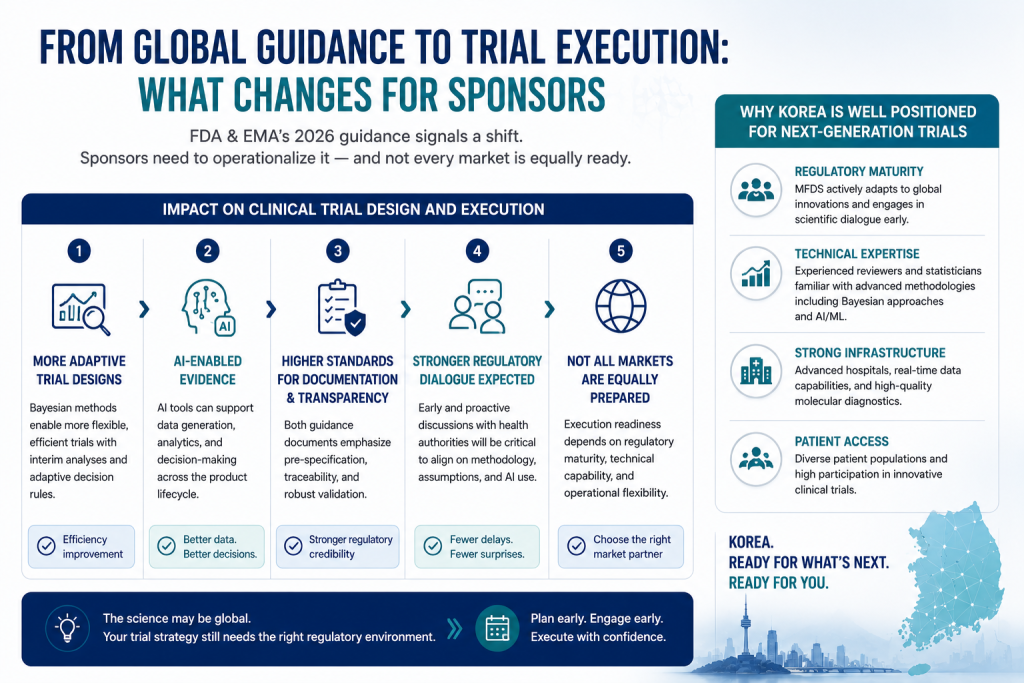
Regulatory guidance documents are usually read in isolation, each addressing its own technical corner of drug development. The reason to read the Bayesian guidance and the AI principles together is that they describe the same underlying change from two different directions: regulators are building the infrastructure to evaluate trials that generate and use evidence in ways that do not fit neatly into the twentieth-century template of a single pre-specified frequentist primary analysis, locked at the protocol stage and untouched until the database lock.
A Bayesian design is, by its nature, more adaptive — it can incorporate accumulating data, external or historical control information, and pre-planned interim looks in ways a fixed frequentist design cannot. AI-generated evidence, whether it comes from a digital biomarker model, a synthetic control arm, or an algorithm supporting endpoint adjudication, similarly introduces a layer of methodological complexity that a reviewer has to be equipped to interrogate. Publishing detailed expectations for both within days of each other is not a coincidence of agency scheduling; it reflects an internal recognition that the review workforce, the statistical infrastructure, and the sponsor community all need the same signal at the same time: these methods are now inside the tent, but only if the documentation, governance, and pre-specification discipline around them meets a materially higher bar than before.
The joint FDA-EMA authorship of the AI principles adds a second layer to this shift. Historically, sponsors have had to manage divergence between US and European regulatory expectations as a cost of doing global development — different endpoints, different statistical preferences, different documentation formats. A joint document, even a non-binding one, narrows that divergence for AI-related evidence specifically. For a sponsor running a single global pivotal program intended to support both an FDA and an EMA submission, this convergence reduces the risk that an AI-supported analysis acceptable to one agency becomes a point of friction with the other. It also raises the practical bar: a submission now has to satisfy a harmonized standard rather than the more forgiving standard of whichever regulator happened to be more permissive on a given issue.
For clinical operations and biostatistics teams, the immediate implication is that trial design conversations that used to happen primarily between the sponsor and its internal statistics group now need to start earlier, and involve regulatory affairs and the receiving country’s authority sooner, particularly if a Bayesian primary analysis or an AI-derived endpoint is on the table. A design that looks statistically elegant on a whiteboard but has not been pre-socialized with the reviewing authority is exactly the kind of submission this new guidance is designed to catch.
What This Means for Trial Execution in Korea
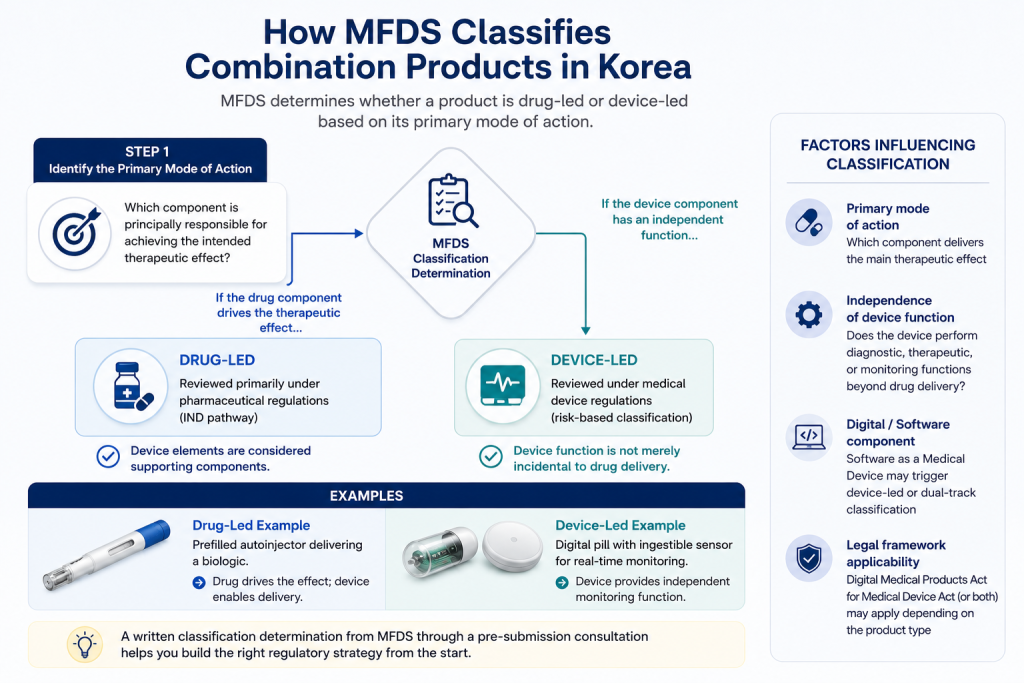
The practical question this raises for global sponsors is which national regulatory environments are actually equipped to have this more technical, earlier conversation — and which will simply apply the new US and European guidance as a distant reference point without the internal capacity to engage with it directly. Korea’s Ministry of Food and Drug Safety has spent the past several years building precisely the kind of structured, pre-submission dialogue that a Bayesian or AI-supported design now requires.
MFDS has offered formal pre-IND consultation since 2019, giving sponsors a channel to discuss trial design — including statistical approach — with reviewers before a formal submission is filed, and in some cases this consultation shortens the subsequent formal review to as little as seven working days. The agency has also built out a specific clinical evaluation framework for digital medical products and software-driven technologies under its Digital Medical Products Act, giving it direct institutional experience evaluating evidence that does not come from a conventional single-arm or randomized comparator design. Korea’s status as an ICH member and a WHO-Listed Authority means that clinical data generated under MFDS oversight is already accepted by both the FDA and EMA as part of a global submission package, which matters directly for a sponsor trying to run one global pivotal program rather than duplicating trials by region.
None of this means a Bayesian or AI-supported trial designed for a Korean site sails through review without scrutiny — the new FDA and EMA guidance is explicit that the documentation burden for these methods is real, and MFDS reviewers will apply comparable rigor. What it does mean is that a sponsor bringing this kind of design to Korea is working with a regulatory counterpart that already has the pre-consultation infrastructure, the digital-evidence review experience, and the international data-acceptance status to have that conversation productively, rather than treating a Bayesian primary endpoint or an AI-derived biomarker as a novelty the local review process has never encountered. For a CRO managing execution on the ground, this translates into a materially different kind of site feasibility and protocol-design conversation with sponsors — one that starts with the statistical methodology itself, not just enrollment projections and site capacity.
Conclusion
The January 2026 guidance from FDA and EMA does not change what a sponsor is required to prove before a drug is approved. It changes how that proof can be constructed, and it removes much of the ambiguity that previously made a Bayesian primary analysis or an AI-supported evidence package a defensible but risky choice. The pairing of a highly specific statistical guidance with a broader, jointly authored set of AI principles suggests regulators are treating this as one connected shift in the infrastructure of drug evidence, not two unrelated technical updates.
For global sponsors, the practical consequence is that trial design decisions now need to be paired earlier with a candid assessment of where in the world a more adaptive, statistically sophisticated design can actually be executed and reviewed without friction. Korea’s combination of structured pre-consultation, digital-evidence review experience, and internationally recognized regulatory status positions it as one of the more prepared environments for that conversation — not because the bar has been lowered, but because the infrastructure to meet a higher one is already in place.
Ready to Discuss Your Trial Design With a Korea-Based Team That Understands the New Regulatory Landscape?
If your next pivotal study involves an adaptive, Bayesian, or AI-supported element, the earlier that conversation happens with a regulatory-fluent execution partner, the fewer surprises you will face at submission.
Q1: What did the FDA’s January 2026 Bayesian methodology guidance actually change?
A1: It was the FDA’s first comprehensive draft guidance addressing Bayesian methods used as the primary basis for inference in pivotal, confirmatory drug and biologic trials, rather than as a secondary or exploratory analysis. It sets out specific expectations, including pre-specified success criteria, simulation-based operating characteristics, justified prior distributions, and sensitivity analyses, giving sponsors a clearer path to propose Bayesian primary endpoints for approval-supporting studies.
Q2: How is the FDA-EMA AI guidance different from the FDA’s earlier 2025 AI draft guidance?
A2: The 2025 FDA draft guidance addressed AI use to support US regulatory decision-making specifically. The January 2026 document is a joint FDA-EMA publication of ten guiding principles covering AI use across the full drug lifecycle in both jurisdictions, effectively harmonizing the two agencies’ expectations rather than leaving sponsors to reconcile separate US and European standards.
Q3: Does this guidance mean AI-generated evidence or Bayesian designs are now easier to get approved?
A3: No. Both documents raise the documentation and pre-specification bar rather than lowering it. What they remove is regulatory ambiguity — sponsors now have a defined set of expectations to design against, rather than having to guess what a reviewer might require for a novel statistical or AI-supported approach.
Q4: Why does Korea’s regulatory environment matter for trials using these newer methodologies?
A4: MFDS has offered structured pre-IND consultation since 2019, has built specific clinical evaluation pathways for digital and software-driven medical products, and Korea’s status as an ICH member and WHO-Listed Authority means MFDS-generated clinical data is already accepted by both FDA and EMA. This combination gives sponsors an earlier, more technically substantive regulatory dialogue than in markets without comparable pre-consultation infrastructure.
Q5: Should sponsors change their site selection strategy because of this guidance?
A5: Site selection should always be evaluated on a study-by-study basis, but sponsors planning a Bayesian-informed or AI-supported pivotal design should factor in whether a candidate country’s regulator has the pre-submission consultation capacity and prior experience with non-traditional evidence types, since that materially affects how smoothly the design will be reviewed.