

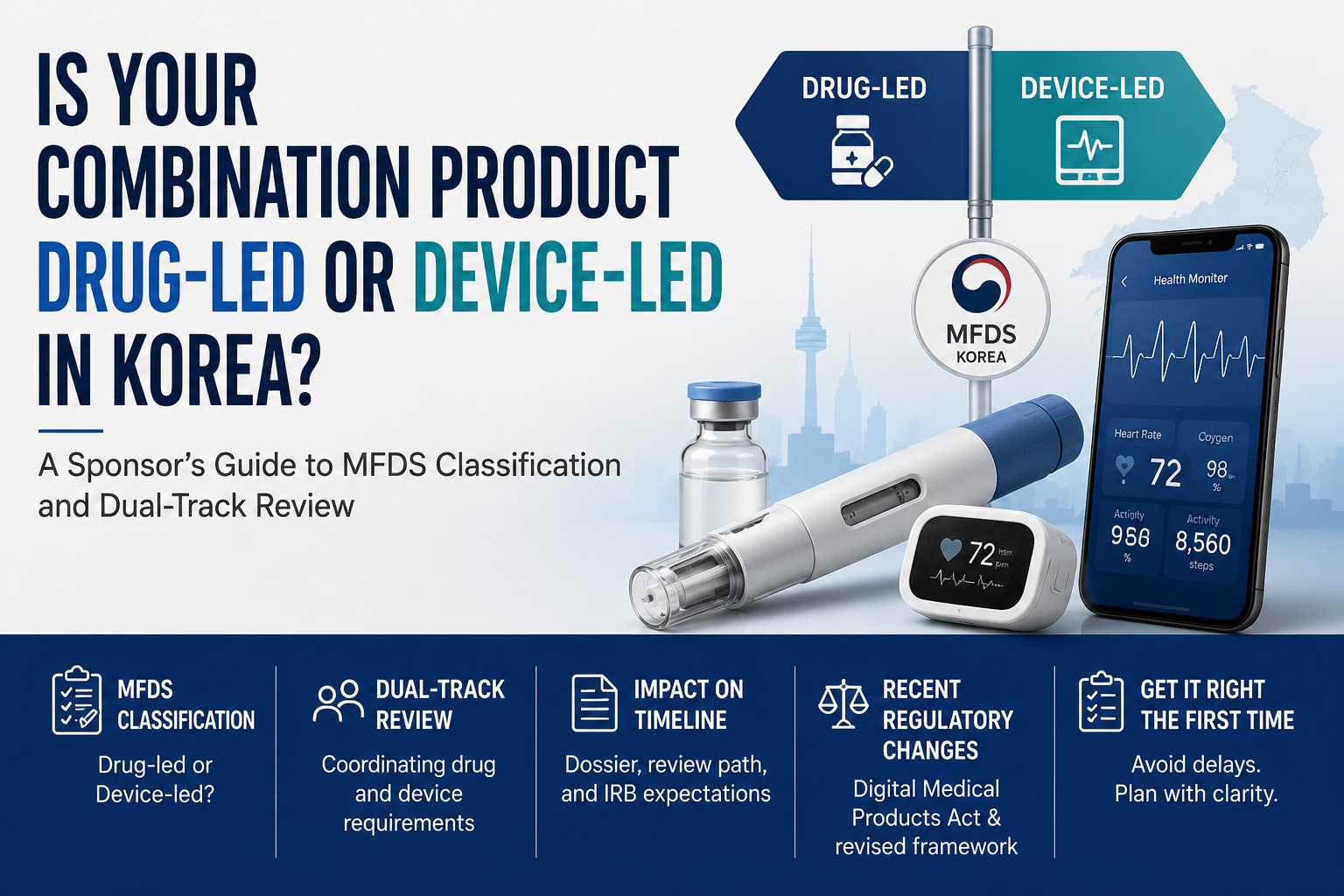
For a sponsor developing a drug-device combination product, one of the earliest and most consequential questions is not scientific but regulatory: which agency framework governs the product, and who leads the review. A prefilled autoinjector paired with a biologic, a digital pill with an ingestible sensor, or a pharmaceutical bundled with a companion monitoring device all raise the same structural question in Korea. Is this a medicine that happens to include a device component, or a device that happens to deliver a drug? The answer determines which regulation applies, which review division at the Ministry of Food and Drug Safety takes the lead, and how the sponsor’s clinical development plan needs to be sequenced.
This is not a formality. Korea’s regulatory architecture treats pharmaceutical and medical device review as distinct tracks, each with its own submission requirements, review timelines, and institutional review board expectations. When a product straddles both categories, the classification decision effectively pre-determines much of what follows: which dossier format applies, whether a single review team or two coordinating teams will evaluate the submission, and how much lead time a sponsor should build into its Korea entry plan. Sponsors who treat this as a downstream administrative detail, rather than an upfront strategic decision, tend to discover the complexity only after their initial submission has already been shaped around the wrong assumptions.
The stakes have risen further with Korea’s recent regulatory restructuring. The introduction of the Digital Medical Products Act alongside a revised Medical Device Act framework has sharpened the criteria for how combination, integrated, and single-use devices are distinguished, and has formally defined categories such as software as a medical device that did not previously have explicit regulatory footing. For sponsors whose combination product includes any digital or software-driven component, this recent tightening of definitions is not background noise. It directly affects which classification a product receives and, in turn, which regulatory track it enters.
This article lays out how MFDS approaches the drug-led versus device-led determination for combination products, why that determination shapes the entire regulatory and clinical timeline that follows, and what practical steps sponsors can take to navigate dual-track review without losing months to jurisdictional ambiguity.
How MFDS Determines Whether a Combination Product Is Drug-Led or Device-Led
MFDS classification logic for combination products centers on a concept familiar to sponsors who have navigated similar frameworks elsewhere: primary mode of action. The regulator asks which component is principally responsible for achieving the product’s intended therapeutic effect. If the pharmaceutical substance drives the clinical outcome and the device component exists primarily to enable delivery, administration, or monitoring, the product is generally treated as drug-led, placing it under pharmaceutical review with device elements assessed as a supporting component of the drug dossier.
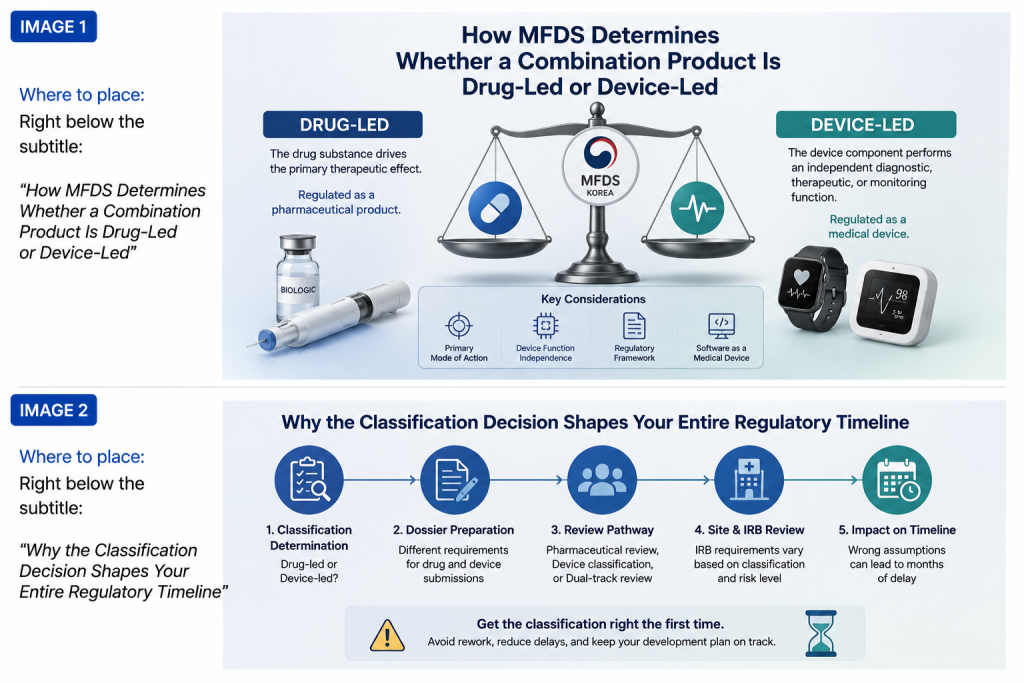
If the device component performs an independent diagnostic, therapeutic, or monitoring function that is not merely incidental to drug delivery, the product may be classified as device-led, subjecting it to the full medical device approval framework, including device classification into risk-based categories.
This determination is rarely self-evident from the product description alone. A prefilled injector delivering a well-characterized biologic is typically a straightforward drug-led case. A digital therapeutic bundled with a pharmaceutical, where the software component independently influences patient behavior or clinical monitoring, is a harder case that may trigger device-led or dual classification. Recent revisions to Korea’s device classification framework have added more explicit criteria for distinguishing combination, integrated, and single-use devices, along with a formal definition of software as a medical device.
For sponsors whose product includes any software or digital health component, this matters directly: what might have been treated as an ancillary feature under an older framework could now meet the threshold for independent device classification, changing the review pathway entirely.
A further complication arises for drug-digital combinations specifically. Where the Digital Medical Products Act does not yet have a corresponding provision for a given product type, Korea’s Medical Device Act continues to apply, meaning some combination products must be evaluated against both frameworks simultaneously rather than a single, cleanly assigned pathway. This dual-framework reality is precisely why sponsors benefit from getting a classification determination in writing before finalizing their clinical development plan, rather than assuming their product’s classification based on how it was categorized in another jurisdiction. A product treated as drug-led under FDA’s primary mode of action framework, for instance, will not automatically receive the same treatment under MFDS review, since the underlying classification criteria and the weight given to device function are not identical across regulators.
Why the Classification Decision Shapes Your Entire Regulatory Timeline
Once a combination product’s classification is determined, nearly every subsequent regulatory milestone follows from that decision. Drug-led products proceed through the pharmaceutical clinical trial approval process, submitting through the Investigational New Drug framework, with device components documented as part of the manufacturing and quality section of the dossier rather than undergoing independent device review. Device-led products, by contrast, are classified into risk-based categories, and higher classifications, which combination products frequently receive given their added complexity, typically require more extensive technical documentation and longer review timelines than a standalone lower-class device would face.
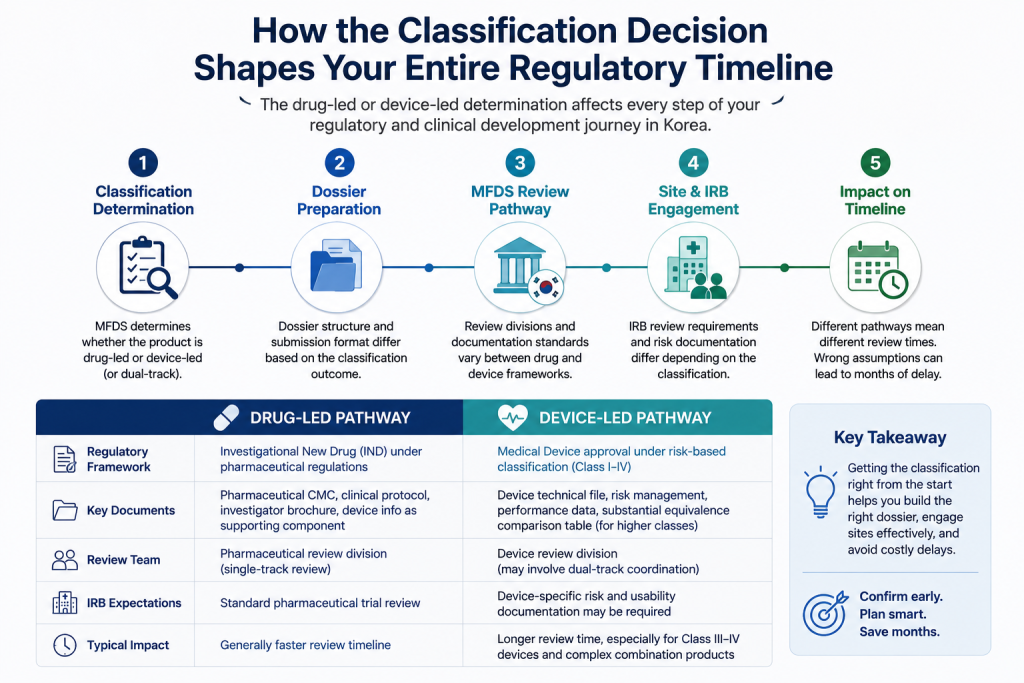
This has direct implications for how a sponsor sequences its Korea entry. A sponsor who assumes a drug-led pathway and prepares a standard pharmaceutical IND dossier, only to have MFDS determine that the device component warrants independent device classification, will need to retrofit device-specific technical files, risk classification justification, and potentially separate review coordination into a submission that was not originally structured for that purpose. This kind of correction after initial submission does not merely add administrative work; it can trigger a fundamentally different review clock, since device review divisions and pharmaceutical review divisions operate on separate procedural tracks with different documentation standards.
The classification decision also affects institutional review board engagement at the trial site level. Drug-led combination products generally follow the IRB review pathway associated with pharmaceutical trials, while device-led products may require the site’s IRB to evaluate device-specific risk documentation that differs materially from a standard pharmaceutical protocol review. Sponsors who have not resolved the classification question before approaching sites risk submitting IRB packages that do not match what individual institutional review boards expect to see, creating avoidable back-and-forth that delays site activation.
Perhaps most consequential for sponsors planning a global development timeline is the recent tightening of documentation requirements tied to Korea’s classification framework revision. Applications for higher device classifications now generally require a comparison table demonstrating substantial equivalence to a device already registered with MFDS, a requirement that did not carry the same weight under the prior framework. For a combination product without a clear predicate device in the Korean market, assembling this comparison becomes a substantive technical exercise in its own right, one that needs to be scoped early rather than treated as a late-stage formality.
Navigating Dual-Track Review: Coordinating Drug and Device Requirements in Practice
For combination products that genuinely straddle both frameworks, whether because the software or device component performs a function independent of drug delivery, or because the product falls into the regulatory gap where the Digital Medical Products Act has no corresponding provision, sponsors face a coordination challenge rather than a simple classification question. In these cases, both the pharmaceutical and device review functions within MFDS may need to evaluate different aspects of the same product, and the sponsor’s dossier needs to be structured so that each review track receives the documentation it requires without duplicating or contradicting the other.
Practically, this means engaging MFDS early to obtain a documented classification position before the clinical development plan is finalized, rather than after a submission has already been prepared. A pre-submission classification consultation allows a sponsor to confirm which review track leads, whether a dual-track review applies, and what the corresponding dossier structure should look like, before committing resources to a development plan built on an assumption that may not hold. This is particularly important for sponsors whose product would be classified differently across major markets, since a classification obtained in the United States, the European Union, or elsewhere in Asia is informative but not determinative for how MFDS will view the same product.
Coordination also extends to how a sponsor’s local regulatory representative and clinical operations partner structure the submission itself. A combination product dossier under dual-track review benefits from a single point of coordination who understands both the pharmaceutical IND process and the device classification and technical file requirements, rather than treating the two as entirely separate workstreams managed by disconnected teams.
Given that Korea’s recent framework revisions have introduced more granular criteria for distinguishing combination, integrated, and single-use devices, along with a formal software as a medical device category, a sponsor’s regulatory partner needs current familiarity with these distinctions rather than reliance on how similar products were classified under the older framework. Misjudging where a digital or software component falls under the revised criteria is one of the more common ways sponsors find their submission timeline extended after the fact.
Finally, sponsors should treat the classification and dual-track coordination question as a strategic input into site and CRO selection, not a separate regulatory workstream that runs in parallel without touching operational planning. A CRO or clinical operations partner with direct experience managing combination product submissions in Korea will typically flag classification ambiguity during initial protocol design, before it becomes a submission-stage problem. Sponsors who bring in that expertise only after drafting their IND dossier around an assumed classification often find themselves reworking core sections of the submission rather than making incremental adjustments.
Getting the Classification Decision Right the First Time
The classification of a drug-device combination product under Korea’s regulatory framework is not a technicality to be resolved after clinical strategy is set. It is one of the first decisions that shapes everything downstream, from which dossier format applies, to how institutional review boards evaluate the trial at each site, to how long the review process is likely to take. Korea’s recent regulatory revisions, particularly the sharper criteria distinguishing combination and integrated devices and the formal recognition of software as a medical device, have made this determination more consequential than it was under the prior framework, especially for sponsors whose product includes any digital or software component.
Sponsors who resolve the drug-led versus device-led question early, ideally through a documented pre-submission consultation with MFDS rather than an internal assumption carried over from another market, position themselves to build a development plan around the actual review pathway their product will face. Those who defer the question risk discovering the answer only after a submission has already been structured around the wrong assumption, at which point the cost is not just delay but the need to rebuild core sections of the regulatory dossier.
Ready to Map Your Combination Product’s Regulatory Pathway in Korea?
If your combination product’s classification under MFDS is not yet confirmed, resolving it before finalizing your clinical development plan can save months of downstream rework.
Q: How does MFDS decide whether a combination product is drug-led or device-led? A: MFDS evaluates which component is principally responsible for the product’s intended therapeutic effect, a concept often referred to as primary mode of action. If the pharmaceutical substance drives the clinical outcome and the device exists mainly to enable delivery or administration, the product is typically treated as drug-led. If the device performs an independent diagnostic, therapeutic, or monitoring function, it may be classified as device-led or subject to dual-track review.
Q: Can a sponsor rely on how their product was classified in another market, such as the United States or the European Union? A: A classification obtained elsewhere is informative context but is not determinative for MFDS review. Korea’s classification criteria, particularly following recent revisions to its device and digital medical product frameworks, do not mirror other jurisdictions exactly, so sponsors should confirm classification directly with MFDS rather than assuming continuity across markets.
Q: What happens if a sponsor submits under the wrong classification assumption? A: If MFDS determines during review that a product requires a different classification than the sponsor assumed, the dossier often needs to be reworked to include the missing technical documentation, such as device risk classification justification or a comparison table demonstrating substantial equivalence. This typically extends the review timeline well beyond what a correctly classified submission would have required.
Q: Why do software or digital components make classification more complicated? A: Korea’s regulatory framework has recently introduced more explicit criteria for distinguishing combination, integrated, and single-use devices, along with a formal definition of software as a medical device. A digital or software component that might previously have been treated as incidental to drug delivery could now independently meet the threshold for device classification, changing which review track applies.
Q: When should a sponsor seek classification guidance from MFDS? A: Ideally before finalizing the clinical development plan and dossier structure, through a pre-submission consultation. Confirming the classification and review track early allows the sponsor to build the regulatory strategy, IRB engagement approach, and CRO coordination around the actual pathway the product will face, rather than an assumption that may need to be corrected later.