

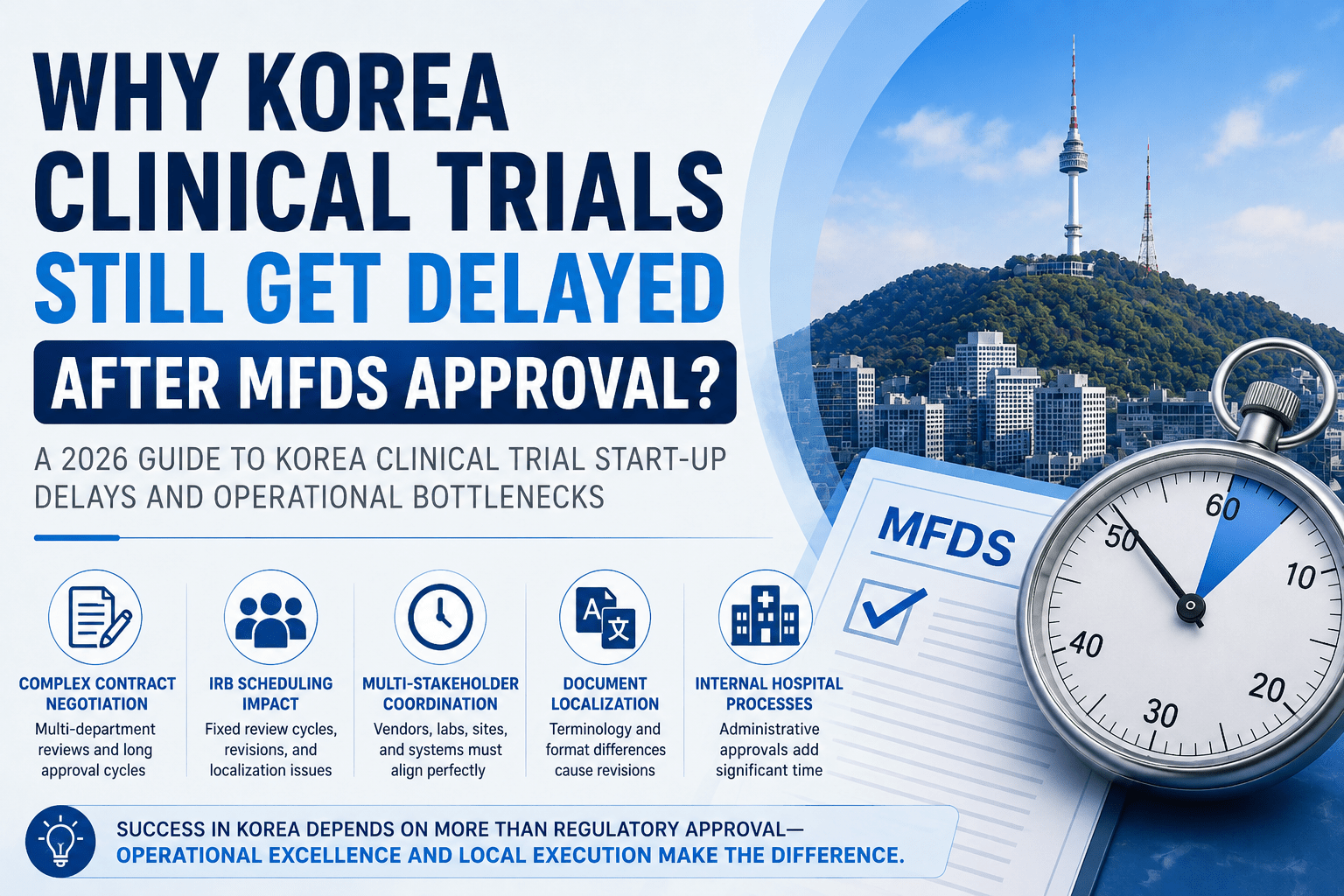
A 2026 Guide to Korea Clinical Trial Start-Up Delays and Operational Bottlenecks
Many global sponsors entering the Korean clinical trial market assume that once they receive approval from the Ministry of Food and Drug Safety (MFDS), patient enrollment and site activation can begin almost immediately. However, companies with real operational experience in Korea often discover that some of the most significant delays occur after regulatory approval rather than during the review process itself.
In recent years, Korea has become increasingly active in oncology, antibody-drug conjugate (ADC), cell and gene therapy (CGT), and rare disease studies. As more global biotech and pharmaceutical companies expand trials into Korea, sponsors are beginning to realize that the true challenges are often related to operational execution rather than regulatory approval alone.
In many studies, the primary bottlenecks are:
- Site activation
- IRB coordination
- Hospital contract negotiation
- Vendor management
- Document localization
- Internal hospital administrative procedures
As study complexity continues to increase, operational coordination has become one of the most important factors influencing overall start-up timelines in Korea.
Why MFDS Approval Does Not Mean Immediate Trial Start-Up
One of the most common misconceptions among foreign sponsors is the belief that MFDS approval automatically means sites can immediately begin patient recruitment. In reality, most Korean clinical trials still require multiple operational steps before enrollment can officially begin.
Even after IND approval is granted, sponsors typically still need to complete:
- IRB approval
- Site contract execution
- Essential document collection
- Vendor setup
- Site initiation activities
- Pharmacy preparation
- Internal hospital administrative approvals
Only after these processes are completed can sites officially open for recruitment.
Large tertiary hospitals in Korea often operate through complex internal administrative structures. Different departments, including legal teams, finance teams, clinical trial centers, and pharmacies, may each have separate review timelines and approval procedures. As a result, a study may receive MFDS approval while still facing weeks of operational preparation before actual activation.
For many sponsors, the biggest challenge in Korea is not obtaining regulatory approval — it is efficiently navigating the post-approval start-up process.
Why Site Contract and Budget Negotiation Often Become Major Bottlenecks
When planning Korean clinical trial timelines, many sponsors focus heavily on regulatory review periods. However, once operational execution begins, sponsors often discover that site contract negotiation is one of the longest and most unpredictable stages of start-up.
Large Korean hospitals typically require multiple layers of internal review before contracts can be finalized. This process may involve:
- Budget review
- Legal review
- Clinical trial center approval
- Financial confirmation
- Multi-department coordination
For complex oncology, CGT, or global multi-center studies, budget discussions often become even more time-consuming due to complicated procedures, additional assessments, and increasing competition for hospital resources.
In recent years, Korean hospitals have become increasingly selective in allocating research capacity because of the growing number of global oncology studies entering the country. Even after MFDS approval is secured, contract negotiations may continue for several additional weeks or longer.
In many Korean studies, the actual timeline bottleneck is not MFDS review — it is site contract execution.
How IRB Scheduling and Document Submission Affect Start-Up Timelines
Most major Korean hospitals operate IRBs on fixed submission and review schedules. Each hospital may have different requirements regarding:
- Submission timing
- Review frequency
- Required document formats
- Revision expectations
If a sponsor misses a submission window, the project may be delayed for several weeks before the next review cycle becomes available.
In addition, IRB revision requests are common, particularly for patient-facing documents such as:
- Informed consent forms
- Recruitment materials
- Patient information sheets
Many foreign sponsors underestimate the importance of Korean-language localization. Translating documents directly from English is often insufficient because Korean hospitals frequently expect language, formatting, and terminology to align with local clinical practices and patient communication standards.
Even relatively small translation inconsistencies may trigger additional revision requests from sites or IRBs. Over time, these seemingly minor issues can significantly extend overall start-up timelines.
Many Site Activation Delays Come From Operational Coordination Challenges
Many sponsors initially view Korea clinical trial start-up primarily as a regulatory process. In reality, site activation involves extensive operational coordination across multiple stakeholders.
Key activities may include:
- Central laboratory setup
- Vendor coordination
- Pharmacy preparation
- Electronic system setup
- Essential document collection
- Site staff scheduling
- Training coordination
In global studies, different vendors often operate on different timelines. Without centralized coordination, delays can easily occur when one operational component is not fully aligned with another.
For example:
- Electronic systems may not be fully configured
- Drug supply preparation may still be pending
- Vendor onboarding may be incomplete
- Final document versions may not be synchronized
Although these are not regulatory issues, they frequently become major contributors to delayed study activation.
As Korean studies become increasingly complex, operational management capability is becoming more critical than ever.
Oncology Competition and Recruitment Pressure Are Increasing in Korea
Over the past several years, Korea has become one of the leading oncology trial markets in Asia. The country has seen significant growth in:
- ADC trials
- Immuno-oncology studies
- CGT programs
- Rare disease research
However, increasing study volume has also intensified competition for patients and research resources.
Many sponsors assume that selecting a prestigious Korean hospital automatically guarantees rapid recruitment. In practice, even highly ranked hospitals may already be participating in multiple competing studies within the same indication.
Particularly in oncology, overlapping eligibility criteria, limited patient pools, and competing global trials can significantly impact enrollment speed.
As a result, successful recruitment depends not only on hospital reputation, but also on:
- Current competing studies
- PI engagement
- CRC availability
- Realistic patient pool analysis
- Accurate feasibility assessment
In many delayed studies, the issue is not hospital quality — it is overly optimistic feasibility assumptions made during planning.
Translation and Localization Remain Common Sources of Delay
Many foreign sponsors underestimate how important localization is in Korea clinical trial start-up. Patient-facing materials, informed consent forms, and recruitment documents often require careful adaptation to Korean clinical and regulatory expectations.
Common localization issues include:
- Inconsistent medical terminology
- Unnatural Korean phrasing
- Site-specific formatting requirements
- Multiple rounds of revision requests
In multi-center studies, different hospitals may request different wording adjustments for the same document, creating additional coordination complexity.
Although these issues may appear relatively minor, they often contribute directly to:
- Increased IRB revision cycles
- Longer approval timelines
- Higher operational burden
Early localization planning can significantly reduce these risks.
How Unrealistic Timeline Expectations Create Delays
Some foreign sponsors estimate Korean trial timelines based on previous experience in the US or Europe. However, Korean hospital structures, contract review systems, IRB processes, and operational workflows often differ substantially from Western markets.
Without sufficient local operational planning, sponsors may encounter:
- Overly aggressive start-up assumptions
- Misaligned vendor timelines
- Incorrect site sequencing
- Underestimated document preparation time
- Inaccurate feasibility expectations
As a result, delays that could have been avoided during planning often emerge during execution.
In Korea, one of the greatest risks is not necessarily regulatory approval itself — it is underestimating operational complexity.
How Sponsors Can Reduce Clinical Trial Delays in Korea
For global sponsors, early operational planning is one of the most effective ways to reduce start-up risk in Korea.
Sponsors should begin with realistic feasibility assessments that evaluate not only patient numbers, but also:
- Competing studies
- PI interest
- Site workload
- Actual recruitment capacity
Early communication with sites is also critical. Establishing relationships and identifying operational challenges early can help sponsors avoid major delays later in the process.
Document localization should begin well before IRB submission, especially for patient-facing materials. Early review of Korean terminology and formatting expectations can significantly reduce revision cycles.
In addition, regulatory timelines and operational timelines should be planned together. Many studies receive regulatory approval before operational readiness is complete, creating unnecessary delays during activation.
Ultimately, the most important factor influencing Korea trial start-up speed is often not regulatory submission itself, but overall operational execution capability.
Final Thoughts: The Real Challenges Often Begin After Approval
Korea remains one of the most attractive clinical trial markets globally, particularly in:
- Oncology
- ADC development
- CGT
- Rare disease studies
- Early-phase trials
Its large hospital systems, experienced investigators, and high-quality clinical infrastructure continue to attract global sponsors.
However, as study complexity and competition continue to increase, successful trial execution now depends on much more than regulatory approval alone.
Operational coordination, realistic planning, local execution capability, and effective site management have become critical components of successful Korea clinical trial start-up.
For global sponsors, understanding the operational realities of Korea early in the planning process can significantly reduce delays and improve overall trial execution efficiency.
Planning a Clinical Trial in Korea?
South Korea continues to strengthen its position as a key global hub for oncology, ADC, CGT, and early-phase clinical development. However, as study complexity and competition continue to increase, successful trial execution now depends on much more than regulatory approval alone.
From site activation and IRB coordination to contract negotiation, patient recruitment, and operational management, having a realistic and locally aligned startup strategy can significantly impact overall study timelines.
If you are evaluating Korea for your upcoming clinical trial, or would like to better understand:
- Realistic Korea startup timelines
- Site and hospital selection strategy
- Operational challenges in Korea clinical trials
- MFDS approval and startup execution considerations
- Oncology / ADC / CGT trial environments in Korea
Our team can support global sponsors in assessing Korea clinical trial feasibility, startup strategy, and operational planning.
👉 Contact us to discuss your Korea clinical trial strategy.