

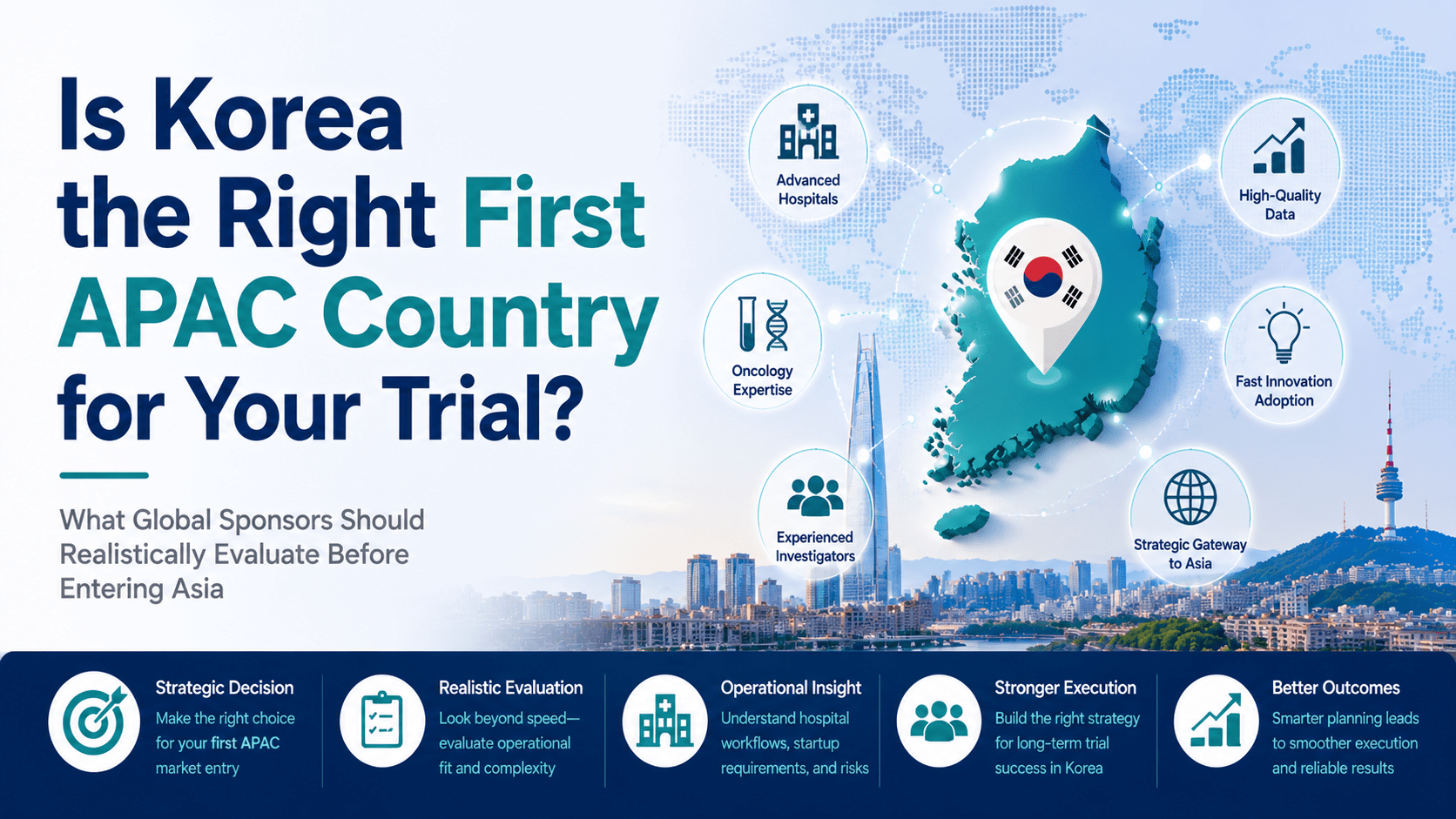
What Global Sponsors Should Realistically Evaluate Before Entering Asia
Over the past few years, South Korea has rapidly evolved from a regional Asian clinical trial market into one of the most strategically important countries for global drug development. Particularly in oncology, ADCs, cell and gene therapy, immunotherapy, and rare disease development, more global biotech and pharmaceutical companies are actively evaluating Korea as part of their early APAC expansion strategy.
For many global sponsors entering Asia for the first time, Korea often appears to be an attractive starting point. The country offers highly advanced hospitals, experienced investigators, digitally integrated healthcare infrastructure, strong patient concentration, and globally recognized clinical data quality. At the same time, the Korean Ministry of Food and Drug Safety (MFDS) has continued to strengthen its support for innovative therapies and global clinical development, further increasing Korea’s visibility within the international clinical trial ecosystem.
However, choosing the first APAC country for a clinical trial is not simply a regulatory decision. Increasingly, global sponsors are realizing that operational fit, execution strategy, and local market realities are just as important as approval timelines or enrollment assumptions.
As a result, many companies are beginning to ask a more strategic question:
Is Korea truly the right first APAC country for their trial?
Why Korea Is Often Considered a Strategic Gateway Into Asia
Korea is frequently viewed as one of the strongest entry points into the APAC clinical trial market for several reasons.
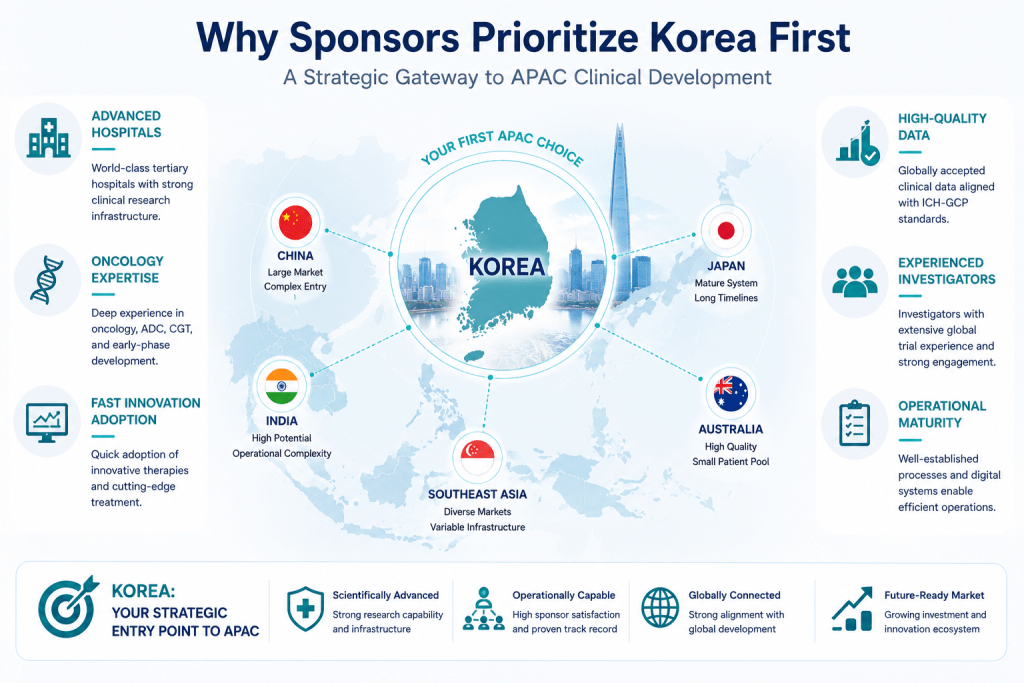
A Strategic Gateway to APAC Clinical Development
The country has a highly concentrated healthcare system centered around large tertiary hospitals and academic medical centers. These hospitals often have extensive experience participating in global multi-regional clinical trials, particularly in oncology and complex therapeutic areas.
Compared with some other APAC markets, Korea also offers relatively centralized patient access, strong diagnostic infrastructure, advanced biomarker testing capabilities, and high adoption rates for innovative therapies.
In addition, many Korean investigators are highly experienced in global development programs and are already familiar with international sponsor expectations, ICH-GCP standards, and complex protocol execution requirements.
For global sponsors entering Asia for the first time, this combination of operational maturity and scientific capability often makes Korea appear more accessible than broader regional expansion strategies.
This is one reason why many global biotech companies increasingly prioritize Korea during early APAC planning discussions.
Why Korea Is Especially Attractive for Oncology, ADC, and Early-Phase Trials
Korea has become particularly attractive for oncology-focused sponsors.
Large Korean hospitals often run multiple global oncology programs simultaneously and have significant experience in biomarker-driven studies, targeted therapies, immuno-oncology, and ADC development.
For sponsors developing highly specialized therapies, Korea’s dense urban patient population and advanced tertiary hospital network can create operational advantages during feasibility and enrollment planning.
In recent years, many global oncology sponsors have also viewed Korea as a valuable market for early-phase expansion due to strong investigator engagement and sophisticated site infrastructure.
The country’s growing experience with cell and gene therapy research has further increased interest among innovative biotech companies looking for strategically important APAC development hubs.
As global competition in oncology and ADC development intensifies, Korea continues to strengthen its position as a scientifically advanced and operationally capable clinical trial market.
Why Korea May Not Be the Right Fit for Every Trial
At the same time, Korea is not automatically the ideal first APAC country for every study.
The best APAC entry strategy often depends on the indication, patient population, development stage, operational priorities, and overall global trial objectives.
For example, some studies may prioritize broader regional diversity across Southeast Asia, while others may require lower-cost operational models or wider population access.
Certain rare disease programs may also require regional expansion beyond Korea in order to achieve realistic enrollment targets.
In oncology, increasing competition between global studies can also affect enrollment assumptions at major hospitals.
As a result, successful APAC strategy planning increasingly depends on realistic operational evaluation rather than broad assumptions about “fast enrollment markets.”
Sponsors that approach Korea strategically — rather than simply viewing it as a high-speed recruitment country — are often better positioned for long-term execution success.
Why Operational Readiness Matters More Than Many Sponsors Expect
One of the biggest surprises for many global sponsors entering Korea is how operationally complex the startup environment can become.
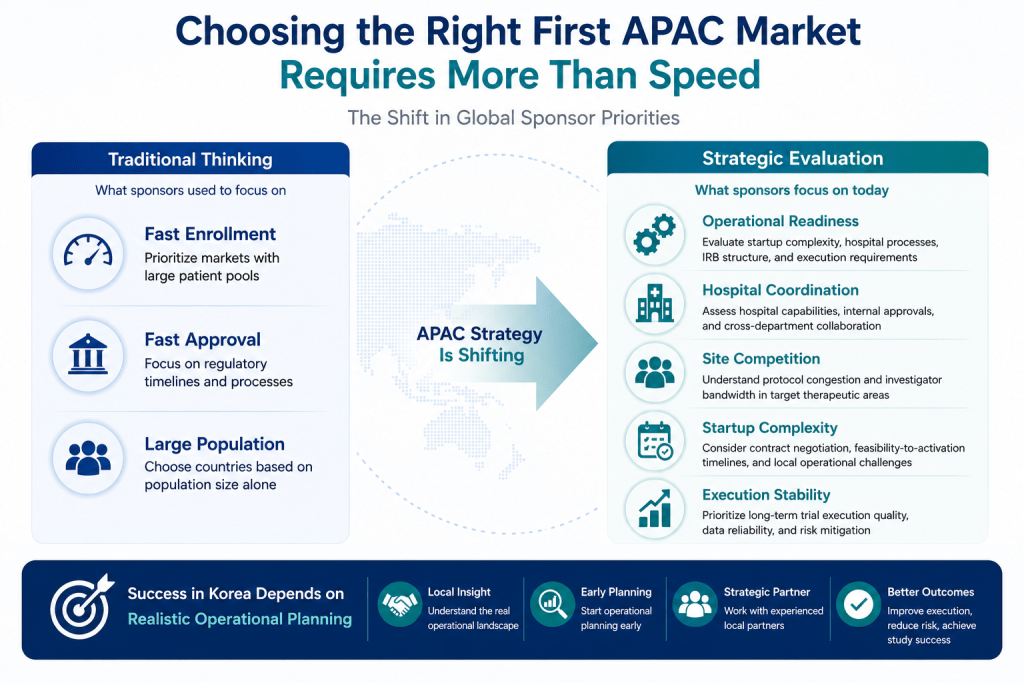
Requires More Than Speed
Many companies initially assume that obtaining MFDS approval is the primary challenge. In reality, site activation, hospital coordination, IRB management, contract negotiation, pharmacy setup, vendor synchronization, and internal hospital workflows often have a greater impact on actual startup timelines.
Korean hospitals operate through highly structured internal systems involving multiple departments simultaneously, including clinical trial centers, legal teams, finance departments, pharmacies, IRBs, CRC teams, and hospital administration.
This means that even after regulatory approval is completed, projects may still experience delays related to operational coordination.
Sponsors without realistic startup planning or local operational insight may underestimate the complexity of execution within Korean hospitals.
Increasingly, successful trial execution in Korea depends not only on regulatory readiness, but also on operational readiness.
Why Many Sponsors Are Prioritizing Operational Fit Over Speed Alone
Historically, Korea was often positioned as a “fast enrollment market.”
While Korea still maintains strong recruitment potential in many therapeutic areas, global sponsors are now becoming more focused on operational quality, execution stability, and realistic feasibility.
This shift is particularly visible in oncology, ADC, and early-phase development, where protocol complexity and operational coordination requirements continue to increase.
Today, many sponsors are no longer simply asking:
“How fast can enrollment happen?”
Instead, they are asking:
“Can this trial realistically execute successfully within Korea’s operational environment?”
As global development programs become more complex, operational fit is becoming just as important as enrollment speed.
This change is reshaping how many sponsors evaluate Korea within broader APAC strategy planning.
What Global Sponsors Should Evaluate Before Choosing Korea as Their First APAC Country
Sponsors considering Korea as their first APAC market should evaluate far more than regulatory timelines alone.
Realistic feasibility planning should include competitive protocol assessment, hospital workload evaluation, investigator engagement, operational complexity, startup coordination requirements, and local execution support.
Understanding how Korean hospitals actually operate global trials is becoming increasingly important for accurate planning.
Sponsors should also carefully evaluate whether their indication, patient population, and operational goals align with Korea’s current clinical research environment.
In many cases, successful Korea entry depends less on theoretical market attractiveness and more on practical execution planning.
The sponsors that perform best in Korea are often those that begin operational planning early and approach the market with realistic expectations.
Conclusion: Korea Can Be a Powerful APAC Entry Market — With the Right Strategy
Korea remains one of the most strategically valuable clinical trial markets in Asia.
Particularly in oncology, ADCs, cell and gene therapy, and early-phase development, Korean hospitals continue to offer strong scientific expertise, advanced infrastructure, and globally competitive research capabilities.
At the same time, operational complexity and study competition within Korea are continuing to increase.
For global sponsors, the most important question is no longer simply whether Korea is attractive as an APAC market.
The more important question is whether the study strategy, operational structure, and execution model are truly aligned with Korea’s clinical trial environment.
Sponsors evaluating Korea as their first APAC country should consider both regulatory and operational readiness from the very beginning.
Planning a Clinical Trial in Korea?
NexBridge Bio supports global sponsors with Korea clinical trial feasibility assessment, startup strategy planning, hospital communication, operational evaluation, and local execution support.
If you are evaluating Korea as part of your APAC clinical trial strategy, feel free to connect with the NexBridge Bio team to discuss your development goals and operational planning considerations.