

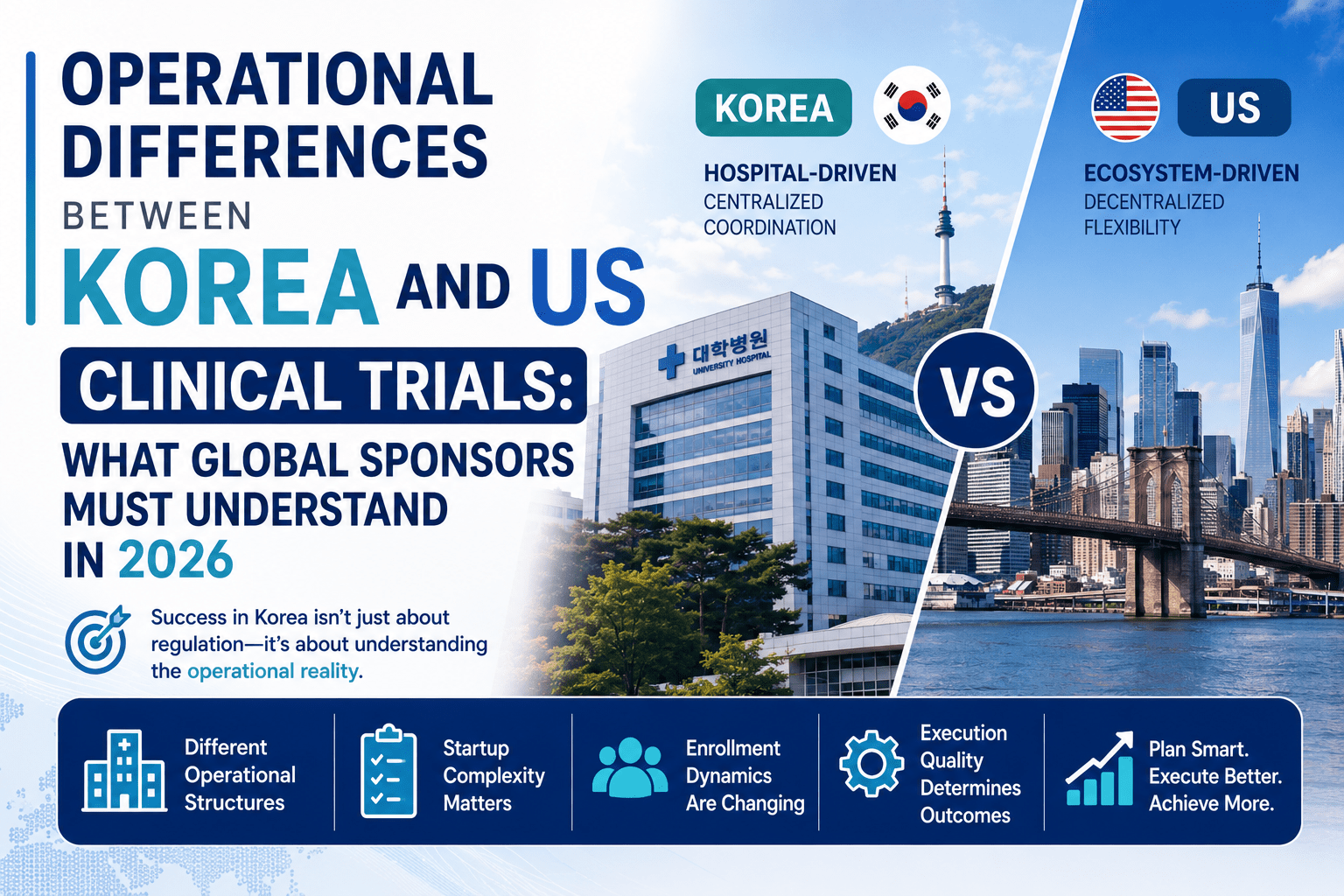
Why Korea and the US May Look Similar — But Operate Very Differently
Over the past decade, South Korea has evolved from a regional Asian clinical trial market into one of the most strategically important countries for global drug development. In particular, Korea has become increasingly significant in oncology, antibody-drug conjugates (ADC), cell and gene therapy (CGT), immunotherapy, and rare disease development programs.
As more global pharmaceutical companies and biotech firms include Korea in multinational studies, many sponsors initially assume that operating a clinical trial in Korea will be similar to operating one in the United States.
On the surface, the two markets appear highly comparable. Both are mature ICH-GCP environments with advanced hospital systems, experienced investigators, strong regulatory frameworks, and globally accepted clinical data quality.
However, sponsors that actually execute studies in Korea quickly realize that the biggest differences are often not regulatory at all. Instead, the real differences emerge in how hospitals operate, how startup activities are coordinated, how sites prioritize studies, and how operational decisions are made internally.
For many global sponsors, one of the most important lessons in Korea is that operational execution often matters more than regulatory approval speed itself.
Why Korea Is More Hospital-Centric Than the United States
One of the biggest structural differences between Korea and the United States is that Korea remains an extremely hospital-centered clinical trial environment.
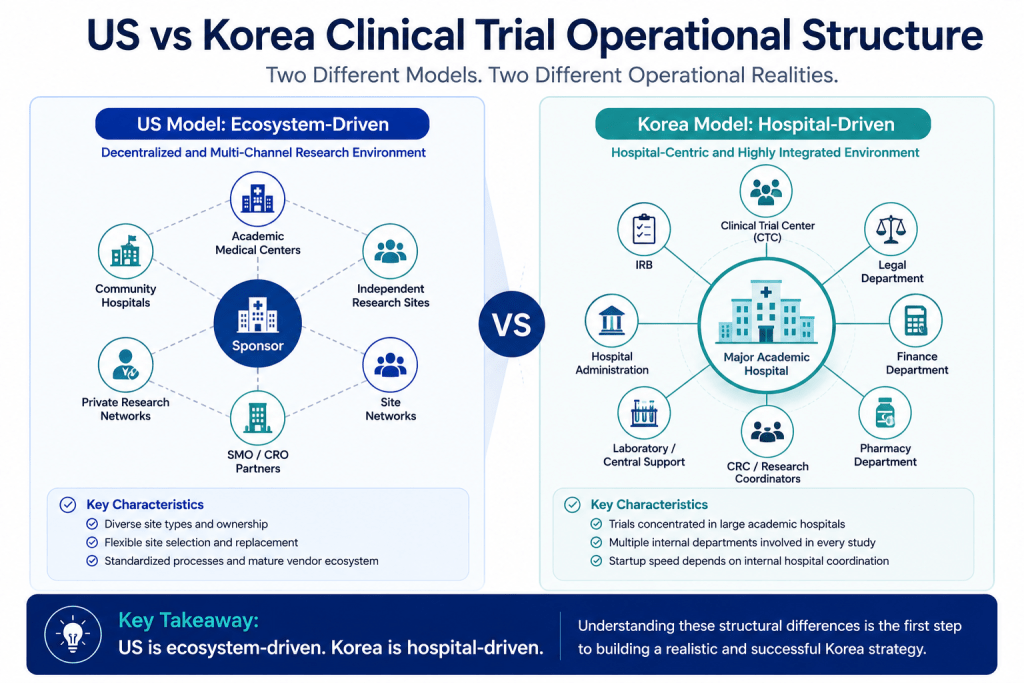
In the United States, clinical trials are conducted across a wide variety of ecosystems, including academic hospitals, independent research centers, site networks, private research organizations, and community-based sites. This creates a relatively decentralized operational structure where studies can often move flexibly between different types of research institutions.
Korea operates very differently.
Clinical trials are heavily concentrated within large university hospitals and major academic medical centers. As a result, Korean clinical trial execution depends heavily on hospital-specific operational systems. In many cases, the internal structure of the hospital itself becomes one of the most important drivers of startup speed and study execution.
In the US, investigator engagement alone can often accelerate startup activities relatively quickly. In Korea, however, even if the principal investigator is highly interested in participating, the study may still require coordination across multiple hospital departments before activation becomes possible.
Clinical trial centers, institutional review boards, legal teams, finance departments, pharmacy units, research coordinators, laboratory departments, and hospital administration teams may all be involved simultaneously.
This creates a highly interconnected operational structure where startup timelines depend heavily on internal coordination rather than sponsor readiness alone.
Why IRB Management Works Differently in Korea
Another major operational difference appears in IRB management.
In the United States, many sponsors rely on centralized or commercial IRB systems that allow relatively streamlined review processes across multiple sites. Korea remains far more hospital-specific.
Most major Korean hospitals operate their own internal IRB systems, each with unique submission timelines, review cycles, formatting expectations, and document preferences.
This means that Korean IRB management is often significantly more operationally sensitive than many sponsors initially expect.
Missing a submission window at a major Korean hospital can delay the entire startup timeline by several weeks.
Furthermore, Korean hospitals often apply very high standards to patient-facing document localization. Many overseas sponsors initially assume that translating English documents into Korean is sufficient.
In practice, hospitals pay close attention to whether the wording sounds natural in Korean medical settings, whether patients can easily understand the language, whether terminology aligns with local clinical usage, and whether formatting matches internal institutional expectations.
As a result, many startup delays in Korea are not caused by regulatory rejection but by repeated localization revisions and operational coordination issues surrounding document preparation.
Why Startup Coordination Is More Operationally Complex in Korea
Startup coordination itself is also fundamentally different between Korea and the United States.
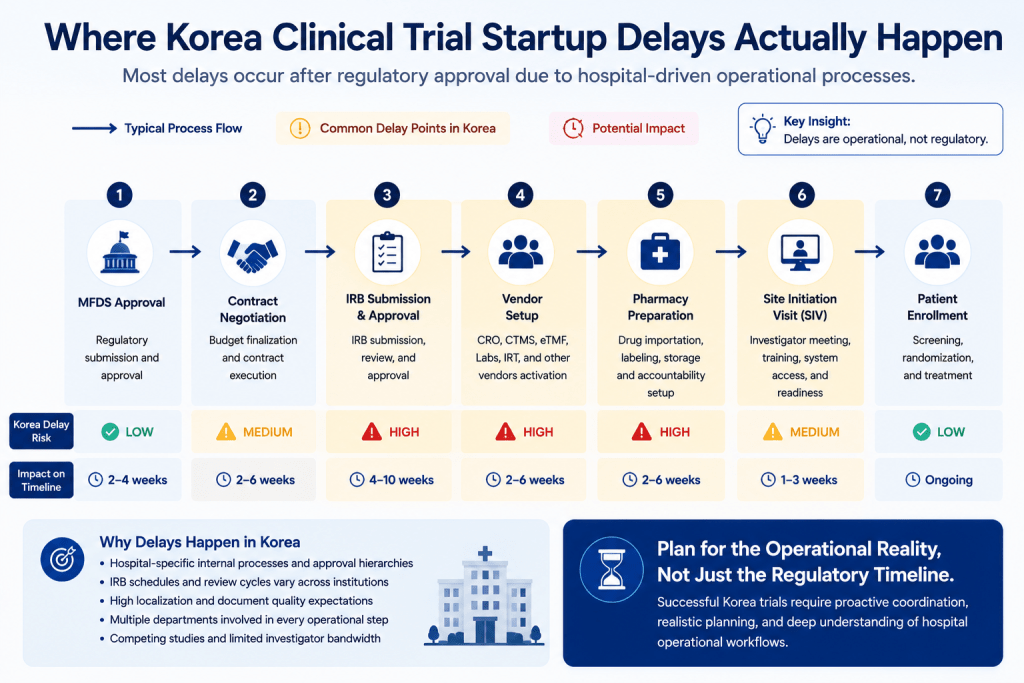
The US clinical trial ecosystem is highly standardized, and many operational workstreams have become relatively systemized over time. In Korea, however, startup coordination remains much more dependent on local operational management and hospital-specific workflows.
Activities such as pharmacy preparation, vendor coordination, equipment setup, electronic medical record integration, source documentation formatting, investigator scheduling, and site initiation planning often require extensive site-level coordination.
Because these workstreams are highly interconnected, delays in one area can easily create cascading effects throughout the startup timeline.
A contract delay may postpone IRB submission. A delayed IRB approval may affect vendor activation. Vendor delays may impact pharmacy preparation or site initiation scheduling.
This parallel coordination complexity is one of the defining characteristics of Korean clinical trial operations.
For this reason, successful project management in Korea often depends on proactive operational control rather than simple regulatory tracking.
Why Patient Enrollment Dynamics Are Changing in Korea
Historically, Korea was widely recognized as a high-performing enrollment market, particularly in oncology studies. In many therapeutic areas, enrollment speed in Korea often exceeded expectations compared to Western markets.
However, the environment has become much more competitive in recent years.
Korean patient pools are highly concentrated within a relatively small number of major hospitals. As global oncology and ADC studies continue to increase, multiple competing protocols are now frequently targeting the same patient populations within the same institutions.
Biomarker-driven studies have intensified this competition even further.
As a result, realistic enrollment forecasting in Korea now requires far more than reviewing epidemiology numbers alone.
Sponsors increasingly need to evaluate investigator prioritization, competing study density, biomarker accessibility, actual screening capacity, hospital workload, and operational bandwidth when assessing feasibility.
This represents a significant shift from earlier perceptions of Korea as simply a “fast enrollment country.”
Why Korea Requires Stronger Operational Execution
Another important operational difference is the growing importance of execution quality.
The United States benefits from a highly mature and highly standardized vendor ecosystem. Korea, while advanced, still relies much more heavily on detailed operational synchronization between sponsors, hospitals, vendors, and internal departments.
In many Korean studies, execution quality at the operational level directly determines timeline performance.
Communication speed between stakeholders, research coordinator availability, scheduling flexibility, startup sequencing, document handling efficiency, and internal hospital responsiveness can all significantly influence study progress.
This is why many experienced sponsors eventually realize that clinical trial success in Korea is often driven less by regulatory speed and more by operational execution capability.
Why More Global Sponsors Are Prioritizing Local Operational Insight
As Korea becomes increasingly important in global drug development, more sponsors are recognizing that understanding Korean hospital operational structures is essential for reducing startup risk and improving study execution efficiency.
Companies that approach Korea using the same operational assumptions applied in the United States often encounter unrealistic timelines, startup bottlenecks, enrollment gaps, and coordination challenges.
By contrast, sponsors that understand Korea’s hospital-driven operational environment are often better positioned to improve site engagement, reduce startup delays, stabilize enrollment performance, and manage execution risk more effectively.
Korea remains one of the most strategically valuable clinical trial markets in the world, especially in oncology, ADC, CGT, immunotherapy, and early-phase development.
However, the market is also becoming increasingly operationally complex and execution-driven.
Conclusion: The Biggest Difference Between Korea and the US Is Operational Structure
For global sponsors in 2026, success in Korea no longer depends solely on obtaining regulatory approval.
Increasingly, it depends on how well sponsors understand the operational realities of Korean hospitals and how effectively they adapt their execution strategy to the local environment.
The United States is largely ecosystem-driven.
Korea, by contrast, remains strongly hospital-driven.
This operational distinction affects startup timelines, site coordination, IRB management, patient enrollment dynamics, and overall execution efficiency.
Sponsors that understand these structural differences early are often better positioned to reduce downstream delays, improve operational stability, and strengthen study execution performance in Korea.
As Korea continues evolving into a highly strategic execution market, operational insight is becoming just as important as regulatory expertise itself.
Planning a Clinical Trial in Korea?
As Korea continues to strengthen its role in oncology, ADC, CGT, immunotherapy, and global early-phase development, more global sponsors are reassessing their Korea startup strategy and operational planning approach.
Intoinworld supports global sponsors with Korea startup feasibility assessment, operational planning, realistic timeline evaluation, hospital communication strategy, and local execution support.
If you would like to discuss your Korea clinical trial strategy, startup planning, or operational execution challenges, feel free to connect with the Intoinworld team.