

Introduction
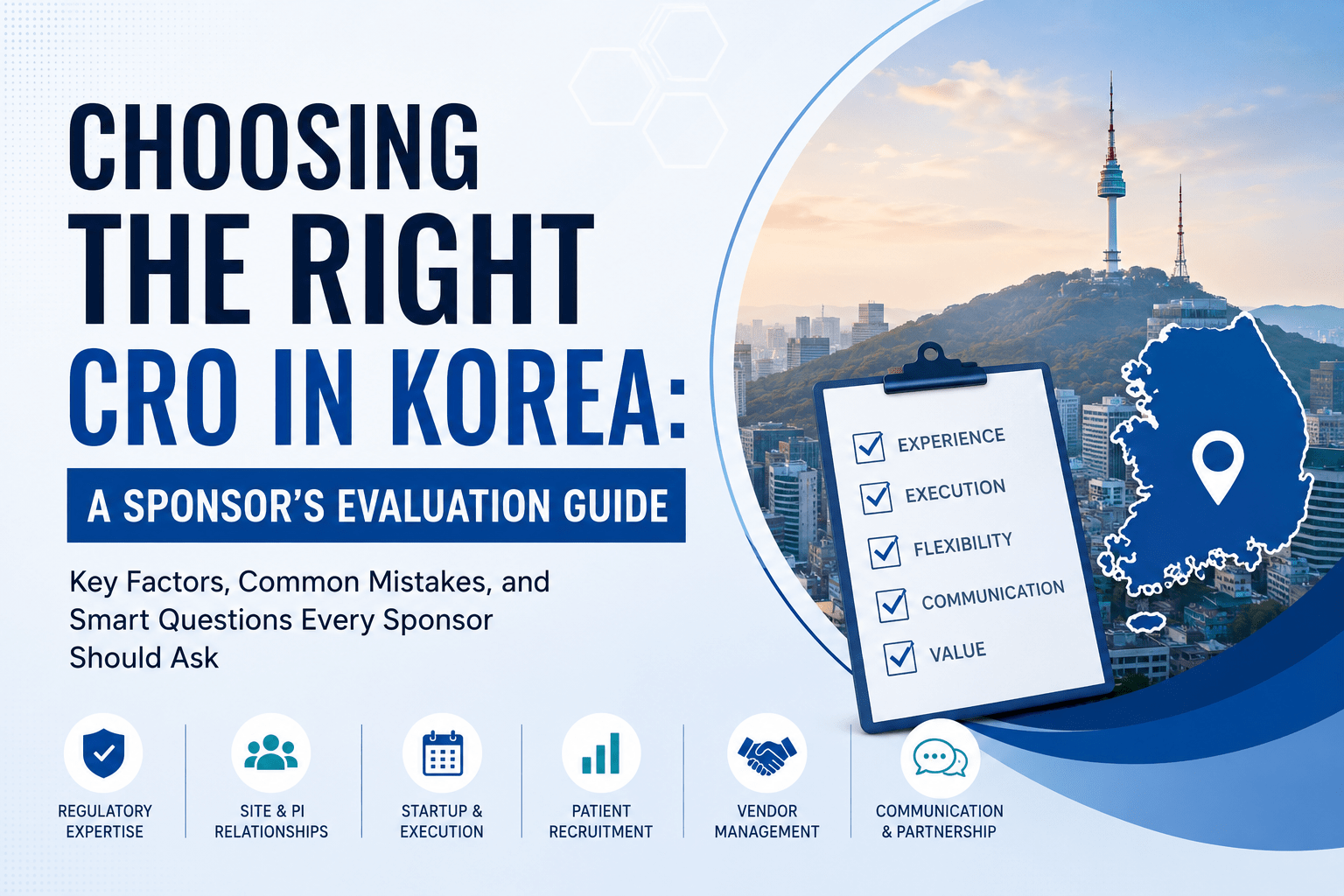
For global pharmaceutical and biotechnology companies entering South Korea, selecting the right CRO is one of the most important decisions in the clinical trial planning process.
A CRO is far more than a service provider responsible for monitoring visits and project administration. In reality, the CRO often becomes the operational engine behind the entire study. From regulatory submissions and site activation to patient recruitment and vendor coordination, the quality of CRO execution can directly influence whether a study stays on schedule or faces costly delays.
Yet many sponsors still evaluate CROs primarily based on cost, company size, or brand recognition.
While these factors may provide useful context, they rarely determine whether a CRO is truly the right fit for a specific study.
For sponsors planning clinical trials in Korea, understanding how to evaluate CRO partners strategically can reduce operational risks and improve overall study performance.
Why CRO Selection Matters More Than Many Sponsors Realize
Many sponsors view CRO selection as a procurement decision.
However, experienced clinical development teams often see it differently.
The right CRO can help accelerate study startup, identify potential operational risks early, improve communication with study sites, and support more realistic patient recruitment planning. Conversely, an unsuitable CRO can create delays that affect timelines, budgets, and overall project execution.
This is particularly important in Korea, where startup activities often involve coordination among multiple stakeholders, including investigators, hospital administrative teams, institutional review boards, regulatory authorities, and various external vendors.
Even when a protocol is well designed and regulatory requirements are clear, operational execution remains a major determinant of success.
As a result, CRO selection should be viewed as a strategic partnership decision rather than a simple vendor comparison exercise.
Common Mistake #1: Choosing a CRO Based Primarily on Cost
Cost is naturally an important consideration during vendor selection.
However, focusing too heavily on the lowest proposal can sometimes lead to higher costs later in the project.
A CRO with a lower service fee may appear attractive during the selection phase, but sponsors often discover that hidden operational inefficiencies can create additional expenses throughout the study lifecycle.
For example, delays in startup activities, inadequate patient recruitment planning, weak vendor coordination, or communication issues may ultimately require additional oversight and resources from the sponsor.
In some cases, the operational impact of these issues can far exceed any initial savings achieved through lower CRO fees.
For this reason, sponsors should evaluate overall study value rather than simply comparing budgets.
The most cost-effective CRO is not always the least expensive one.
It is often the partner that can deliver consistent execution, realistic planning, and fewer operational surprises.
Common Mistake #2: Assuming Bigger CROs Are Always Better
Large global CROs offer many advantages.
They typically have established systems, extensive global infrastructure, standardized operating procedures, and experience managing multinational studies.
For certain programs, these capabilities can be extremely valuable.
However, larger organizations are not automatically the best choice for every study.
Smaller biotechnology companies frequently discover that their projects may not receive the same level of attention as large pharmaceutical programs within major CRO organizations. Communication can become more structured, decision-making processes may take longer, and flexibility can sometimes be limited.
In contrast, smaller or boutique CROs often provide more direct access to project teams, faster communication, and greater adaptability when unexpected challenges arise.
This does not mean that boutique CROs are always superior.
Rather, it highlights an important reality:
The best CRO is not necessarily the largest CRO.
The best CRO is the one whose strengths align most closely with the needs of the study.
Common Mistake #3: Focusing Only on Global Experience
Many sponsors place significant emphasis on global clinical trial experience when evaluating CROs.
While international experience is certainly valuable, local execution capability is often just as important.
A CRO may have managed hundreds of global studies, yet still face challenges if it lacks practical experience operating within the Korean clinical research environment.
Clinical trial execution in Korea involves unique considerations, including local regulatory expectations, hospital-specific startup procedures, investigator relationships, contract negotiation practices, and patient recruitment dynamics.
Sponsors should therefore assess whether a CRO has meaningful experience navigating these local realities.
A strong understanding of how Korean hospitals operate can often have a greater impact on study execution than global credentials alone.
Evaluating Regulatory Expertise in Korea
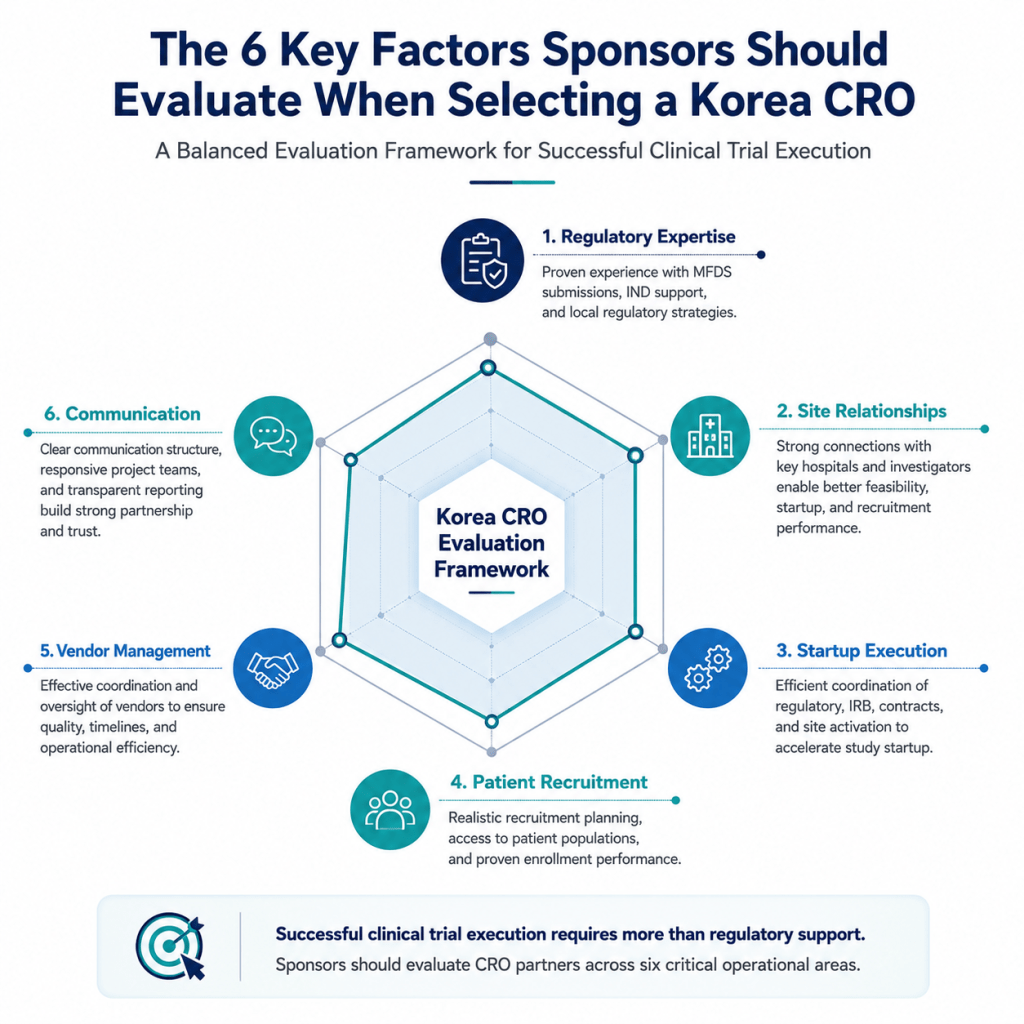
Evaluate When Selecting a Korea CRO
Regulatory support is one of the first areas sponsors should evaluate when assessing a CRO.
Although MFDS submission requirements are generally well established, successful regulatory execution often depends on identifying potential issues before submission rather than simply preparing documents.
An experienced Korea CRO should be able to guide sponsors through local regulatory expectations, anticipate common questions, and help minimize avoidable delays.
More importantly, the CRO should understand how Korean regulatory requirements intersect with global development strategies.
The most effective regulatory partners do not simply react to regulatory challenges.
They help sponsors identify and address them proactively.
When discussing regulatory capabilities, sponsors should look beyond submission numbers and focus on how the CRO approaches problem-solving and risk management throughout the regulatory process.
Site Relationships Matter More Than Most Sponsors Think
Strong relationships with study sites are often one of the most valuable assets a CRO can possess.
Many sponsors assume that access to major hospitals automatically guarantees successful study execution. In reality, effective site management requires far more than simply knowing investigators.
Experienced CROs understand the operational characteristics of different institutions, including their startup timelines, internal review processes, patient populations, and recruitment capabilities.
This knowledge can significantly improve feasibility assessments and site selection decisions.
For example, a prestigious hospital may not necessarily be the strongest recruitment site for a specific protocol.
Meanwhile, a less prominent institution may have a more suitable patient population and greater investigator engagement.
The ability to identify these differences often separates highly effective CROs from those that rely primarily on reputation or existing relationships.
Ultimately, sponsors should evaluate not only how many sites a CRO can access, but how well it understands those sites.
Startup Execution Is Often More Important Than Submission Speed
Many sponsors focus heavily on regulatory approval timelines when planning a study.
However, some of the most significant delays occur after regulatory approval has already been obtained.
Contract negotiations, budget discussions, institutional review board approvals, vendor readiness, and site activation activities can all create bottlenecks that delay study initiation.
A capable CRO understands how to manage these activities in parallel whenever possible.
Rather than treating startup as a series of independent tasks, experienced teams coordinate multiple workstreams simultaneously to reduce overall timelines.
Sponsors should therefore evaluate whether a CRO has a realistic understanding of startup challenges in Korea and whether it can demonstrate a structured approach to managing them.
A CRO that promises extremely aggressive startup timelines without explaining the underlying assumptions may actually represent a greater risk than a CRO that provides a more realistic plan.
Patient Recruitment Experience Should Be Carefully Evaluated
Patient recruitment remains one of the most common causes of clinical trial delays worldwide.
In Korea, recruitment success depends on much more than identifying hospitals with large patient populations.
Competing studies, protocol complexity, eligibility criteria, investigator workload, and changing treatment practices can all affect enrollment performance.
An experienced CRO should be able to evaluate these factors objectively and provide realistic recruitment forecasts.
Sponsors should be cautious when enrollment projections appear overly optimistic or are based solely on investigator estimates.
Strong recruitment planning requires a deeper understanding of local patient availability, competitive study activity, and historical site performance.
The goal is not simply to predict recruitment numbers.
The goal is to build a recruitment strategy that can adapt when real-world conditions differ from initial assumptions.
Vendor Management Can Become a Hidden Risk
Modern clinical trials depend on numerous vendors working together effectively.
Central laboratories, imaging providers, logistics companies, ECG vendors, ePRO systems, depots, and other service providers all play important roles in study execution.
When vendor coordination is weak, even relatively simple studies can experience delays.
For more complex programs such as oncology, rare disease, radiopharmaceutical, or cell and gene therapy studies, vendor management becomes even more critical.
Sponsors often focus heavily on site management while underestimating the impact that vendor coordination can have on overall study performance.
An experienced CRO should be able to oversee vendor activities, identify potential issues early, and facilitate communication among all parties involved.
The smoother this coordination process becomes, the more predictable study execution tends to be.
Communication Structure Can Make or Break a CRO Partnership
Communication is frequently overlooked during CRO selection.
Yet many project challenges can ultimately be traced back to communication failures rather than technical limitations.
Sponsors should understand exactly who will be managing the study, how communication will be structured, and how issues will be escalated when necessary.
Clear communication becomes especially important when global sponsors are working across multiple time zones and languages.
The most effective CRO partnerships are built on transparency, responsiveness, and a shared understanding of project priorities.
A highly experienced team can still struggle if communication is inconsistent.
Conversely, a responsive and collaborative team can often resolve challenges before they become major problems.
Large CRO vs Boutique CRO in Korea
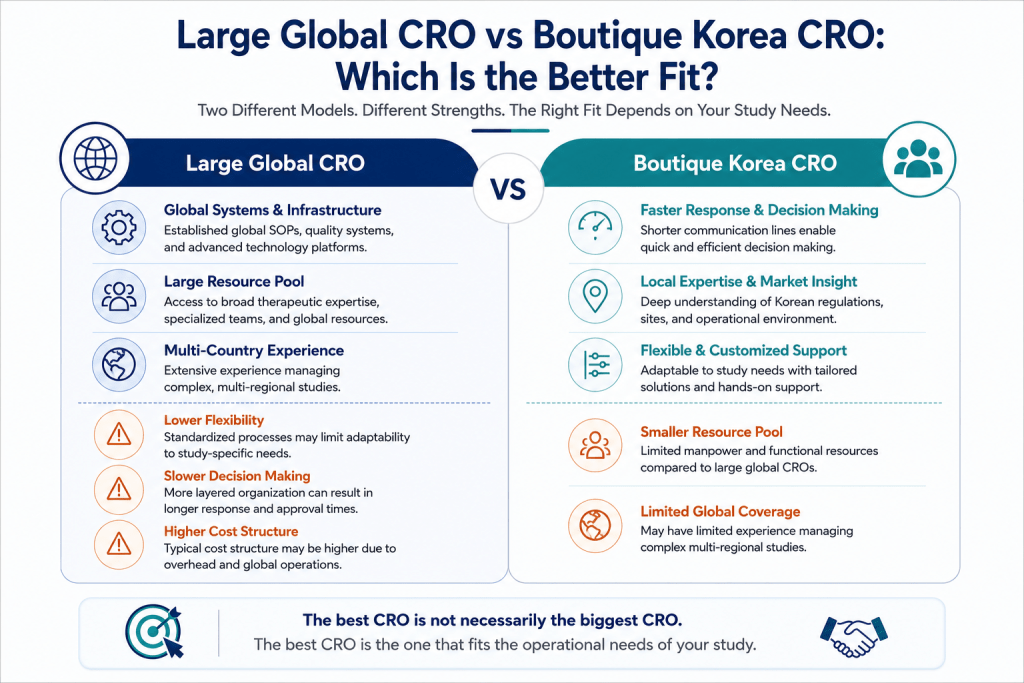
Which Is the Better Fit?
When comparing CRO options in Korea, sponsors often find themselves choosing between large global organizations and smaller local specialists.
Both models have advantages.
Large CROs may offer greater global infrastructure, extensive systems, and broad therapeutic expertise.
Boutique CROs may provide more flexibility, faster decision-making, stronger local focus, and greater day-to-day accessibility.
Neither model is universally superior.
The optimal choice depends on study complexity, sponsor expectations, budget considerations, communication preferences, and the level of local support required.
Rather than focusing solely on organizational size, sponsors should focus on which CRO is most likely to support the study successfully.
Questions Every Sponsor Should Ask Before Selecting a CRO
Before making a final decision, sponsors should take time to understand how the CRO operates in practice.
Important discussions should focus on previous experience with similar studies, approaches to patient recruitment, startup planning methodologies, vendor management processes, communication structures, and risk management strategies.
The objective is not simply to evaluate capabilities.
It is to determine whether the CRO’s approach aligns with the sponsor’s expectations and the study’s operational needs.
The quality of these conversations often provides valuable insight into how the partnership will function once the study begins.
Warning Signs Sponsors Should Not Ignore
Several warning signs may indicate potential challenges during study execution.
These include unrealistic startup promises, overly optimistic recruitment projections, limited local resources, unclear communication structures, and high staff turnover.
While no CRO is perfect, sponsors should pay attention to whether concerns are discussed openly and whether potential risks are addressed transparently.
Organizations that acknowledge challenges and explain mitigation strategies often provide greater confidence than those that promise flawless execution.
The Best CRO Is Not Always the Biggest CRO
Selecting the right CRO in Korea is ultimately about finding the partner that best fits the study’s needs.
The strongest partnerships are built on local expertise, realistic planning, effective communication, operational flexibility, and a deep understanding of the Korean clinical research environment.
While brand recognition and global infrastructure may be important, they should not overshadow the practical capabilities that drive day-to-day study execution.
For many sponsors, success comes not from choosing the biggest CRO, but from choosing the CRO that can execute the study most effectively.
Planning a Clinical Trial in Korea?
Choosing the right CRO can significantly influence study timelines, patient recruitment performance, operational efficiency, and overall project success.
If you are evaluating CRO partners for a Korea clinical trial, understanding both local execution capability and strategic expertise is essential.
Book a Free Korea Trial Consultation
Discuss your Korea clinical trial plans with our team and explore practical approaches for study startup, patient recruitment, vendor management, and operational execution.
Frequently Asked Questions (FAQ)
Q1. How do I choose the right CRO in Korea?
Sponsors should evaluate local regulatory expertise, site relationships, startup execution capability, patient recruitment experience, vendor management processes, and communication structure.
Q2. Should sponsors always select a global CRO?
Not necessarily. Global CROs may offer strong infrastructure, while boutique Korea CROs often provide greater flexibility and local responsiveness. The best choice depends on the study’s needs.
Q3. What CRO capabilities are most important in Korea?
Key capabilities include MFDS experience, site relationships, startup management, patient recruitment planning, vendor coordination, and effective communication.
Q4. How can CRO selection affect patient recruitment?
A CRO with strong local experience can help identify realistic recruitment opportunities, evaluate competing studies, and develop more accurate enrollment forecasts.
Q5. What questions should sponsors ask before outsourcing a study?
Sponsors should discuss similar study experience, startup planning, recruitment strategies, communication structure, risk management approaches, and vendor coordination processes.