

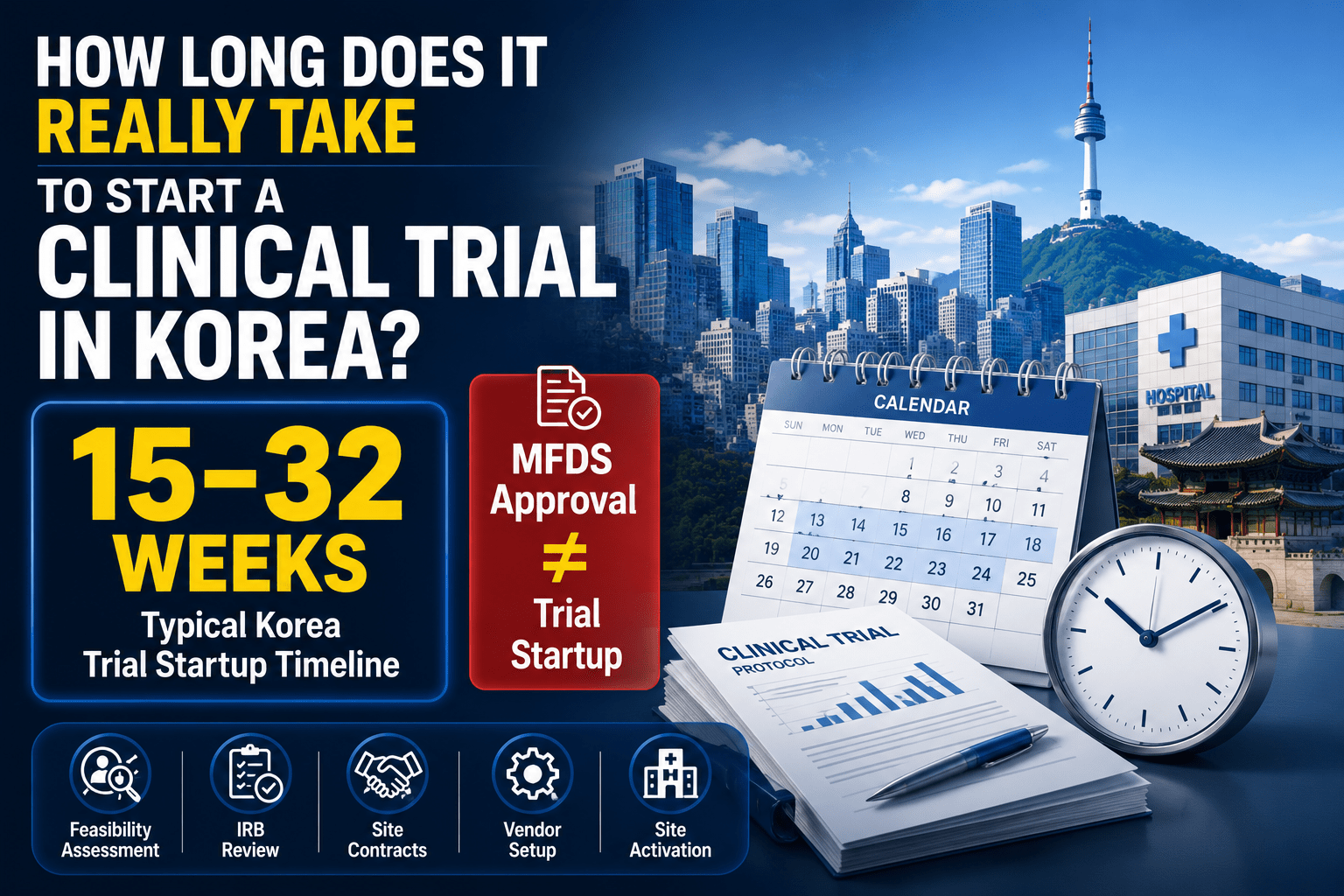
Understanding the Real Clinical Trial Startup Timeline in Korea
One of the most common questions global sponsors ask when planning a clinical trial in South Korea is:
“How long will it take to start the study?”
Many companies focus primarily on MFDS review timelines when estimating project schedules. While regulatory approval is certainly important, it represents only one part of the overall startup process.
In reality, the timeline from protocol finalization to First Patient In (FPI) depends on multiple factors, including feasibility assessments, site selection, ethics committee approvals, contract negotiations, vendor setup, and operational readiness.
As clinical trials become increasingly complex, startup delays are often caused by operational challenges rather than regulatory review itself.
This article explores the typical clinical trial startup timeline in Korea and highlights the factors that most commonly influence study initiation in 2026.
Why MFDS Approval Is Only One Part of the Timeline
Many first-time sponsors assume that clinical trial startup begins with regulatory submission and ends once MFDS approval is received.
However, successful startup involves multiple parallel workstreams.
Before a site can enroll its first patient, sponsors must complete activities such as:
- Feasibility assessment
- Site selection
- Regulatory submission
- IRB review
- Site contract negotiation
- Vendor setup
- Drug supply planning
- Site activation
Each of these activities can influence overall timelines.
In many cases, a study receives regulatory approval on schedule but still experiences delays because other startup activities are not completed in time.
Understanding the entire process is essential for building realistic project timelines.
A Typical Clinical Trial Startup Timeline in Korea
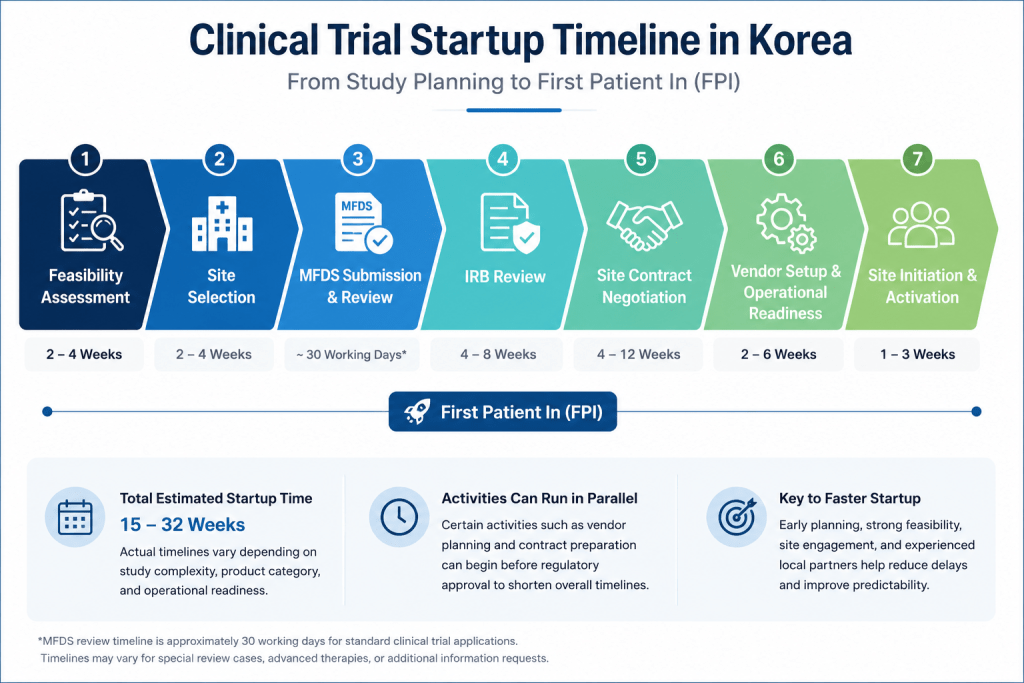
Although timelines vary depending on protocol complexity, therapeutic area, and study design, a typical startup process may include the following phases:
| Startup Activity | Typical Duration |
|---|---|
| Feasibility Assessment | 2–4 Weeks |
| Site Selection | 2–4 Weeks |
| MFDS Review | Approximately 30 Working Days* |
| IRB Review | 4–8 Weeks |
| Site Contract Negotiation | 4–12 Weeks |
| Vendor Setup | 2–6 Weeks |
| Site Initiation & Activation | 1–3 Weeks |
*Actual timelines may vary depending on study type, product category, and submission quality.
Importantly, several activities can occur in parallel, which may shorten overall startup timelines when managed effectively.
Step 1: Feasibility Assessment
A strong startup process begins with feasibility assessment.
This phase helps sponsors evaluate whether the study can realistically be conducted within expected timelines and recruitment targets.
Key considerations include:
- Patient availability
- Investigator interest
- Competing clinical trials
- Site capacity
- Standard treatment practices
- Protocol complexity
Many startup delays can be traced back to overly optimistic feasibility assumptions made during the planning stage.
For example, a site may have extensive experience in a therapeutic area but limited enrollment capacity due to participation in multiple competing studies.
The purpose of feasibility assessment is not simply to identify potential sites. It is to determine which sites are capable of delivering the required study outcomes.
Step 2: Site Selection and Study Planning
Once feasibility activities are completed, sponsors typically move into site selection.
The goal is to identify sites that not only have scientific expertise but also possess the operational capacity to support the study.
During this phase, sponsors often evaluate:
- Previous clinical trial experience
- Enrollment performance
- Investigator availability
- Institutional capabilities
- Startup expectations
Strong site selection can significantly reduce future startup risks and improve overall study execution.
Conversely, selecting sites based solely on reputation rather than operational readiness may create challenges later in the project.
Step 3: MFDS Submission and Regulatory Review
The MFDS review process remains one of the most visible components of clinical trial startup.
Sponsors must prepare and submit required regulatory documentation before initiating the study in Korea.
During review, regulators may request clarifications or additional information depending on the submission.
Many sponsors focus heavily on this phase because it has a clearly defined review process.
However, regulatory approval alone does not guarantee immediate study activation.
Studies frequently receive approval while still waiting for site contracts, vendor setup, or IRB completion.
For this reason, sponsors should view MFDS review as one part of a larger startup strategy rather than the sole determinant of project timelines.
Step 4: IRB Review and Site Preparation
Institutional Review Board (IRB) approval is another critical startup milestone.
Each participating hospital typically conducts its own ethical review process according to institutional requirements.
Review timelines may vary between sites due to:
- Meeting schedules
- Documentation requirements
- Review procedures
- Administrative workload
As a result, some sites may receive approval significantly earlier than others.
Sponsors should account for these variations when planning activation schedules.
Early preparation of IRB documentation can help reduce avoidable delays during this stage.
Step 5: Site Contract Negotiation
For many studies, site contract negotiation becomes one of the most significant startup bottlenecks.
Although regulatory approval often receives the most attention, contract discussions frequently require substantial time and coordination.
Common negotiation topics include:
- Budget review
- Payment schedules
- Legal terms
- Insurance requirements
- Institutional policies
Large hospitals may involve multiple stakeholders during contract review, which can further extend timelines.
Sponsors who underestimate contract negotiation often experience delays despite having already received regulatory approval.
This is one reason why contract planning should begin as early as possible.
Step 6: Vendor Coordination and Operational Setup
Modern clinical trials rely on multiple specialized vendors to support study execution.
Operational setup may involve:
- Central laboratories
- Imaging providers
- IRT systems
- eCOA platforms
- Drug depots
- Logistics providers
- Courier services
Each vendor requires planning, coordination, and alignment with study timelines.
For complex studies, particularly oncology, rare disease, cell and gene therapy, and radiopharmaceutical trials, vendor readiness can significantly influence startup speed.
Effective coordination between sponsors, sites, CROs, and vendors is essential for minimizing delays.
Why Clinical Trial Startup Timelines Often Slip
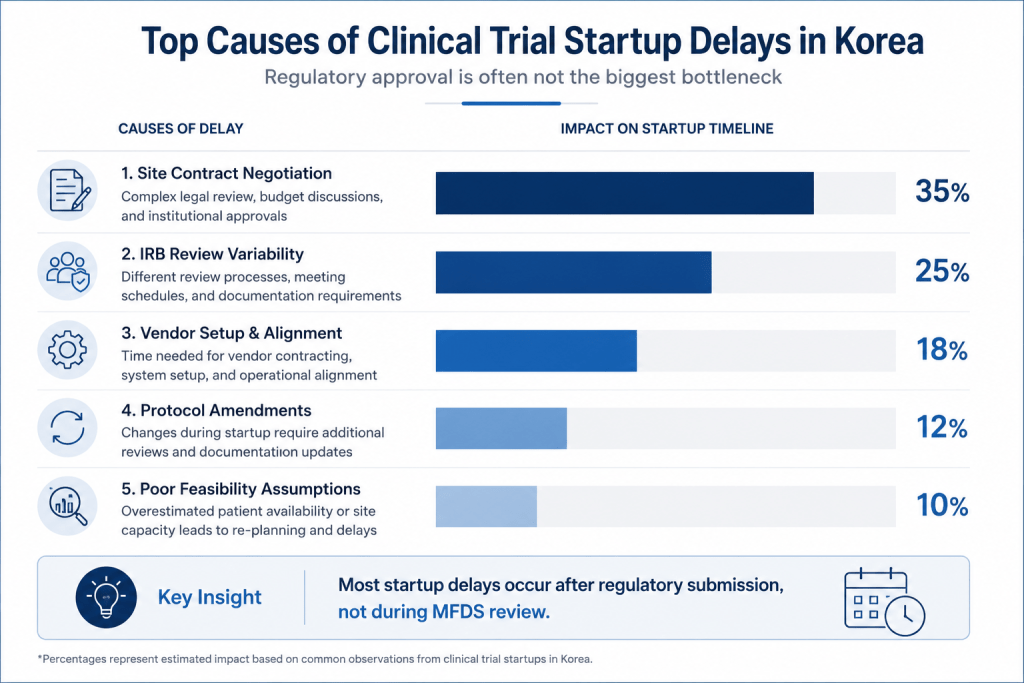
Even well-planned studies can encounter unexpected startup challenges.
Several factors repeatedly contribute to timeline extensions.
Poor Feasibility Assumptions
Overestimating patient availability or site capacity can create enrollment and activation challenges later in the study.
Contract Negotiation Delays
Lengthy legal and budget discussions often take longer than sponsors initially expect.
Vendor Readiness Issues
Incomplete vendor setup may delay site activation even after approvals are received.
Protocol Amendments
Protocol changes during startup frequently require additional reviews and documentation updates.
Misaligned Expectations
Differences between sponsor expectations and site realities can create operational bottlenecks.
Recognizing these risks early can significantly improve startup predictability.
How Sponsors Can Accelerate Clinical Trial Startup in Korea
While some startup activities require time regardless of planning, several strategies can help improve efficiency.
Conduct Feasibility Early
Early feasibility assessment helps identify risks before startup activities begin.
Engage Sites Early
Open communication with sites can reduce delays related to contracts and activation.
Align Vendors Before Approval
Vendor planning should occur in parallel with regulatory activities whenever possible.
Build Realistic Timelines
Aggressive assumptions often create unnecessary pressure and increase project risk.
Leverage Local Expertise
Experienced local partners can help sponsors navigate regulatory, operational, and site-specific requirements more efficiently.
Startup Success Depends on More Than Regulatory Approval
South Korea remains one of Asia’s most attractive destinations for clinical research.
The country offers experienced investigators, advanced hospitals, strong research infrastructure, and increasing participation in global clinical development programs.
However, successful startup requires more than obtaining MFDS approval.
Sponsors that manage feasibility, site selection, contract negotiations, vendor coordination, and operational planning alongside regulatory activities are often better positioned to achieve faster and more predictable study activation.
Understanding the full startup process is one of the most effective ways to reduce delays and improve clinical trial execution in Korea.
Planning a Clinical Trial in Korea?
A successful startup strategy requires more than understanding regulatory timelines.
Feasibility planning, site selection, operational readiness, vendor coordination, and local expertise can all influence study timelines and outcomes.
Book a Free Korea Trial Consultation
Discuss your study startup strategy, timeline expectations, and operational planning requirements with our Korea clinical trial team.
Frequently Asked Questions (FAQ)
Q1. How long does MFDS review typically take for a clinical trial application?
MFDS review timelines vary depending on study type and submission quality, but many clinical trial applications are reviewed within approximately 30 working days.
Q2. Is MFDS approval the longest part of startup?
Not necessarily. Site contract negotiations, IRB reviews, and vendor setup often take as much time as regulatory review and may become major sources of delay.
Q3. How long does site contract negotiation usually take in Korea?
Contract timelines vary by institution, but negotiations commonly require between four and twelve weeks depending on study complexity and internal review procedures.
Q4. Can IRB review occur in parallel with MFDS review?
In many situations, certain startup activities can be planned in parallel, helping sponsors shorten overall study timelines.
Q5. What causes the biggest startup delays before First Patient In?
Common causes include poor feasibility assumptions, contract negotiation delays, vendor setup challenges, protocol amendments, and unrealistic project timelines.