

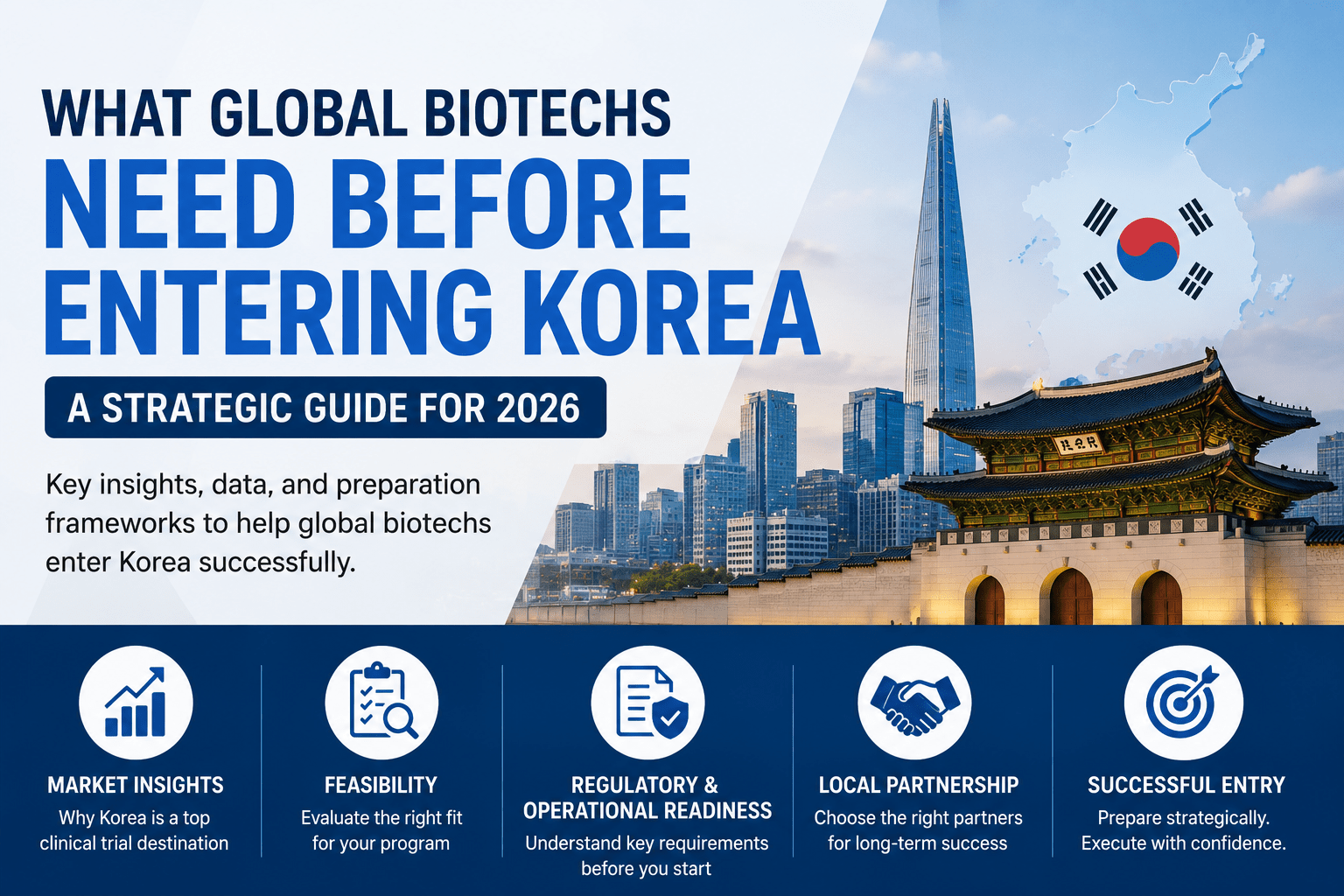
Korea Is No Longer Just Another APAC Market
Over the past decade, South Korea has emerged as one of the most attractive destinations for clinical development in the Asia-Pacific region. Global biotechs increasingly view Korea not only as a valuable clinical trial market but also as a strategic component of broader global development programs.
Strong healthcare infrastructure, internationally recognized investigators, advanced medical centers, and a highly engaged patient population have contributed to Korea’s growing importance in global studies. In particular, oncology, rare disease, cell and gene therapy, and antibody-drug conjugate (ADC) programs have seen significant growth in Korea in recent years.
However, successful entry into Korea requires much more than simply obtaining regulatory approval. Companies that achieve the best outcomes are often those that invest time in understanding the local environment, evaluating feasibility, and building realistic operational strategies before launching their programs.
As competition for patients, investigators, and hospital resources continues to increase, preparation is becoming one of the most important factors influencing success in Korea.
Understanding Why Korea Has Become a Strategic Market
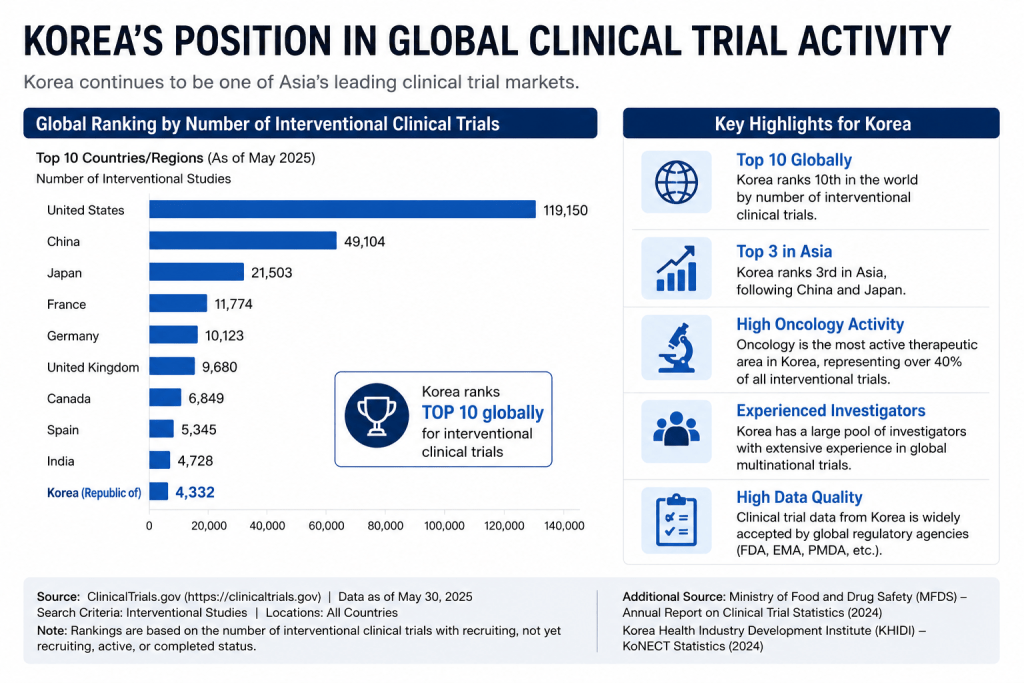
Many global biotechs are attracted to Korea because of its ability to support high-quality clinical research.
The country is home to some of Asia’s leading academic medical centers and cancer hospitals. Investigators are experienced in participating in multinational studies, and Korean clinical data is widely accepted by major regulatory agencies, including the FDA and EMA.
Korea also offers strong capabilities in precision medicine, biomarker-driven studies, and advanced therapeutic areas. This has made the country particularly attractive for innovative biotechnology companies developing next-generation therapies.
For many sponsors, Korea is no longer viewed simply as an additional country within a global study. Instead, it is increasingly becoming a strategic market capable of accelerating development timelines and generating valuable clinical data.
Understanding these advantages is often the first step in determining whether Korea should be included in a global development strategy.
Evaluating Whether Korea Fits Your Development Strategy
Although Korea offers significant advantages, it is not necessarily the right choice for every program.
Before entering the market, biotechs should carefully evaluate whether Korea aligns with their development objectives. Factors such as disease prevalence, patient availability, competing studies, treatment standards, and site capacity can all influence trial feasibility.
A program that performs well in one region may face different challenges in Korea due to local treatment patterns or competitive enrollment environments.
Similarly, some studies may benefit significantly from Korea’s strong hospital network and experienced investigators, while others may not achieve the same advantages.
Rather than assuming Korea should automatically be included in every development program, sponsors should assess how the market supports their specific clinical and commercial objectives.
A strategic decision made early can help avoid costly delays later in the development process.
Building a Realistic Korea Feasibility Plan
One of the most common mistakes made by emerging biotechs is underestimating the importance of feasibility assessment.
A strong feasibility plan involves much more than identifying hospitals that have experience in a particular therapeutic area.
Sponsors should evaluate investigator interest, competing clinical trials, patient availability, protocol complexity, startup expectations, and operational requirements.
For example, a site may have strong scientific expertise but limited enrollment capacity due to participation in competing studies. Similarly, a protocol that appears feasible on paper may present practical challenges once hospital workflows and patient populations are evaluated.
The goal of feasibility assessment is not simply to determine whether a study can be conducted in Korea. It is to determine whether the study can be conducted successfully, efficiently, and within expected timelines.
Companies that invest in detailed feasibility planning often gain a significant advantage during startup and enrollment phases.
Preparing for Regulatory and Operational Requirements
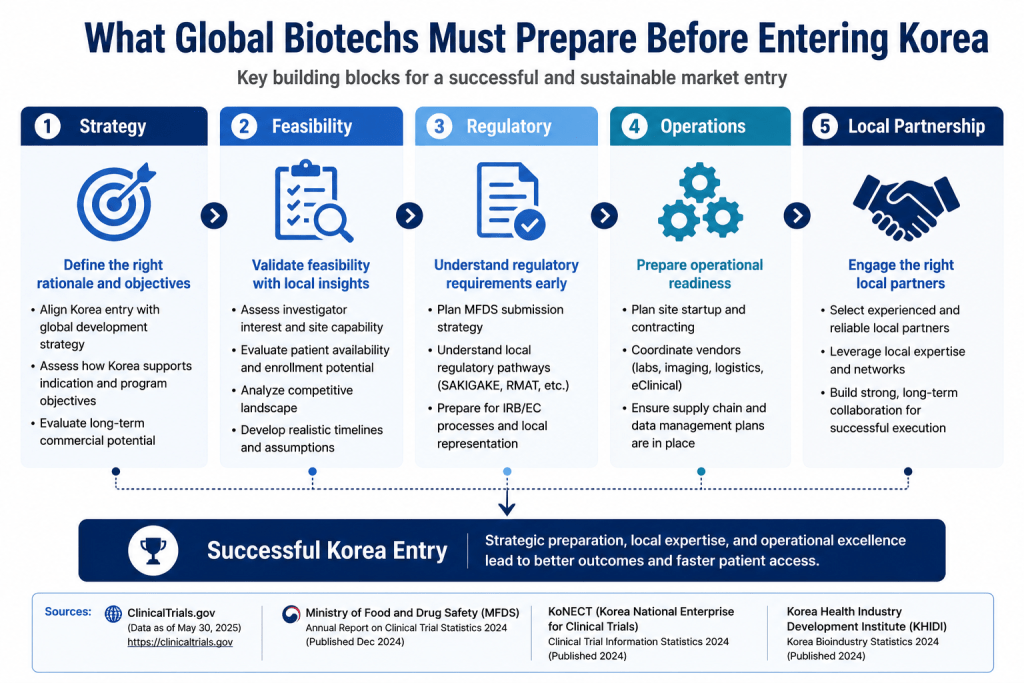
Many first-time sponsors focus heavily on regulatory approval requirements while overlooking operational preparation.
Although MFDS submissions are an important component of study startup, they represent only one part of a much larger process.
Successful execution also requires preparation for local representation requirements, ethics committee reviews, site contract negotiations, vendor coordination, drug supply planning, and startup management.
These operational activities often have as much impact on project timelines as regulatory review itself.
Sponsors entering Korea for the first time frequently discover that operational readiness can become a major differentiator between smooth execution and unexpected delays.
Understanding these requirements early allows companies to develop more realistic timelines and reduce startup risks.
Selecting the Right Local Partners
Choosing the right local partners is one of the most important decisions a biotech can make when entering Korea.
Local expertise can help sponsors navigate regulatory requirements, evaluate site capabilities, coordinate operational activities, and address challenges that arise during study execution.
However, partner selection should not be based solely on cost.
Sponsors should evaluate experience, therapeutic expertise, communication quality, responsiveness, operational capabilities, and local network strength.
The right partner can provide valuable insights during feasibility planning, startup preparation, patient recruitment, and ongoing study management.
As studies become increasingly complex, strong local partnerships often become a significant competitive advantage.
For many emerging biotechs, selecting the right local support structure can have a direct impact on development timelines and project outcomes.
Common Mistakes Global Biotechs Make When Entering Korea
Several challenges repeatedly appear among companies entering Korea for the first time.
One common mistake is assuming that Korea operates similarly to other APAC countries. While there may be similarities, each market has unique regulatory, operational, and healthcare characteristics that require local understanding.
Another frequent mistake is underestimating startup timelines. Sponsors often focus on regulatory review while overlooking contract negotiations, operational setup, and site activation requirements.
Some companies also conduct only limited feasibility assessments, relying on assumptions rather than detailed local analysis.
Others focus heavily on regulatory strategy while giving insufficient attention to operational execution.
Finally, many biotechs engage local partners too late in the planning process, reducing opportunities to identify risks and optimize study design before startup activities begin.
Avoiding these common pitfalls can significantly improve the likelihood of a successful market entry.
Korea Rewards Preparation, Not Assumptions
Korea continues to strengthen its position as one of the most important clinical development markets in Asia.
The country offers outstanding research infrastructure, experienced investigators, advanced hospitals, and strong clinical research capabilities. However, success in Korea is rarely achieved through speed alone.
The most successful sponsors are often those that invest in careful planning before entering the market.
Strategic evaluation, detailed feasibility assessment, operational preparation, and strong local partnerships all contribute to successful execution.
For global biotechs considering Korea in 2026, preparation may be the single most important factor determining long-term success.
Planning a Clinical Trial in Korea?
Entering Korea successfully requires more than regulatory preparation. Strategic planning, feasibility assessment, startup readiness, and local operational expertise can significantly influence study outcomes.
If you are evaluating Korea as part of your global development strategy, our team would be happy to discuss your study requirements and clinical development goals.
Book a Free Korea Trial Consultation
Discuss your study feasibility, startup strategy, site selection, and operational planning with our Korea clinical trial team.
Frequently Asked Questions (FAQ)
Q1. When should a biotech begin planning for Korea?
Ideally, planning should begin during protocol development or global study design. Early assessment allows sponsors to evaluate feasibility, identify risks, and incorporate Korea into their development strategy more effectively.
Q2. Is Korea suitable for early-phase clinical trials?
Yes. Korea has strong capabilities in Phase I and Phase II research, particularly in oncology, rare disease, cell and gene therapy, and innovative biologics.
Q3. How important is local feasibility assessment?
Local feasibility assessment is critical. It helps sponsors understand patient availability, investigator interest, competing studies, operational challenges, and enrollment potential before study startup.
Q4. What are the biggest startup challenges in Korea?
Common challenges include site contract negotiations, operational coordination, ethics committee timelines, vendor management, and realistic enrollment planning.
Q5. Should global biotechs work with a local CRO?
Many sponsors benefit from working with experienced local CRO partners who understand the regulatory environment, hospital network, operational requirements, and clinical trial landscape in Korea.