

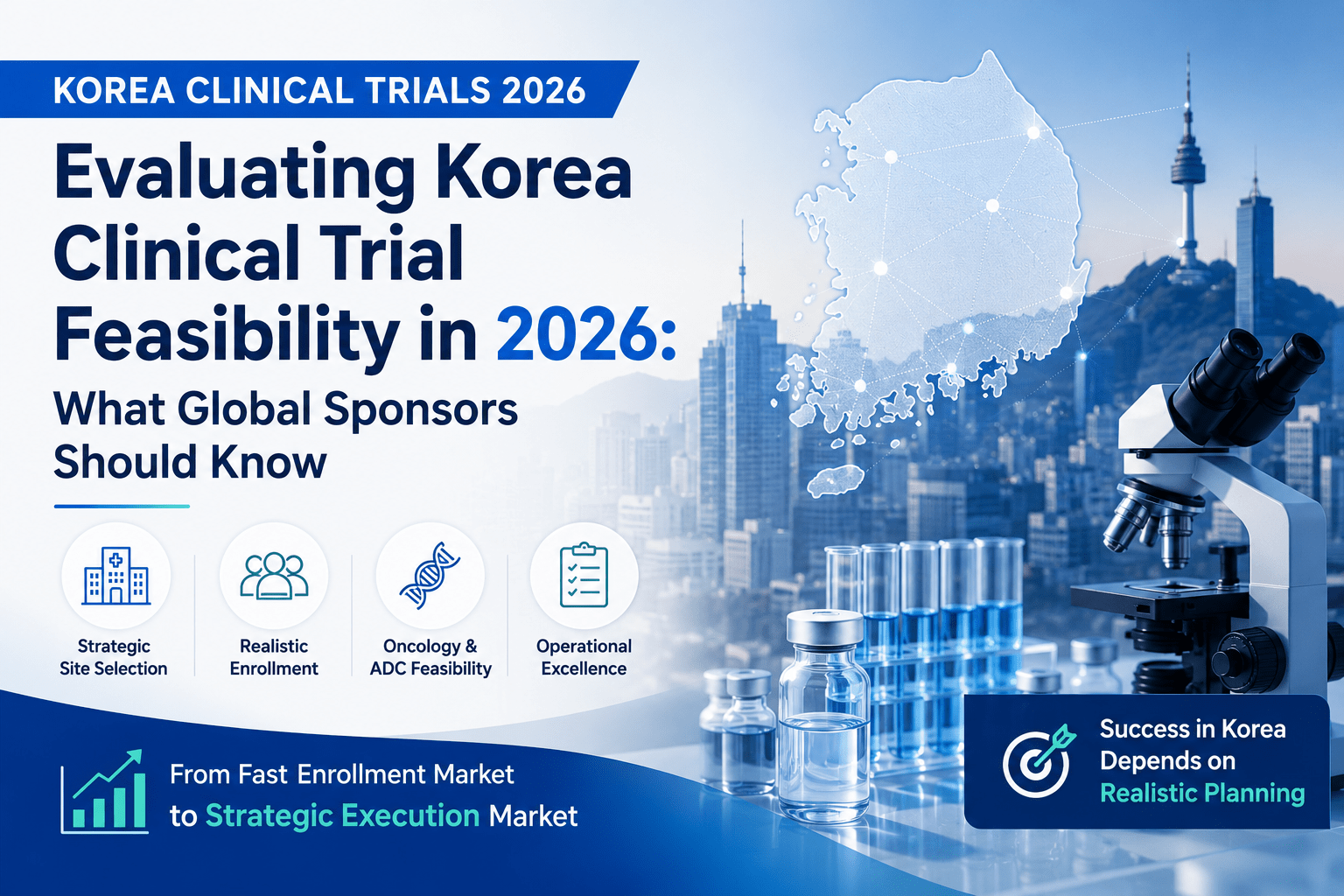
Over the past few years, South Korea has evolved into one of the most important global clinical trial markets in Asia. Particularly in oncology, antibody-drug conjugates (ADC), cell and gene therapy (CGT), immuno-oncology, and rare disease development, an increasing number of global pharmaceutical companies and biotech firms are incorporating Korea into their clinical development strategies.
Korea continues to offer several major advantages for global sponsors, including highly experienced investigators, advanced tertiary hospitals, strong digital healthcare infrastructure, concentrated patient populations, and high-quality clinical data. These strengths have positioned Korea as a highly attractive destination for multinational clinical trials.
At the same time, however, the Korean clinical trial landscape is becoming increasingly sophisticated and competitive.
As more global studies enter Korea, sponsors are beginning to realize that successful execution depends not only on regulatory approval, but also on how realistically feasibility planning is approached from the beginning.
Today, Korea feasibility assessment is no longer simply about whether a study can be conducted in Korea. It is increasingly about how strategically and operationally a study can be executed within a highly active and competitive research environment.
Why Korea Feasibility Planning Has Become More Important in 2026
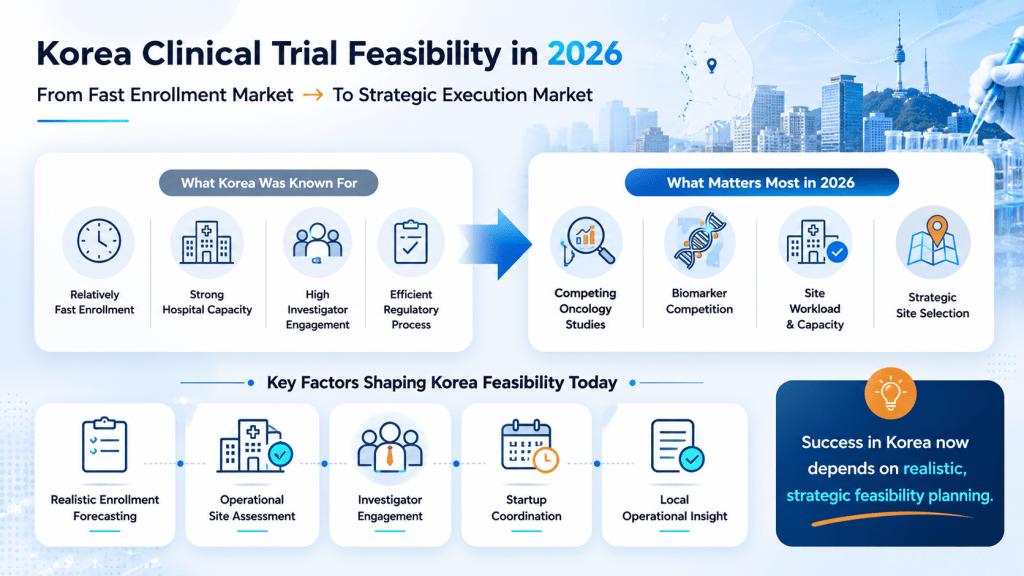
Historically, Korea was widely recognized for relatively fast enrollment speed and strong investigator engagement. Many global sponsors viewed Korea as a market where opening sites would naturally lead to rapid patient recruitment.
However, the environment has changed significantly over the past several years.
Global oncology studies have increased rapidly across Korea’s major hospitals. ADC pipelines continue to expand, biomarker-driven trials are becoming more competitive, and hospitals are simultaneously managing a growing number of multinational protocols.
As a result, the operational environment inside Korean hospitals has become far more complex than many overseas sponsors initially expect.
Today, opening additional sites does not automatically guarantee faster enrollment. Instead, realistic feasibility planning, strategic site selection, and operational alignment are becoming increasingly important to overall study success.
Korea remains an exceptionally strong clinical trial market, but the market is also becoming more mature and operationally competitive.
Korea Feasibility Is No Longer Just About Patient Numbers
One of the most common misconceptions in Korea feasibility assessment is assuming that theoretical patient population directly translates into realistic enrollment potential.
Many global sponsors initially evaluate feasibility based on disease prevalence, hospital size, epidemiology data, or historical enrollment assumptions.
While these factors remain important, they do not fully reflect the operational reality of patient recruitment in Korea today.
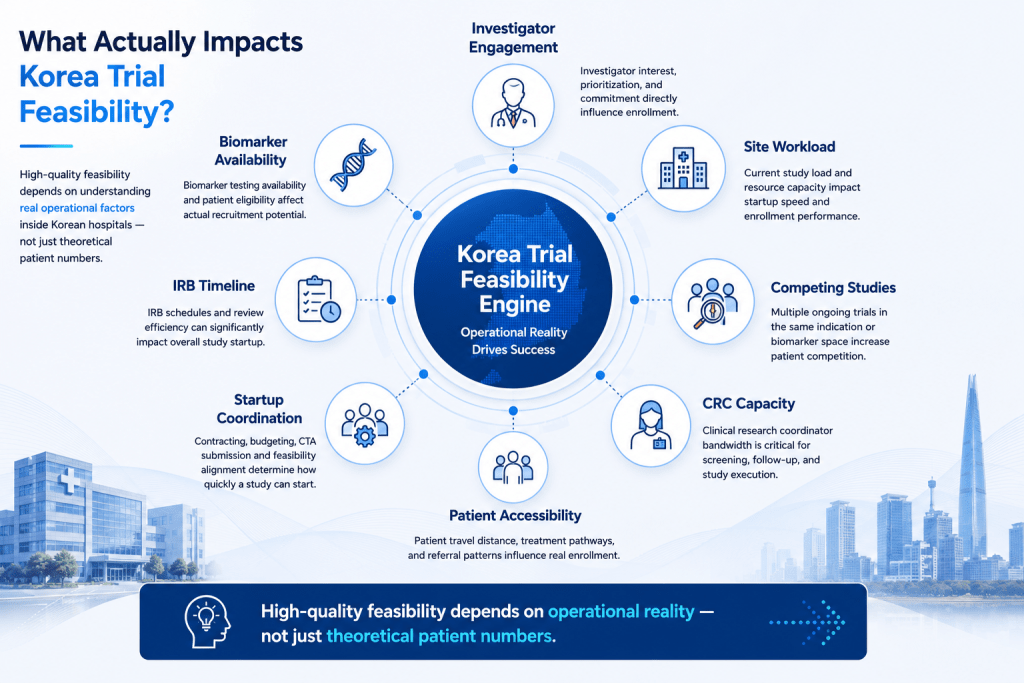
In practice, actual enrollment potential is influenced by many additional factors, including competing studies, biomarker requirements, inclusion and exclusion criteria, prior treatment exposure, investigator engagement, site workload, and realistic patient accessibility.
Particularly in oncology and ADC studies, multiple global protocols are often competing for highly overlapping patient populations within the same hospitals.
As Korea’s clinical trial ecosystem becomes more specialized, realistic enrollment forecasting is becoming increasingly important for global sponsors planning Korean studies.
Why Strategic Site Selection Matters More Than Ever
In the past, many sponsors approached Korea with a simple assumption that opening more sites would naturally lead to faster enrollment.
However, Korea’s clinical trial environment has evolved considerably.
Large tertiary hospitals are now simultaneously managing numerous global oncology, immunotherapy, ADC, and rare disease trials. Investigators and clinical research coordinators often face increasing operational workload, while patient competition between protocols continues to intensify.
As a result, site quality is becoming far more important than site quantity.
Today, successful site selection depends not only on hospital reputation, but also on investigator interest, current study workload, operational capability, realistic patient access, and protocol prioritization within the site.
This is one reason why some highly recognized hospitals may not always deliver the fastest enrollment for every study.
Korea site selection is increasingly becoming a strategic operational decision rather than a purely reputation-driven decision.
Korea Oncology and ADC Feasibility Is Becoming More Specialized
Korea has rapidly emerged as one of Asia’s leading oncology and ADC clinical trial markets.
A growing number of studies targeting HER2, EGFR, TROP2, Claudin18.2, and other biomarkers are simultaneously being conducted across Korean hospitals.
This rapid growth is creating a much more competitive feasibility environment, particularly for biomarker-driven oncology studies.
Today, sponsors must evaluate not only whether hospitals have eligible patients, but also how many competing protocols are already targeting similar patients, whether investigators can realistically prioritize the study, how active the enrollment landscape currently is, and how much operational bandwidth sites still have available.
As oncology and ADC development continue to accelerate globally, Korea feasibility assessment is becoming increasingly specialized and strategically driven.
Why Local Operational Insight Is Becoming Increasingly Important
Many global sponsors continue to rely heavily on questionnaire-based feasibility assessment.
While questionnaires remain useful, they often cannot fully capture operational realities within Korean hospitals.
In practice, factors such as internal site workload, investigator prioritization, startup capability, operational bottlenecks, CRC availability, and competing internal studies may significantly influence study execution, even if they are not fully reflected in survey responses.
This is why local operational insight is becoming increasingly valuable in Korea feasibility planning.
High-quality feasibility assessment today is no longer based solely on theoretical data. It increasingly depends on understanding how Korean hospitals are actually operating within today’s highly active clinical trial environment.
Korea Clinical Trials Are Entering a More Strategic Execution Era
Korea remains one of the most strategically valuable clinical trial markets globally, particularly in oncology, ADC, CGT, immunotherapy, and rare disease development.
However, the Korean market is also becoming more mature, more competitive, and more operationally sophisticated.
As a result, successful clinical trial execution increasingly depends on realistic feasibility planning, strategic site selection, operational coordination, local execution capability, and realistic enrollment forecasting.
Korea is not becoming less attractive for global trials. Rather, the market is evolving into a more strategically driven clinical research environment.
For global sponsors, this means that realistic operational planning is becoming just as important as regulatory strategy itself.
Planning a Clinical Trial in Korea?
As Korea continues to strengthen its position in oncology, ADC, CGT, and innovative drug development, many global sponsors are reassessing how they approach Korea feasibility and startup strategy.
If you are evaluating Korea clinical trial feasibility, site strategy, enrollment planning, or operational execution environment, the NexBridge Bio team can help support your planning process.
We support global sponsors with Korea feasibility assessment, strategic site selection, operational planning, realistic enrollment evaluation, and oncology / ADC trial execution strategy.
👉 Contact us to discuss your Korea clinical trial strategy.
Frequently Asked Questions (FAQ)
Q1: Is Korea still considered a strong market for global clinical trials in 2026?
A: Yes. Korea remains one of the most important clinical trial markets in Asia, particularly in oncology, ADC, CGT, immunotherapy, and rare disease development. Korean hospitals continue to offer experienced investigators, high-quality clinical data, strong digital infrastructure, and globally recognized research capabilities.
Q2: Why can Korea enrollment forecasts sometimes differ from initial expectations?
A: In many cases, theoretical patient population does not fully reflect actual enrollment reality. Competing studies, biomarker overlap, inclusion and exclusion criteria, investigator workload, and current site activity can all influence recruitment speed. This is why realistic operational assessment has become increasingly important during Korea feasibility planning.
Q3: Does selecting a top Korean hospital automatically guarantee faster enrollment?
A: Not necessarily. Large tertiary hospitals in Korea are often involved in multiple global studies simultaneously, especially in oncology and ADC programs. While these hospitals have strong research capabilities, enrollment speed may also depend on investigator engagement, current study workload, competing protocols, and operational capacity.
Q4: Why is local operational insight important during Korea feasibility assessment?
A: Questionnaire-based feasibility alone may not fully reflect real operational conditions inside Korean hospitals. Operational factors such as startup workload, CRC availability, internal study competition, IRB scheduling, and investigator prioritization can significantly influence study timelines and enrollment performance.
Q5: What should global sponsors evaluate first when planning a Korea clinical trial?
A: Sponsors should evaluate not only regulatory strategy, but also realistic enrollment potential, competing study landscape, site operational capability, investigator engagement, startup coordination requirements, and operational execution risks. As the Korean clinical trial market continues to mature, successful studies increasingly depend on realistic planning and strategic operational execution from the early stages.