

Introduction
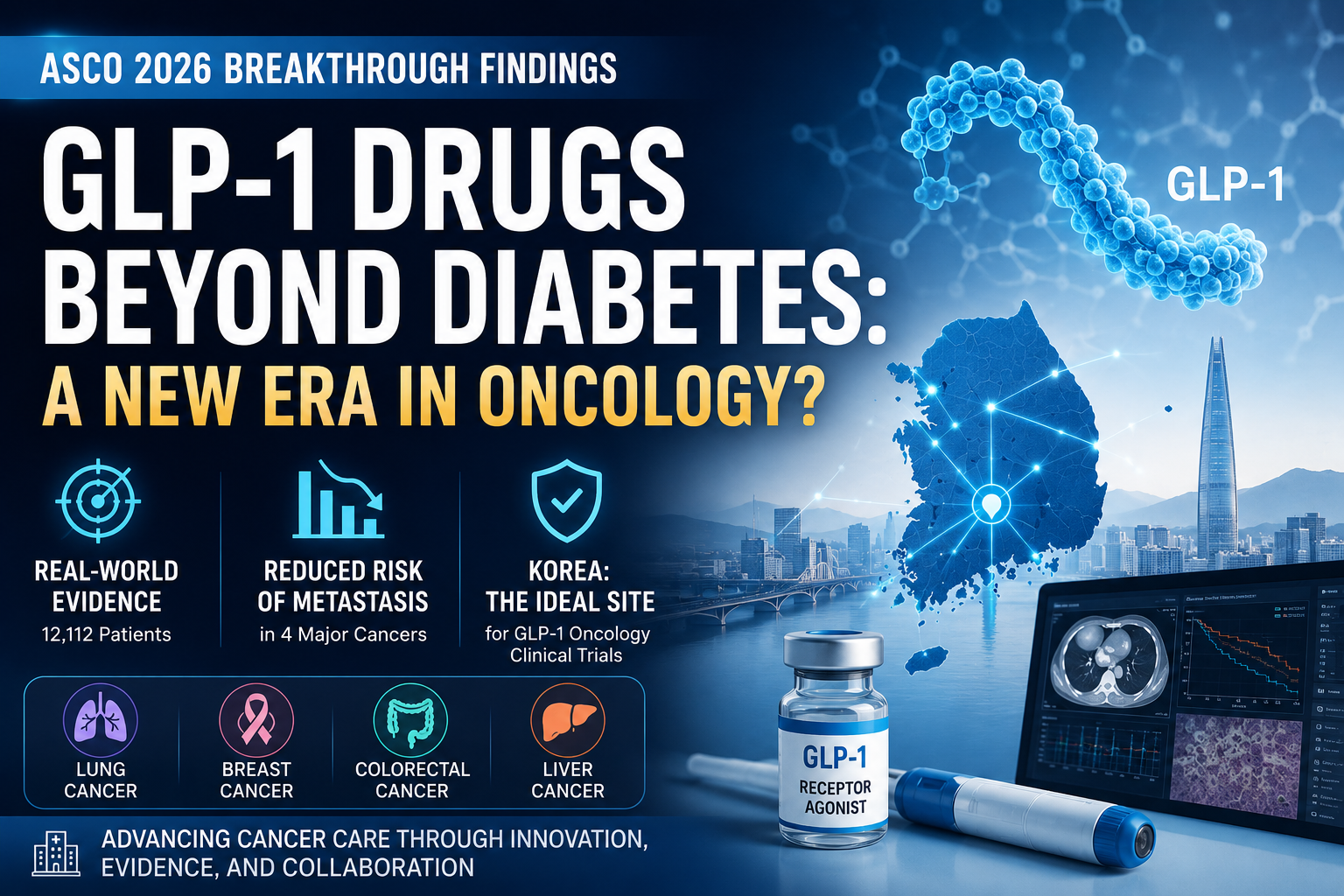
For most of its clinical history, the GLP-1 receptor agonist class existed firmly within the domain of metabolic medicine. These drugs were developed to regulate blood glucose and, more recently, to drive substantial weight reduction in patients with obesity. Oncology was not the intended destination. That assumption changed at the 2026 American Society of Clinical Oncology Annual Meeting, where a cluster of real-world studies placed GLP-1 receptor agonists at the center of a conversation that most clinical trial sponsors had not expected to have: whether a drug approved for metabolic conditions could meaningfully slow the progression of some of the most common cancers in the world.
The headline finding came from a propensity-matched analysis of more than 12,000 patients drawn from the TriNetX Global Health Research Network, comparing outcomes for patients taking GLP-1 receptor agonists against those taking DPP-4 inhibitors across seven obesity-related cancer types. For four of those cancers — non-small cell lung cancer, breast adenocarcinoma, colorectal adenocarcinoma, and hepatocellular carcinoma — the reduction in metastatic progression was statistically significant and, by any clinical measure, substantial. In non-small cell lung cancer, for instance, the rate of progression to stage IV disease was roughly half as frequent among GLP-1-exposed patients. The pattern held consistently across the other three cancer types, with hazard ratios ranging from 0.57 to 0.69.
These numbers come with an important caveat that the researchers themselves were careful to state: this is observational data, not a randomized controlled trial. Causation cannot be inferred from these results alone. But the consistency of the signal across different tumor types, combined with a secondary analysis showing that cancers with higher GLP-1 receptor expression were associated with meaningfully lower mortality risk, has given oncology researchers and drug developers a defensible scientific rationale to pursue prospective trials. As one of the expert commentators at the meeting noted, the consistency of the findings warrants a randomized trial. The question for sponsors now is not whether that investigation is scientifically justified — it clearly is — but where, and how, to run it.
Korea’s existing oncology infrastructure and patient population position the country well to absorb what may become a significant wave of novel-mechanism oncology trials. Understanding why requires looking at both the biology suggested by the ASCO 2026 data and the structural realities of running this type of trial in the Korean healthcare system.
What the ASCO 2026 Data Actually Signals for Trial Design
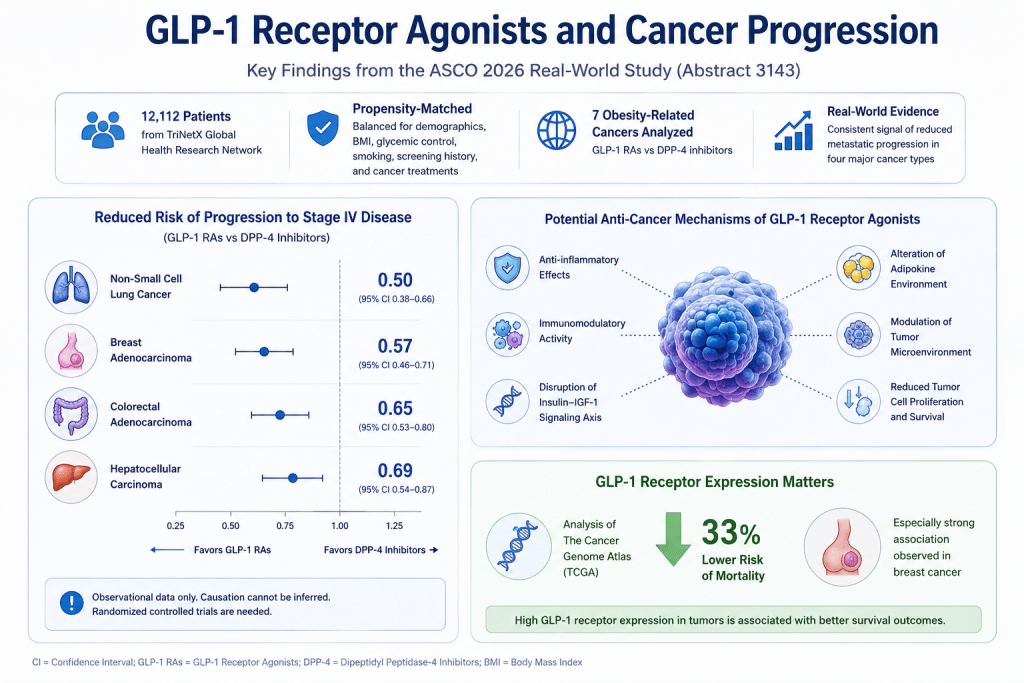
The study presented at ASCO 2026 (Abstract 3143) was designed with methodological care unusual for a real-world retrospective analysis. The investigators used propensity matching to align patients across the two treatment groups on a broad range of variables, including demographics, body mass index, glycemic control, smoking status, cancer screening history, and oncologic treatment regimens. This matching approach substantially reduces — though cannot eliminate — the most obvious confounding pathways. The resulting dataset of 12,112 patients offers a level of analytical rigor that distinguishes this work from simple observational correlation.
The four cancer types showing statistically significant results are not arbitrary. Non-small cell lung cancer, breast adenocarcinoma, colorectal adenocarcinoma, and hepatocellular carcinoma all carry documented epidemiological links to obesity, metabolic dysfunction, and chronic systemic inflammation — the same pathways that GLP-1 receptor agonism is understood to modulate. The biological mechanisms under investigation include anti-inflammatory effects downstream of weight reduction, direct immunomodulatory activity at the tumor microenvironment level, disruption of the insulin-IGF-1 proliferative signaling axis, and alterations to the adipokine environment that obesity-related cancers exploit for growth. None of these mechanisms is fully characterized, which is precisely why prospective trials are needed.
What makes the secondary genomic analysis particularly compelling is that it bypasses the prescription-confounding problem entirely. By examining The Cancer Genome Atlas data to identify tumors with high GLP-1 receptor expression, the researchers found a 33 percent lower risk of mortality in that patient subgroup, with breast cancer showing an especially strong association. This receptor-expression signal suggests that some component of the observed benefit may be direct rather than solely mediated through metabolic improvement — a mechanistic distinction that has significant implications for how future trials are designed. If the anti-tumor activity is partly receptor-mediated, then the next generation of trials will need to incorporate companion diagnostics or biomarker stratification to identify which patients are most likely to respond. Protocol designers are already beginning to think through what that selection process looks like.
The three cancer types that did not show statistically significant progression benefits — prostate adenocarcinoma, renal cell carcinoma, and pancreatic adenocarcinoma — also carry useful information. Pancreatic adenocarcinoma has a distinct metabolic biology, and GLP-1 receptor agonists carry existing regulatory labeling considerations in that context. The absence of a signal in renal cell carcinoma aligns with its less consistent obesity dependence. These non-findings help narrow the trial design space: the early-phase opportunity is most credible in the four cancer types where the ASCO data showed clear directionality.
Why Korea Is a Credible Site for This Category of Trial
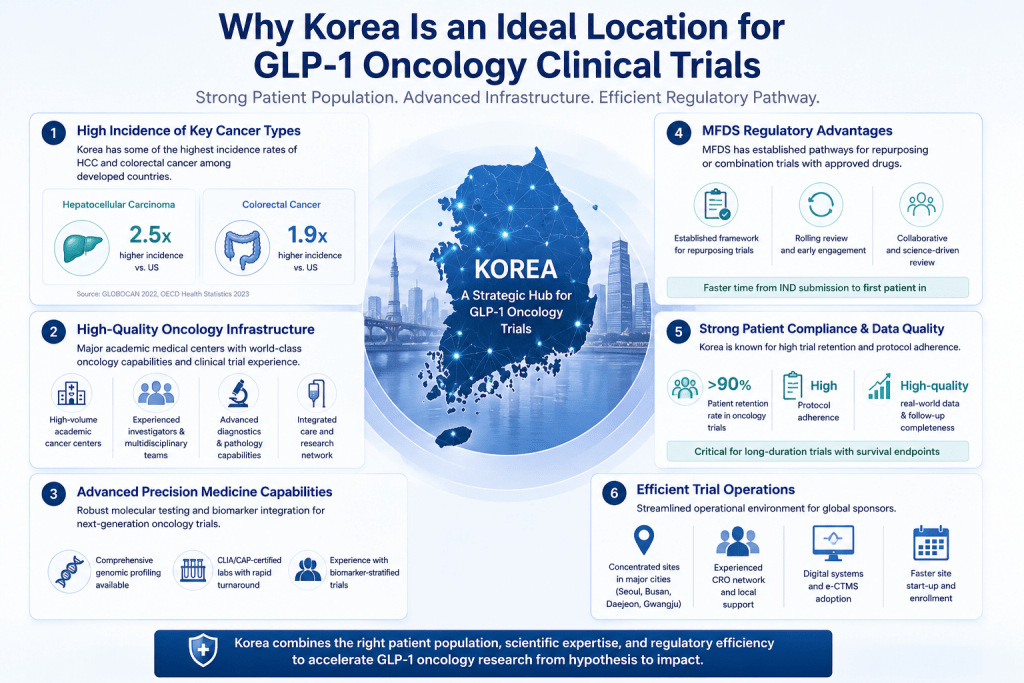
The clinical logic of running GLP-1 oncology trials in Korea begins with patient epidemiology. Korea has among the highest incidence rates of hepatocellular carcinoma and colorectal cancer in the developed world, driven by a combination of historical hepatitis B prevalence, dietary patterns, and metabolic risk factors that overlap substantially with the population studied at ASCO 2026. Gastric cancer rates are also exceptionally high, and while gastric cancer was not part of the ASCO dataset, the oncology site infrastructure that serves it is directly relevant to the four cancer types that were. The patient populations are large, clinically well-characterized, and recruited through a hospital system where most serious oncology care is concentrated in high-volume academic medical centers — the same institutions that serve as clinical trial sites.
The MFDS has developed regulatory pathways that can accommodate the specific complexity of a repurposing or combination trial involving an already-approved class of drug. IND submissions for trials investigating approved molecules in novel indications are reviewed under established frameworks, and the agency’s rolling-review mechanism allows sponsors to engage with regulators during the submission process rather than waiting for a single complete-review cycle. For early-phase oncology trials — which are precisely the trials the ASCO 2026 data now justifies — this kind of iterative regulatory engagement meaningfully compresses the time between protocol finalization and first patient enrolled.
Patient compliance and data quality are structural advantages that are easy to understate. Korea’s healthcare system produces clinical trial data with consistently low dropout rates and high protocol adherence, characteristics that matter especially for trials in the GLP-1 oncology space where the treatment duration is long and the endpoints — progression to metastatic stage, survival — require sustained follow-up. Observational data has already shown that GLP-1 receptor agonist benefit may accumulate over time. A trial that loses patients to follow-up at high rates will struggle to detect that signal. Korea’s track record of keeping patients in trials through completion is a direct operational asset for this trial type.
For sponsors considering a biomarker-stratified protocol — selecting patients based on tumor GLP-1 receptor expression — Korea’s oncology centers have established molecular pathology capabilities and experience with companion diagnostic integration. The infrastructure to run genomically-informed trials at scale, across multiple high-volume sites, is in place in a way that is not uniformly true across other regional markets in Asia.
What Sponsors Should Think Through Before Moving Forward
The ASCO 2026 data justifies scientific curiosity, not automatic trial initiation. Sponsors who are seriously evaluating a GLP-1 oncology program need to work through several protocol and operational questions before a Korea IND makes sense.
The first question is mechanistic hypothesis clarity. The ASCO dataset was observational and pooled patients across treatment regimens, tumor stages, and comorbidity profiles. A prospective trial needs a defined mechanistic hypothesis — whether the primary claim is anti-inflammatory, receptor-mediated cytostatic, immune-enhancing, or metabolic — because that hypothesis determines endpoint selection, patient eligibility criteria, and what biomarkers need to be collected at baseline. Sponsors who enter IND preparation without this clarity tend to produce protocols that are too broad to generate actionable data and too complex to recruit efficiently.
The second question is patient eligibility architecture. The ASCO analysis required patients to have both an obesity-related cancer diagnosis and exposure to a GLP-1 receptor agonist, which in real-world practice means patients who were diagnosed with cancer while already taking these drugs. In a prospective trial, the eligibility design is more deliberate: sponsors need to determine whether they are studying GLP-1 agonism as a concurrent treatment alongside standard-of-care oncology therapy, as a maintenance therapy following first-line treatment, or as a standalone intervention in a defined patient subset. Each of these designs has different site selection implications, different competitive enrollment environments, and different conversations to have with MFDS.
Third, sponsors should consider the regulatory labeling context for the GLP-1 molecules they intend to study. Semaglutide, tirzepatide, and the candidates moving through late-stage development each carry different approved indications, label restrictions, and manufacturing considerations that affect how a combination oncology protocol is reviewed. Working with a CRO that has navigated MFDS review of repurposing-class oncology submissions is materially different from relying on experience with conventional novel-drug oncology filings.
Finally, the competitive landscape for this trial category is still early but not empty. The ASCO 2026 data was public and widely covered across oncology and endocrinology circles. Sponsors who begin feasibility assessment now — site qualification, regulatory pre-submission engagement, protocol development — will be in a meaningfully stronger position than those who wait for the field to congeal around a consensus design before acting.
Conclusion
The ASCO 2026 GLP-1 data represents one of the more unexpected pivots in recent clinical oncology. A drug class developed for metabolic disease is now generating credible, peer-reviewed evidence that it may slow the progression of some of the most common solid tumors in the world. The scientific community’s response to that evidence — a call for prospective randomized trials — is both appropriate and imminent. For sponsors in a position to act before that wave arrives, Korea offers a combination of patient population depth, regulatory accessibility, and operational infrastructure that is directly suited to this specific trial category.
The question is not whether GLP-1 oncology trials will happen. They will. The more useful question is where they will run, and whether the sponsors who run them have thought carefully enough about protocol design to generate the kind of data that actually resolves the biological question the ASCO study raised.
Planning an Oncology Clinical Trial in Korea?
NexBridge Bio works with global sponsors to assess site feasibility, navigate MFDS regulatory pathways, and manage trial operations across Korea’s major oncology centers. If you are evaluating a GLP-1 or metabolic-oncology program, we can help you assess whether Korea belongs in your trial strategy.
FAQ
1. Does the ASCO 2026 data prove that GLP-1 drugs treat cancer?
No. The primary dataset presented at ASCO 2026 was a retrospective, observational analysis, which means it can identify associations but cannot establish that GLP-1 receptor agonists directly caused the reduction in cancer progression observed. The study’s lead author and expert commentators explicitly noted that randomized controlled trials are required before any causal conclusion can be drawn. The data provides scientific justification to pursue those trials, not a clinical claim about existing treatment.
2. Which cancer types showed the strongest signal in the ASCO 2026 analysis?
Four of the seven cancer types studied showed statistically significant reductions in metastatic progression among patients taking GLP-1 receptor agonists: non-small cell lung cancer, breast adenocarcinoma, colorectal adenocarcinoma, and hepatocellular carcinoma. Prostate adenocarcinoma, renal cell carcinoma, and pancreatic adenocarcinoma did not reach statistical significance, though directional trends were present in some of those groups as well.
3. Why is Korea a relevant site for GLP-1 oncology trials specifically?
Korea has high incidence rates of hepatocellular carcinoma and colorectal cancer — two of the four tumor types showing significant GLP-1 benefit signals at ASCO 2026 — which creates a large and well-characterized patient pool for enrollment. Korea’s oncology trial infrastructure, including molecular pathology capabilities for biomarker-based patient selection, also aligns well with the design requirements that GLP-1 oncology trials are likely to need as they move into early-phase prospective study.
4. How does MFDS handle IND submissions for trials using already-approved drugs in novel indications?
MFDS has established review processes for repurposing-type submissions, where a drug approved in one indication is being investigated in a new therapeutic context. The review pathway and documentation requirements differ from a standard novel chemical entity submission. Sponsors benefit from early regulatory engagement — ideally before final protocol lock — to align on what the agency will need to evaluate the scientific rationale and patient safety plan for the new indication.
5. What should a sponsor do first if they are considering a GLP-1 oncology trial in Korea?
The most productive first step is developing a clear mechanistic hypothesis that the trial is designed to test, and then assessing whether the patient population required to test it is realistically available in Korea. Site feasibility, regulatory pre-submission engagement, and CRO scoping can all follow from a well-defined protocol concept. Sponsors who begin with operational questions before the scientific premise is settled tend to encounter the most delays once the trial is underway.