

Introduction
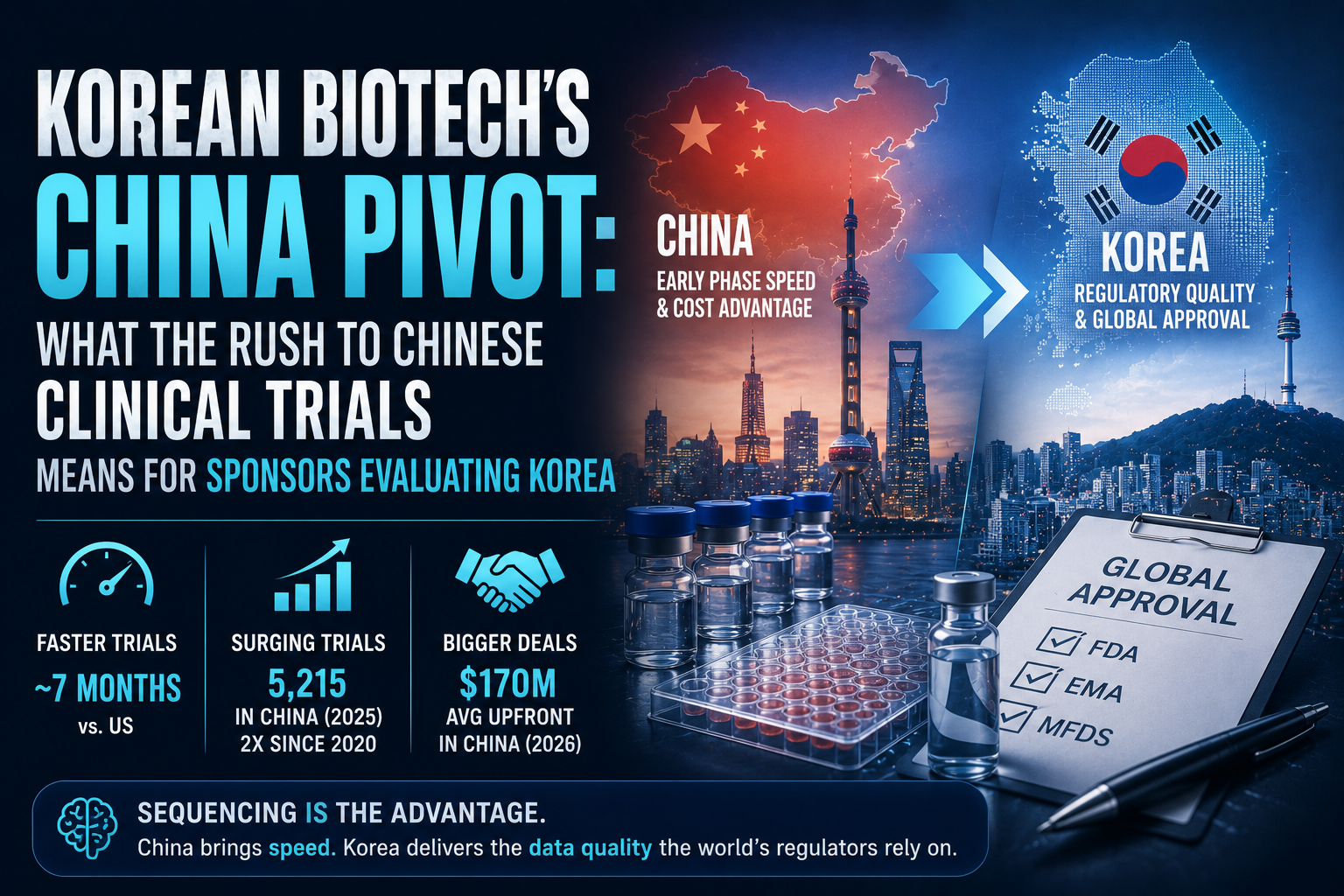
Korean biotech companies are increasingly running their earliest clinical trials in China rather than at home, using the resulting patient data to strike global licensing deals faster than Korea’s own trial infrastructure allows. The strategy is straightforward: Phase 1 trials in China take roughly seven months less than in the United States and cost 30–50% less, and China’s new drug clinical trial registrations reached 5,215 in 2025, more than double the 2,602 recorded in 2020. For sponsors and Korean biotechs alike, the practical question is no longer whether China can generate clinical data faster — it clearly can — but whether that data, and the deals built on it, hold up once a program reaches the confirmatory trials and multi-region filings that global regulators actually require.
This shift is reshaping how Korean biotech negotiates with global pharma. Korean technology transfer contracts fell from 8 in the first half of 2025 to 5 in the first half of 2026, even as the share of licensed assets already in Phase 2 or later trials jumped from 37.5% to 80% — meaning fewer deals, but each one now demands more mature clinical evidence to close. Companies like Y-Biologics and LG Chem, the latter partnered with OTR Therapeutics on a model where China handles early trials while Korea manages global late-stage development, are treating China less as a competitor and more as a data-generation engine feeding a Korea- and US/EU-anchored development plan.
Book a Free Korea Trial Consultation →
Want the full picture behind these findings? Download our 2026 Clinical Trials CRO Selection Survey Report for the complete data, red flags, and strategic recommendations.
Download the Report →
Why Are Korean Biotechs Moving Early-Phase Trials to China?
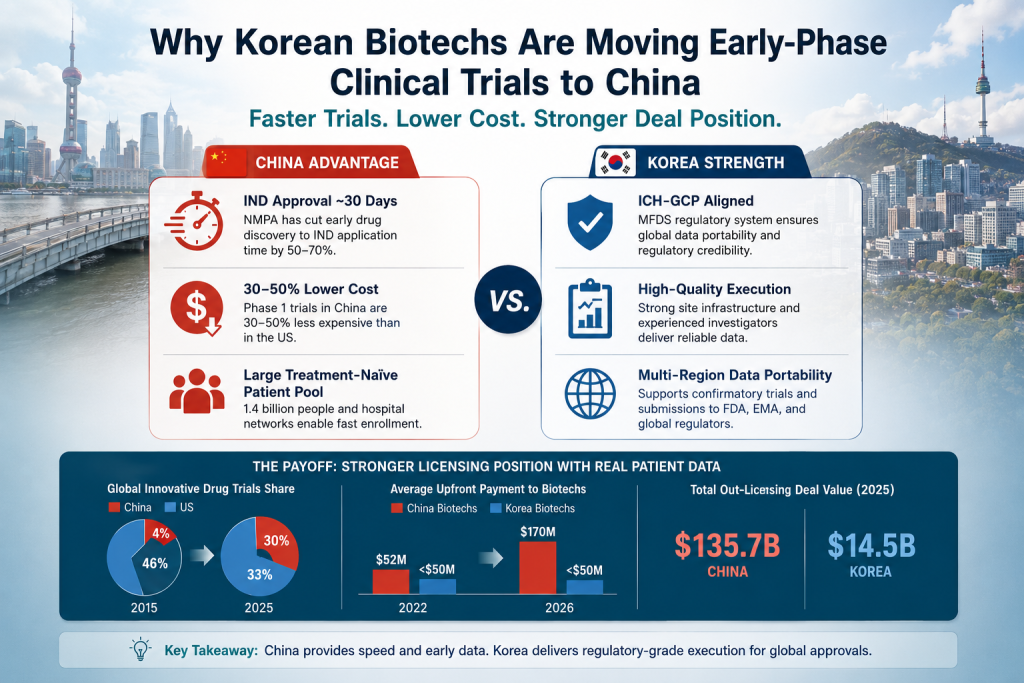
Korean biotechs are moving Phase 1 trials to China primarily because China now combines faster enrollment, lower cost, and a regulatory system built to move investigational drugs into human testing quickly. China’s National Medical Products Administration (NMPA), the country’s drug regulator, has cut the time from early drug discovery to IND application — the regulatory filing required before a company can begin human trials — by 50–70%, and now grants IND approval within roughly 30 days in many cases. Combined with a treatment-naive patient population large enough to fill trial sites quickly, this has pulled China’s share of global innovative drug trials from 4% in 2015 to 30% in 2025, while the United States’ share fell from 46% to 33% over the same period.
For Korean biotechs, the payoff shows up directly in licensing economics. Global pharmaceutical companies increasingly treat real human patient data, not preclinical results alone, as the deciding factor in technology licensing decisions — which means whoever generates that data first has the stronger negotiating position. The gap this creates is stark: Chinese biotechs received average upfront payments of $170 million in 2026, nearly triple the $52 million average in 2022, while Korean upfront payments have stayed under $50 million across the first half of 2026. In one widely cited case, Eli Lilly paid Korea’s ABL Bio $40 million for a bispecific antibody platform while paying China’s Innovent Biologics $350 million for a comparable multi-year collaboration — a ninefold difference for structurally similar technology. Total out-licensing deal value tells the same story at scale: China’s out-licensing deals reached $135.7 billion in 2025, against Korea’s $14.5 billion, even though Korea continues to rank third globally by number of drug candidates in development.
What Are the Risks of Relying on China-Only Clinical Data?
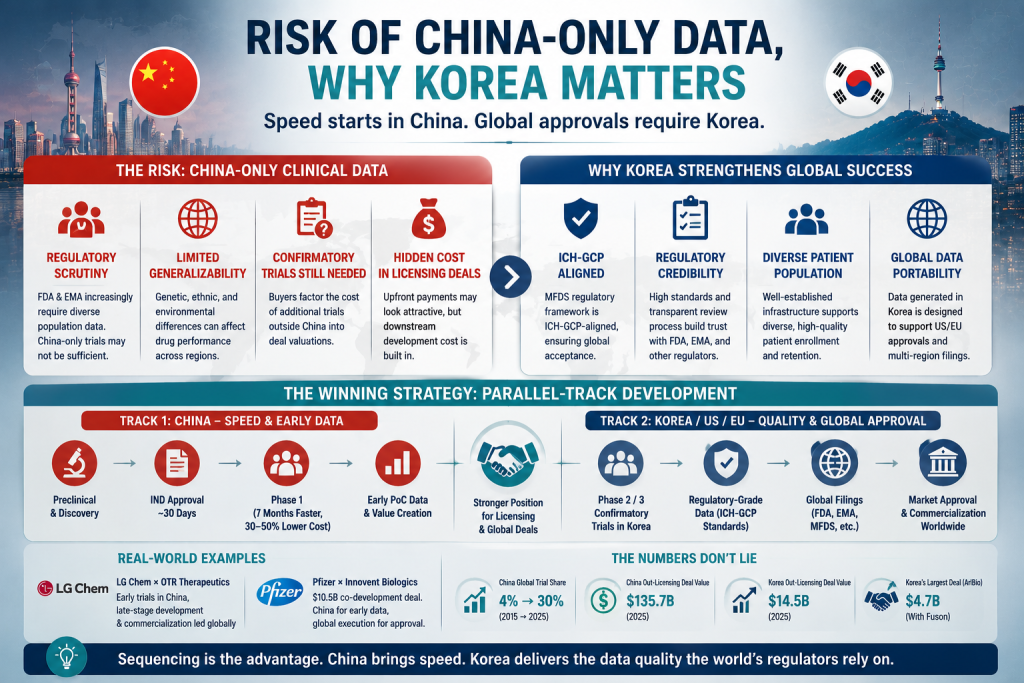
The risk in a China-first strategy is that clinical data generated exclusively in one country doesn’t automatically satisfy the regulators who ultimately decide whether a drug reaches the US, EU, or other major markets. Global regulators, including the FDA and European Medicines Agency (EMA), have grown more attentive to whether single-country trial populations — particularly from a market with a genetically and environmentally distinct patient base — adequately represent the populations a drug will eventually be marketed to. This is not a rejection of Chinese data on principle; it is a structural requirement that confirmatory and registrational trials demonstrate consistency across regions, which a China-only development plan cannot do on its own.
For oncology, immunology, and other indications where regulators specifically weigh how a drug performs across genetically diverse populations, this scrutiny is not a hypothetical concern — it is the reason global pharma buyers structure licensing deals as staged collaborations rather than one-time data purchases. A buyer acquiring China-originated early data is typically also acquiring the obligation to run additional confirmatory trials elsewhere before that data translates into an approval in the US or EU. That downstream cost is priced into the deal even when it is not visible in the upfront payment, which is why sponsors evaluating a China-first strategy need to model the full development pathway rather than the speed of the first data readout alone.
This is precisely why the Korean companies moving fastest on the China strategy are not abandoning multi-region development — they are sequencing it. LG Chem’s arrangement with OTR Therapeutics keeps early trials in China but retains global late-stage development and commercialization within its own control, and Pfizer’s $10.5 billion co-development deal with China’s Innovent follows a similar structure: China generates speed and early proof-of-concept, while a second, more heavily scrutinized execution track handles the trials that regulators in the largest markets will actually rely on. Korea Biotechnology Industry Organization leadership has explicitly warned that Korea risks falling behind on early-stage competitiveness despite its strong pipeline, and has called for success-contingent loans and private matching funds to keep early Korean trials viable rather than ceding that stage to China by default.
The deal-value gap reinforces why sequencing, not substitution, is the rational posture. Korea’s largest publicized licensing deal in the current cycle, AriBio’s agreement with Fuson, reached $4.7 billion — a substantial figure in isolation, but modest next to China’s BMS-Hengrui deal at $15.2 billion or AstraZeneca’s $18.5 billion agreement with CSPC. Those numbers reflect scale advantages China has built deliberately: a treatment-naive patient pool of roughly 1.4 billion people, hospital networks structured for rapid enrollment, and a regulatory system tuned specifically for early-phase throughput. Korea was never going to out-scale that, and trying to compete on China’s terms would mean competing on the one variable — enrollment volume — where the gap is structural rather than a matter of policy or investment.
How Should Sponsors Weigh Korea Against China for Clinical Trial Execution?
Sponsors should treat Korea and China as complementary rather than competing options, using China where raw trial speed and cost matter most and Korea where regulatory credibility and data quality matter most for the trials that support eventual global filings. Korea’s Ministry of Food and Drug Safety (MFDS) operates under an ICH-GCP-aligned regulatory framework — Good Clinical Practice standards set by the International Council for Harmonisation that are recognized across the US, EU, and other major regulatory jurisdictions — giving trial data generated in Korea a level of direct portability into global submissions that a China-only dataset does not automatically carry. For sponsors running oncology, immunology, or metabolic disease programs where regulators will eventually ask for evidence across diverse patient populations, Korea offers exactly the kind of methodologically rigorous, globally accepted execution environment that a speed-first China strategy is not designed to provide on its own.
The parallel-track model gaining traction among Korean biotechs — generating early data in China while running Korea- or US/EU-based trials on a second track — is a reasonable template for global sponsors evaluating the same tradeoff, not just domestic companies managing their own pipeline. Intoinworld, a Seoul-based contract research organization, supports global sponsors executing Phase 2 and Phase 3 clinical trials in Korea under MFDS’s ICH-GCP-aligned regulatory framework, precisely the stage where data quality and regulatory portability matter most. Sponsors that treat China purely as a shortcut, without a credible plan for the confirmatory trials that follow, risk discovering the tradeoff only after a licensing deal is signed and a regulator asks for data the China-only trial never generated.
Conclusion
The rush of Korean biotechs into Chinese clinical trials is a rational response to a real speed and cost gap, not a signal that Korea’s trial infrastructure has become obsolete. China’s advantages in Phase 1 speed and cost are well documented and unlikely to close soon, and Korean companies are right to use them where early proof-of-concept data is the goal. But the licensing economics that make China attractive — faster data, bigger upfront payments — depend on that data eventually supporting drugs that clear FDA and EMA review in markets China’s own trial infrastructure was not built to satisfy alone. That is the stage where Korea’s ICH-GCP alignment, MFDS regulatory credibility, and multi-region data portability become the deciding factor rather than a secondary consideration.
For global sponsors watching this shift from outside Korea, the lesson is less about choosing a single country and more about sequencing: China for early speed, Korea for the regulatory-grade execution that confirmatory trials and global filings require. Companies that build both into their development plan from the start will be better positioned than those that discover the gap only when a regulator asks a question China-only data cannot answer.
Is Korea Still Worth Considering for Clinical Trials Given China’s Speed Advantage?
Korea remains a strong option for the trial stages where regulatory rigor and data portability outweigh raw enrollment speed, particularly Phase 2 and Phase 3 confirmatory trials feeding US and EU filings. Sponsors weighing both markets should think in terms of sequencing rather than substitution — China for early proof-of-concept, Korea for the ICH-GCP-aligned execution that global regulators expect before approval.
Book a Free Korea Trial Consultation →
Want the full picture behind these findings? Download our 2026 Clinical Trials CRO Selection Survey Report for the complete data, red flags, and strategic recommendations.
Download the Report →
FAQ
Q1: Why are Korean biotechs running clinical trials in China instead of Korea?
Korean biotechs are moving early-phase trials to China because Chinese Phase 1 trials are roughly seven months faster and 30–50% cheaper than equivalent trials in the US, letting companies generate licensable patient data sooner and negotiate global deals from a stronger position.
Q2: Is clinical trial data generated in China accepted by the FDA and EMA?
China-generated data can support regulatory submissions, but the FDA and EMA increasingly expect confirmatory and registrational trials to include data from populations representative of the markets a drug will be sold in, which a single-country China trial does not fully provide on its own.
Q3: What is the difference between Korea’s and China’s clinical trial regulatory systems?
China’s NMPA has cut IND approval timelines to roughly 30 days and streamlined early-phase trial startup for speed, while Korea’s MFDS operates under an ICH-GCP-aligned framework that prioritizes regulatory portability into US, EU, and other major-market submissions.
Q4: Why do Chinese biotechs get higher upfront licensing payments than Korean biotechs?
Chinese biotechs’ average upfront payments reached $170 million in 2026, up from $52 million in 2022, largely because faster trial execution lets them present global pharma with mature clinical data sooner, while Korean upfront payments have stayed under $50 million on average.
Q5: Should global sponsors choose Korea or China for clinical trials?
Most sponsors don’t need to choose exclusively — a parallel-track approach using China for early-phase speed and Korea for ICH-GCP-aligned Phase 2/3 execution matches how leading Korean biotechs themselves are now structuring global development plans.