

Introduction
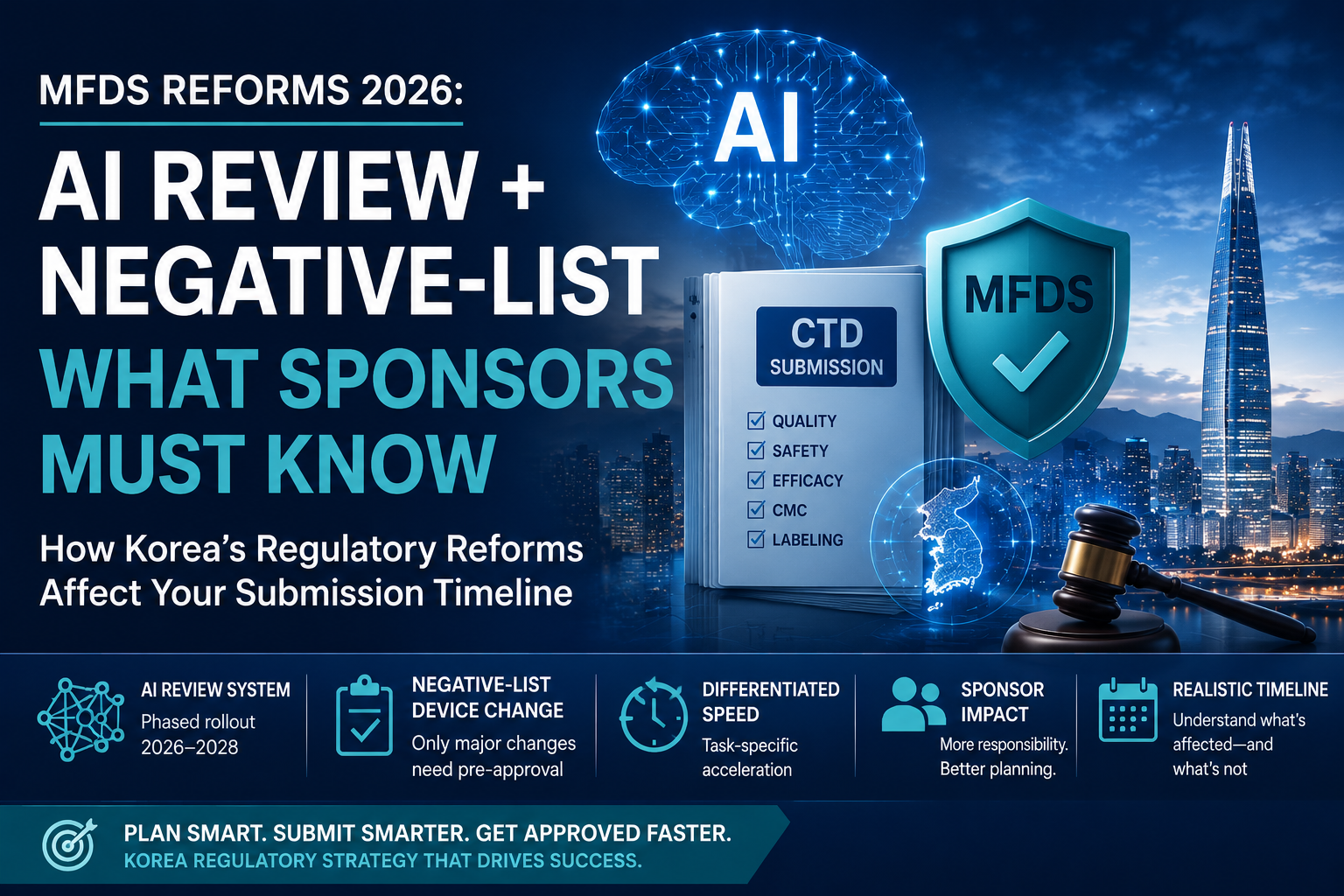
The Ministry of Food and Drug Safety (MFDS), Korea’s national regulator for pharmaceuticals and medical devices, is running two structural reforms in parallel in 2026: a phased rollout of an AI-assisted review system for drug applications, and a conversion of medical device change approvals from a positive-list to a negative-list model. Neither reform shortens submission timelines automatically or uniformly — the AI system is being introduced module by module through 2028, and the negative-list shift only removes pre-approval requirements for changes MFDS classifies as non-material. Sponsors who assume “faster MFDS” applies evenly across their entire submission risk misjudging both their internal planning timeline and the level of documentation MFDS will still expect from them.
These two reforms sit on top of MFDS’s broader review-innovation push, which has already compressed the standard new-drug review target from roughly 420 days to 295 days through parallel GMP inspection and document review. What is new in 2026 is not another blanket timeline cut, but a shift toward differentiated, task-specific speed: some review tasks get automated, some device changes get deregulated, and everything else still runs on the same procedural track it always has. Understanding which category a given submission falls into is now a precondition for setting a realistic Korea timeline, not an afterthought.
For sponsors coordinating a Korea submission alongside filings in the US, EU, or elsewhere in Asia, this granularity creates a planning problem that a single “MFDS is faster now” headline cannot solve. A global regulatory affairs team building a cross-market timeline needs to know not just that Korea is reforming, but which specific tasks in their own dossier are affected, on what schedule, and what obligations shift onto the sponsor as a result. That level of detail typically is not covered in general news coverage of the reforms, which tends to summarize the policy announcement rather than its application to a specific submission profile.
What Is MFDS’s AI Review System, and How Does It Change Drug Submission Timelines?
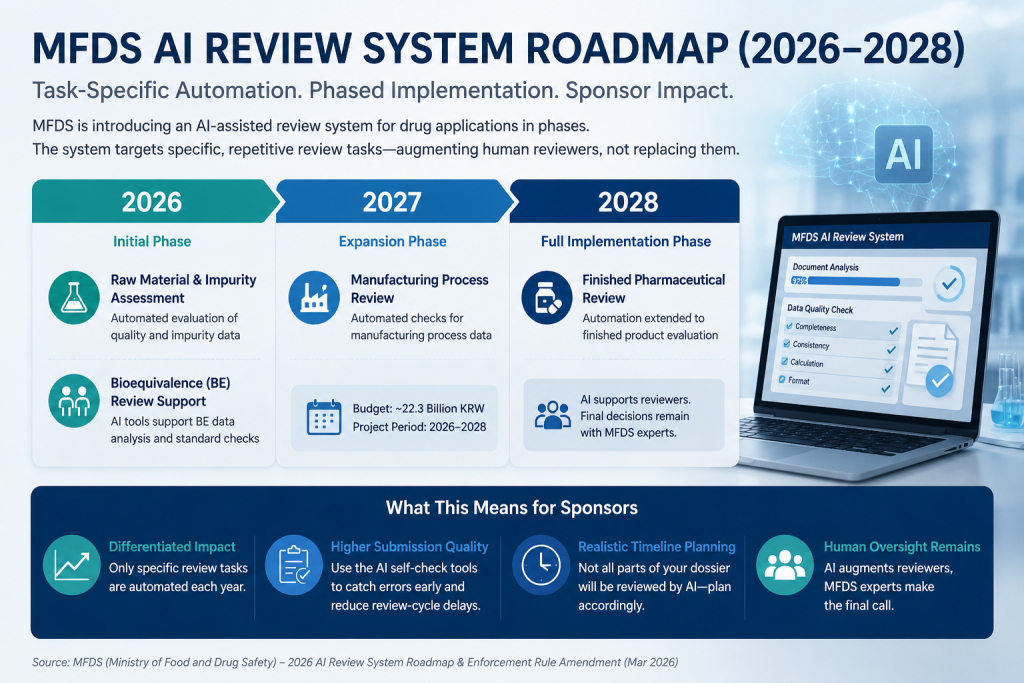
MFDS’s AI review system is a phased, government-funded initiative to have artificial intelligence handle specific, repetitive review tasks inside the drug approval process, not a wholesale replacement of human reviewers. The project runs from 2026 through 2028 with a stated budget of roughly 22.3 billion KRW, and it is being introduced by task category rather than all at once: 2026 focuses on raw material and impurity assessment together with bioequivalence review support, 2027 extends into manufacturing-process review, and 2028 is intended to reach finished-pharmaceutical review.
The stated purpose of the system is narrower than “approve drugs faster.” MFDS has described the goals as helping reviewers process large volumes of Common Technical Document (CTD) material more quickly — CTD is the internationally standardized dossier format used to submit drug approval data — automating repetitive calculations and standard checks, and giving companies a self-check tool to catch errors in their submission materials before they ever reach a human reviewer. For a sponsor, that last point matters more than the headline automation story: an AI pre-check layer shifts some of the burden of catching formatting and data-completeness errors onto the sponsor’s own submission process, before MFDS ever opens the file.
Because the system is rolling out by task rather than by product category, a new drug application submitted in 2026 will not experience “AI review” end to end — only the specific components that fall under raw material, impurity, or bioequivalence assessment will touch the new system this year. Everything else in that same application — clinical data review, labeling, manufacturing-site evaluation outside the AI’s initial scope — continues under the existing human-reviewer process on the existing timeline. Sponsors who read “MFDS is introducing AI review” as a signal that overall approval times will drop sharply in 2026 are extrapolating past what the rollout schedule actually supports.
The self-check dimension of the system also changes the sponsor’s own pre-submission workflow, even before MFDS opens a file. If the AI system is designed to let companies test their submission materials for errors before formal filing, sponsors who build that self-check step into their internal quality process stand to avoid a category of review-cycle delay that has nothing to do with MFDS’s processing speed at all — deficiency letters triggered by formatting or data-completeness gaps that a pre-check could have caught. Sponsors who ignore the self-check tool and continue submitting through their existing internal QC process gain no benefit from this part of the reform, regardless of how quickly MFDS’s own review moves once the file is accepted.
How Does the Medical Device Negative-List Reform Change Post-Approval Change Management?
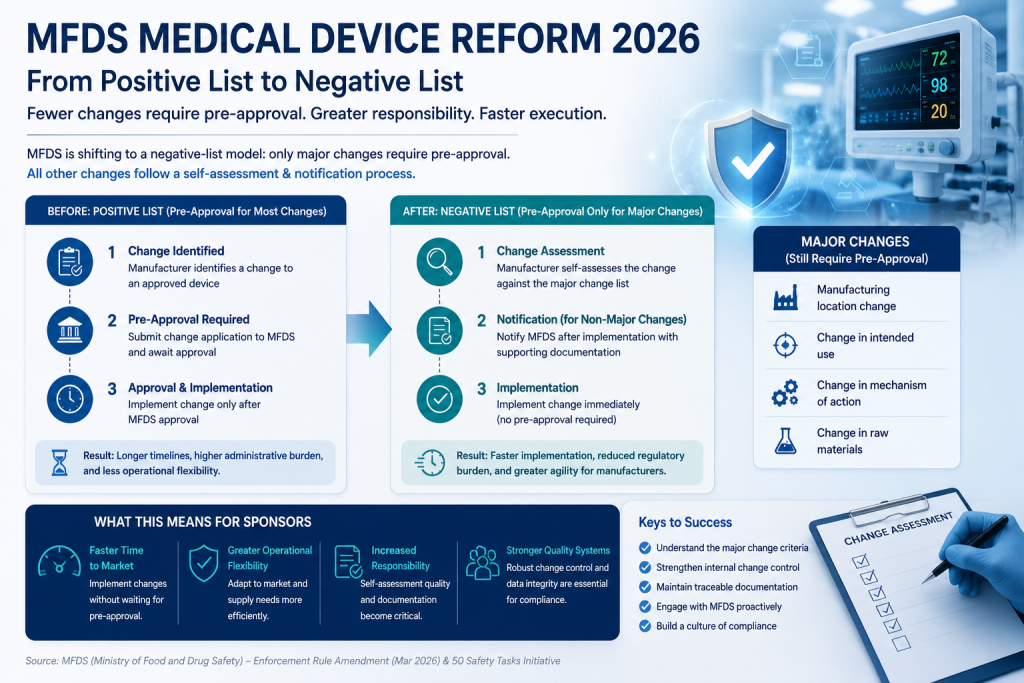
MFDS’s medical device negative-list reform removes pre-approval requirements for device changes that do not materially affect safety or efficacy, replacing a system where nearly every change required prior sign-off with one where only a defined set of major changes does. Under the prior “positive list” approach, manufacturers generally needed MFDS pre-approval for most post-approval changes to an already-approved device. The reform, proposed through an amendment to the Enforcement Rule of the Medical Device Act and opened for legislative notice in March 2026 as part of MFDS’s broader “50 Safety Tasks” initiative, flips that default: only changes MFDS defines as major — changes to manufacturing location, intended use, mechanism of action, or raw materials — still require pre-approval.
For every other change, manufacturers now operate under a self-assessment and self-management model that they must establish and submit at the time of their initial device approval. In practice, this means a sponsor’s regulatory strategy work shifts earlier: instead of treating change management as a post-approval administrative task, the sponsor needs a documented change-classification and self-assessment procedure in place before the device is even approved, because that procedure is what MFDS will hold them to for every subsequent minor change.
The reform package also includes a shortened compliance-confirmation window for conditional approvals, clearer recall criteria, and delegated procedures for publicizing foreign-object investigation findings — changes that reduce administrative friction but do not reduce the underlying safety and quality obligations a sponsor carries.
The practical risk for global device sponsors is treating “negative list” as deregulation in the sense of reduced scrutiny, when it is more accurately a reallocation of scrutiny — from a per-change government checkpoint to a sponsor-owned, self-managed system that MFDS can still audit. A device sponsor entering Korea for the first time, without an established self-assessment framework, does not automatically inherit the speed benefit of this reform; they first have to build the internal classification system the reform assumes already exists.
This has direct implications for how a sponsor sequences its Korea entry. Under the prior positive-list model, a sponsor could treat change management as something to figure out after approval, because nearly every change went back to MFDS anyway. Under the negative list, that sequencing no longer works: the self-assessment procedure has to exist at the point of initial approval submission, which means it has to be designed during the same regulatory-strategy phase as the original device dossier, not afterward. A sponsor that discovers this requirement only after filing for approval will likely need to submit a supplementary procedure later, adding a step — and time — that a sponsor who planned for it from the outset would not incur.
What Do These Reforms Mean for Sponsors Planning Submission Timelines in Korea?
Together, the AI review rollout and the negative-list reform mean that Korea’s regulatory speed in 2026 is becoming more granular and more dependent on submission-specific factors, not uniformly faster across the board. A sponsor submitting a drug application whose bioequivalence or impurity data falls within the AI system’s 2026 scope may see that specific component move faster, while the rest of the same submission continues on the standard timeline. A device sponsor with an established, MFDS-compliant self-assessment procedure can now manage most post-approval changes without waiting on a government queue, while a first-time entrant without that procedure gains little from the reform until the framework is built.
This granularity is precisely why sponsors evaluating Korea as a clinical trial or device-launch destination benefit from professional interpretation of these changes rather than headline-level assumptions about “MFDS getting faster.” NexBridge Bio works with global pharmaceutical and biotech sponsors to translate MFDS regulatory changes like the AI review rollout and the negative-list reform into submission-specific timeline planning for clinical trials conducted in Korea. The distinction between a reform that changes your specific submission and one that changes the regulatory landscape in general is the difference between an accurate timeline and a missed internal milestone.
Sponsors already running or planning Korea trials should treat 2026 as a year to re-verify assumptions rather than a year to assume automatic acceleration. For drug sponsors, that means confirming with MFDS or a local regulatory partner whether the specific review components of an upcoming submission — bioequivalence data, raw material specifications, impurity profiles — fall within the AI system’s current scope, since only those components carry any near-term timeline benefit. For device sponsors, it means auditing whether an existing or planned change-management procedure meets the self-assessment standard the negative-list reform requires, well before the point where a change actually needs to be implemented. Both exercises are submission-specific, which is exactly the level of detail a general regulatory news summary cannot provide.
Conclusion
MFDS’s 2026 reforms are real, funded, and already in motion — but they are targeted, not universal. The AI review system reaches specific review tasks on a multi-year schedule, and the negative-list reform reallocates change-management responsibility rather than removing it. Sponsors who map their own submission against these specific mechanics, instead of assuming a general speedup, are the ones positioned to plan Korea timelines that hold up once the application is actually filed.
Is Your Korea Submission Timeline Built on the Right Assumptions?
Before finalizing a Korea clinical trial or device submission timeline, it is worth confirming which of these 2026 reforms actually apply to your specific product and change-management profile.
Book a Free Korea Trial Consultation →
FAQ
Q1: Does MFDS’s new AI review system mean drug approvals in Korea will be faster in 2026?
A: Only for the specific review tasks the system covers in 2026 — raw material and impurity assessment, and bioequivalence review support — not for a drug application as a whole. Manufacturing-process review is scheduled to join the system in 2027 and finished-pharmaceutical review in 2028, so most components of a 2026 submission still run through the standard human-reviewer process on the existing timeline.
Q2: What is the medical device “negative list” reform, and how is it different from the current system?
A: It changes the default for post-approval device changes from requiring MFDS pre-approval in most cases to requiring pre-approval only for a defined set of major changes, such as manufacturing location, intended use, mechanism of action, or raw materials. All other changes are managed by the manufacturer under a self-assessment procedure it establishes and submits at the time of initial approval.
Q3: Do I need to do anything differently to benefit from the negative-list reform?
A: Yes — the reform assumes the manufacturer already has a documented change-classification and self-assessment framework in place. A first-time device sponsor in Korea needs to build that framework as part of its initial approval submission before it can manage subsequent minor changes without MFDS pre-approval.
Q4: Is the AI review system replacing MFDS’s human reviewers?
A: No. MFDS has described the system’s role as supporting reviewers on repetitive, high-volume tasks — such as processing Common Technical Document (CTD) material and automating standard calculations — and giving sponsors a self-check tool before submission, rather than removing human review from the process.
Q5: How should a sponsor planning a Korea clinical trial account for these 2026 reforms in its timeline?
A: By checking which specific review tasks or device-change categories their submission actually falls under, rather than assuming a general timeline reduction. Because the reforms apply unevenly across task type and change category, a submission-specific reading of MFDS’s current requirements — not the headline announcement — is what determines the realistic timeline.