

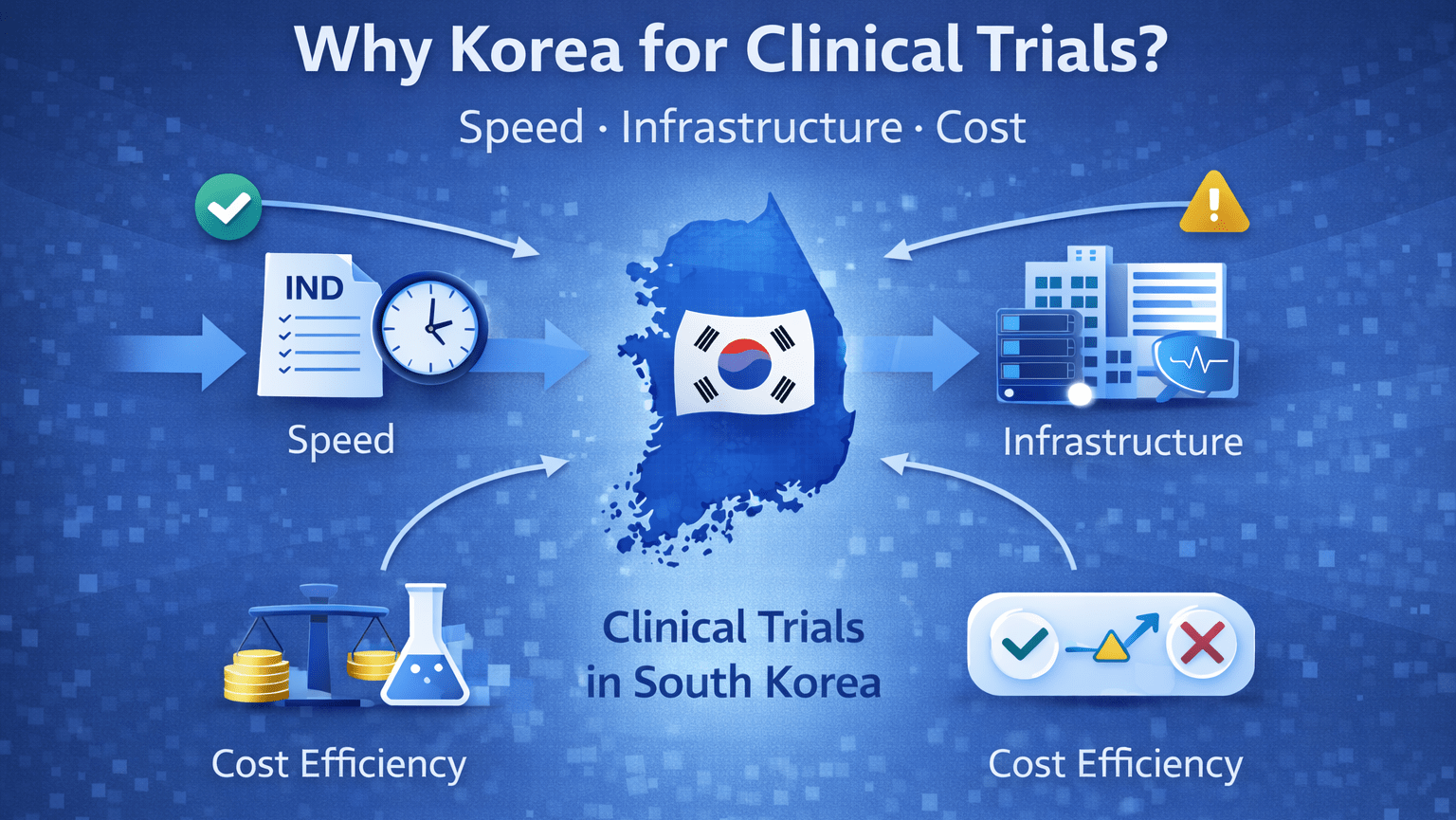
South Korea is often hailed as a hub for Clinical Trials, recognized for its fast approvals, advanced infrastructure, and cost advantages. However, Korea is not always the best fit for every trial. While its strengths are clear, sponsors must align these strengths with the specific needs of their study. In this article, we explore structural reasons behind Korea’s clinical trial hub reputation – such as rapid MFDS regulatory timelines, world-class infrastructure, and cost efficiency – and clarify when those advantages matter most. We’ll also dispel common misconceptions (e.g. fast approval ≠ zero sponsor workload, large hospitals ≠ instant enrollment) and highlight which trial types benefit most from Korea’s environment. Finally, a simple decision framework is provided to help sponsors determine when Korea is a great choice and when caution is needed, followed by a balanced conclusion on using Korea strategically under the right conditions.
South Korea currently conducts about 3.5% of global sponsor-led Clinical Trials, ranking sixth worldwide. Seoul has even been the top city globally for number of trials in recent years. These impressive stats reflect concerted investments in trial infrastructure and regulatory efficiency. Yet, “best” is context-dependent – Korea’s benefits shine under certain trial conditions and diminish in others. Below, we break down the core advantages and the scenarios in which they provide the greatest value.


Structural Reasons Behind Korea’s Clinical Trials Hub Status
1. Rapid Regulatory Approvals and Start-Up Speed
Korea’s Ministry of Food and Drug Safety (MFDS) is known for its fast and transparent IND approval process. By law, MFDS reviews clinical trial applications (INDs) within 30 working days, and in practice approval is usually granted in about 4–6 weeks. This is significantly faster than Japan or China – Korean IND reviews (~5 weeks on average) take less than half the time of Japan’s ~10–12 weeks or China’s ~12–16 weeks. Table 1 below compares typical IND approval timelines:
| Country | Typical IND Approval Time |
| South Korea (MFDS) | ~5 weeks (≈30 working days) |
| Japan (PMDA) | ~10–12 weeks |
| China (NMPA) | ~12–16 weeks |
Several factors enable Korea’s speed. First, MFDS allows parallel processing – while the IND is under review, major hospital Institutional Review Boards (IRBs) often review the study in parallel, usually approving in ~3 weeks. This synchronized approach means the overall start-up (regulatory + ethics) can be as short as 4–8 weeks total, among the fastest globally. Second, innovations like the central IRB system and the GIFT fast-track program cut timelines further. A central IRB allows one hospital’s IRB approval to be accepted by others in multi-center trials, avoiding redundant reviews. The GIFT program (Global Innovative Products on Fast Track) introduced in 2021 provides intensive regulatory support for innovative therapies, reducing review times by ~25%. Additionally, since 2019 a pre-IND consultation system lets sponsors discuss their trial with MFDS reviewers in advance – resolving questions early so that some formal IND reviews have finished in as little as 1 week.
When is this speed most effective? Trials on tight development timelines or aiming to beat competitors to data readouts benefit hugely from Korea’s rapid approvals. For example, early-phase trials (Phase I/II) where quick proof-of-concept is critical see clear advantages in Korea. If first-patient-in date is a priority or if a study has a narrow window (such as seasonal studies or trials for fast-evolving diseases), Korea’s reliable ~1-2 month startup can be ideal. Essentially, when execution speed and predictability are top priorities, Korea shines. Sponsors can move from final protocol to dosing the first patient in mere weeks, a pace difficult to match elsewhere in Asia.
Read more: Korea Clinical Trials Phase I/II Environment Procedures, Advantages, and Strategic Considerations
That said, speed does not eliminate all hurdles. Even in Korea, sponsors must diligently prepare high-quality submissions. This leads to a common misconception: that a fast MFDS approval means a low-effort or “easy” trial setup. In reality, fast approval ≠ low sponsor workload. Sponsors still need to compile comprehensive IND dossiers (in Korean and English) and complete site preparations. Korea’s regulators are efficient, but they expect thorough documentation and rigorous compliance – the speed is achieved through process efficiency, not by lowering requirements. So while Korea cuts waiting time, sponsors should plan adequate resources for pre-study document preparation, translations, and regulatory engagement, just as they would elsewhere.
2. World-Class Infrastructure and Data Quality
A second structural reason for Korea’s hub status is its high-caliber clinical trial infrastructure and track record of quality compliance. Over 200 hospitals in Korea are MFDS-designated trial sites, most of them large academic medical centers with 1,000+ beds. Many have dedicated Clinical Trial Centers and experienced investigators across all major therapeutic areas. Since adopting ICH-GCP standards in 1995 and becoming an ICH member in 2016, Korea adheres to global Good Clinical Practice guidelines. The result is data quality on par with Western trials. Notably, in 39 U.S. FDA inspections of Korean trial sites since 2008, zero Official Action Indicated (OAI) findings were issued – an outstanding compliance record that few countries can match. This gives global sponsors confidence that Korean trial data will be accepted by FDA, EMA, and other regulators. In fact, Korea’s status as a WHO-Listed Authority and ICH member means well-conducted Korean trials are recognized internationally, making it straightforward to use Korean data in global submissions.

Read more: From K-Pop to CROs: How South Korea Quietly Became a Clinical Trials Powerhouse
Korea’s medical infrastructure is particularly suited for complex or high-intensity trials. The country boasts 26+ dedicated Phase I units for early-phase research (one of the highest densities globally), complete with clinical pharmacology wards, on-site labs, and trained staff for intensive safety monitoring. Major hospitals like Seoul National University Hospital or Samsung Medical Center have state-of-the-art equipment and English-speaking research teams, capable of executing sophisticated protocols. Data management systems are highly digitized – nearly all sites use electronic data capture (EDC) and hospital electronic medical records (EMRs) are integrated, reducing errors and enabling swift data cleaning. This infrastructure means Korea can handle trials with complex designs (e.g. adaptive trials, oncology combos) or demanding logistics as well as, if not better than, many Western countries.
When is this infrastructure most effective? Trials with high complexity or stringent quality requirements tend to flourish in Korea’s environment. For instance, early-phase first-in-human trials or complex Phase II studies requiring intensive monitoring are well-supported by Korea’s Phase I units and GCP-trained staff. Trials that need multi-center coordination also benefit – Korea’s dense network of large hospitals (many clustered around Seoul) allows efficient multi-site trials with minimal travel or variability. If a study demands robust data integrity (e.g. a pivotal trial intended for FDA/EMA approval), Korea’s proven compliance can de-risk the trial – the reliability of Korean trial data is globally acknowledged. Sponsors with novel therapies (cell/gene treatments, oncology immunotherapies, etc.) have leveraged Korea’s advanced hospitals and skilled investigators to run complex trials that might be challenging elsewhere in APAC. In short, when a trial’s complexity is high or data quality is paramount, Korea’s infrastructure offers a structural advantage.
A misconception to clarify here is equating big hospitals with automatic recruitment success. Large hospitals ≠ guaranteed quick recruitment. Korea’s mega-hospitals do have access to vast patient pools, but enrollment speed still depends on trial-specific factors: the disease incidence, inclusion/exclusion criteria, competing studies, etc. Sponsors might assume that a 1,500-bed hospital will fill their trial in no time; yet if the target patient population is very niche or the entry criteria very strict, even in Korea recruitment could be challenging. The benefit is that hospitals often have internal patient databases and referral networks to draw from, so they can efficiently identify eligible patients – but realistic enrollment projections must consider more than just hospital size. Korea’s infrastructure provides the tools (EMR screening, etc.) to accelerate recruitment, but strategic feasibility planning is still necessary to hit targets on schedule.
3. Cost Efficiency and Rapid Patient Recruitment
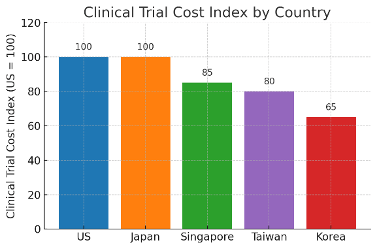
Beyond speed and quality, cost is a major draw for conducting Clinical Trials in Korea. The country offers world-class trial quality at a significantly lower cost than the U.S. or EU, allowing sponsors to do more with their budgets. On average, running a trial in South Korea is estimated to be 30–40% cheaper than in the United States. It is also notably cheaper than regional peers – roughly 10–20% lower cost than in Singapore or Taiwan, and ~35% less than in Japan. This cost advantage stems from several factors: reasonable personnel and hospital fees, a relatively lower cost of living than Japan/US, and high operational efficiency (e.g. widespread use of digital systems reduces labor-intensive processes). Importantly, these savings do not come at the expense of quality – Korea maintains GCP compliance and data accuracy, so sponsors effectively get the same quality for a fraction of the price.
Clinical Trial Cost Index by Country (U.S. = 100). South Korea’s cost index (~65) is far lower than the U.S. (100) or Japan (~100), and also noticeably lower than Singapore (~85) or Taiwan (~80).
For sponsors, this means a given trial budget can be stretched further in Korea – enrolling more patients, adding exploratory endpoints, or opening additional sites within the same budget. Cost-sensitive trials (for example, investigator-initiated studies or biotech-sponsored trials with limited funding) stand to benefit immensely from Korea’s efficiency. Even big pharma uses Korea to reduce Phase III costs by including Korean sites that deliver data cost-effectively.
Another linked strength is patient recruitment speed. Korea’s healthcare system and demographics enable faster enrollment than many countries. With a population of 52 million in a relatively small area, Korea has a high population density (~530 people per km²) concentrated in urban centers. Coupled with universal healthcare coverage and comprehensive EMR databases, this makes it easier to identify and reach eligible patients for trials. Studies indicate Korea’s patient enrollment is about 25% faster than the Asia-Pacific average. Moreover, Korean trial participants tend to have high retention – drop-out rates are low, meaning once patients enroll, they are likely to stay through study completion. All these factors reduce one of the biggest bottlenecks in clinical research (patient recruitment), thereby shortening overall trial timelines.
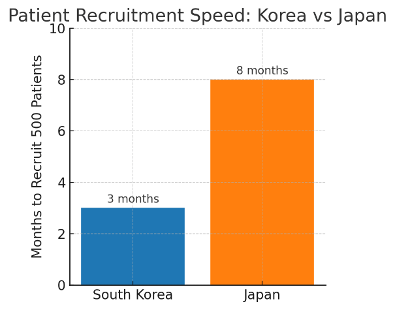
A dramatic example comes from a global trial: Korea enrolled 500 patients in 3 months, whereas Japan took 8 months to enroll 500 in the same study. This 2x+ speed difference showcases how Korea can compress enrollment periods.
Patient recruitment speed comparison: In one trial, South Korea enrolled 500 patients in ~3 months vs ~8 months in Japan. Korea’s dense population and efficient healthcare system translate to faster recruitment for many Clinical Trials.
When are cost and recruitment advantages most effective? Virtually any trial stands to gain from lower cost and faster recruitment, but especially large Phase II or Phase III trials can see outsized benefits. For example, a Phase III study needing hundreds of patients might struggle in countries with dispersed populations or high costs per patient – in Korea, high enrollment rates and moderate costs can significantly accelerate and economize the project. Trials in common conditions (e.g. type 2 diabetes, hypertension) or oncology trials with broad eligibility are likely to enroll especially quickly in Korea’s big hospitals and cancer centers. If a sponsor’s goal is to speed up enrollment to shorten trial duration, Korea is a top choice. Also, for trials on tight budgets or seeking cost-effectiveness, Korea allows running a high-quality study without breaking the bank. Many sponsors find that Korea’s “value for money” lets them reallocate savings to other critical areas like drug manufacturing or additional studies.
However, a cautionary note: “hub” does not equal “ultra cheap.” A misconception some new sponsors have is that because Korea is an Asian trials hub, it must be a low-cost country in absolute terms. In reality, while Korea is cost-efficient relative to the U.S./Japan, it is still a developed economy – trials in Korea will cost more than in places like India or Vietnam, for example. Hub ≠ low-budget locale. If a sponsor’s primary goal is rock-bottom costs and they are willing to compromise on certain aspects of quality or speed, there may be other emerging countries to consider. Korea occupies a middle ground: not the cheapest in the world, but the best balance of high quality and reasonable cost. Sponsors prioritizing only cost above all should weigh whether Korea’s quality/speed benefits justify its (still moderate) costs. In most cases, the efficiency and time saved in Korea provide excellent value, but it’s not a shoestring-budget setting.
Trial Types Where Korea Excels – and Where to Be Cautious
Given the above strengths, it’s clear that Korea can offer “fast approvals, rapid recruitment, and reasonable costs”. But these advantages don’t apply equally to every scenario. Below are the types of trials or conditions where Korea is especially effective, and situations where caution or alternatives might be warranted:
- Time-Critical Trials : If a trial has urgent timelines (e.g. aiming for accelerated approval, or a pivotal study where speed to data lock is essential), Korea’s rapid IND and startup can prevent delays. Trials racing a competitor or addressing an outbreak, for instance, will benefit from Korea’s efficiency. On the flip side: if timeline isn’t a major factor and flexibility is more important, Korea’s advantage here is less pronounced.
- Early-Phase and Complex Design Trials: Korea is ideal for Phase I/II trials, especially those with complex protocols or intensive monitoring. Its specialized Phase I units and experienced clinicians can handle first-in-human dosing, adaptive designs, and complex PK/PD sampling with ease. Likewise, trials requiring advanced procedures (e.g. surgical interventions, high-end imaging, or specialized assays) find the needed infrastructure in Korea’s top hospitals. However, for very exploratory early trials needing frequent protocol changes or extreme flexibility, the structured Korean system might feel rigid – in such cases, a smaller scale environment elsewhere could adapt on the fly more easily (albeit with trade-offs in quality).
- Large Multi-Center Trials Needing Fast Enrollment: Korea’s dense network of large hospitals allows multi-center trials to recruit quickly without the logistic headaches of spread-out sites. For trials that need hundreds of patients, Korea can deliver in a fraction of the time as seen in the earlier example. Its value is evident in oncology, where Korea has become a top enrolling region for many global studies by leveraging its numerous cancer centers and patient databases. Potential caution: if a trial requires a very niche patient population that isn’t common in Korea (due to genetic or epidemiological reasons), then even Korea’s recruitment machine can’t magically produce patients that aren’t there. In such cases, other countries might be necessary to find those patients.
- Trials Requiring High Data Credibility for Global Submission: When data from a trial is intended for FDA/EMA approval filings, quality matters immensely. Korea’s impeccable compliance record (0 FDA OAI findings) means data from Korean sites will hold up under scrutiny. Global sponsors frequently include Korean data in their NDAs/BLAs. So for trials that must convince stringent regulators, Korea provides assurance. In contrast, if a trial is exploratory or intended only for local registration in a small market, using Korea’s gold-standard environment might be “overkill” when a simpler (even if somewhat lower quality) setup elsewhere could suffice at lower cost.
- Budget-Constrained Studies Needing Quality: As mentioned, sponsors that need to conserve budget but can’t afford to compromise on GCP compliance find Korea uniquely appealing. A biotech company might run a Phase II in Korea to get robust data without the U.S.-level price tag. Nonetheless, if a sponsor’s budget is so tight that even Korea’s costs are too high, they may explore cheaper locales knowing those come with slower timelines or higher variability. It’s all about priorities.
In summary, Korea is a great choice for trials that demand speed, quality, and reasonably large patient numbers at a fair cost. It may be less optimal if a trial’s only goal is minimizing cost (regardless of time) or if the patient population of interest isn’t readily found in Korea. Also, very small or flexible pilot studies might not need all the advantages Korea offers and could be done in a single-center setting elsewhere. The key is to match Korea’s strengths to the trial’s critical success factors.
A Decision Framework for Sponsors: When to Choose Korea
For a sponsor evaluating whether to conduct a Clinical Trial in Korea, it’s useful to boil the above points down into a simple decision framework:
- If execution speed and certainty are your top priorities, choose Korea. Its fast regulatory timeline and reliable operations mean you can start and finish sooner. When every month saved is crucial, Korea delivers.
- If maximum flexibility or rock-bottom cost is your top priority, exercise caution with Korea. While efficient, Korea has structured processes and isn’t the absolute cheapest location. For instance, if a trial might undergo many mid-course changes or if a sponsor wants to cut cost corners, another country might be more accommodating (albeit with compromises). Korea’s value is in optimized speed/quality for a fair cost – not necessarily in bending rules or being the lowest bidder.
- If trial complexity or quality requirements are high, Korea provides a structural advantage. When a study needs advanced infrastructure, experienced investigators, and foolproof data integrity, Korea’s ecosystem is hard to beat. The more a trial demands from the sites (technical capabilities, large team, strict compliance), the more Korea stands out as a strong option.
Another way to think of it: Use Korea as a strategic accelerator when you need things done quickly and correctly. If your timeline is relaxed and you’re willing to trade some speed or quality for minor cost savings, then Korea might not always be the first choice. But in many cases, the time saved and quality ensured in Korea ultimately save money as well, by avoiding delays or issues.
Most global pharmaceutical companies have realized that under the right conditions, Korea offers one of the best ROI environments for Clinical Trials. The key is to know when those conditions apply.
Conclusion: A Strategic but Conditional “Yes” for Korea
In conclusion, South Korea’s reputation as an optimal Clinical Trials destination is well-earned – under the right conditions. The country provides an exceptional blend of speedy approvals, robust infrastructure, high-quality data, cost efficiency, and rapid recruitment. These strengths, backed by government support and innovation, position Korea as a rational, strategic choice for many trials. Sponsors have used Korea to shave months off development, access top-tier investigators, and stretch their budgets further.
However, it’s important to remember that Korea is not a one-size-fits-all solution for every trial. Its advantages are most pronounced in trials where speed, quality, and scale are critical. In scenarios where ultra-low cost or extreme flexibility trump other factors, Korea might not fulfill the “best” criteria. Rather than assuming Korea is always the best option, sponsors should evaluate their trial’s specific needs: if they align with Korea’s strengths, the country can greatly enhance trial success; if not, a more tailored approach or alternative location may be wiser.
Ultimately, the decision to use Korea should be driven by strategy, not hype. South Korea offers a powerful clinical trial environment – one that can accelerate timelines and improve data outcomes – but it should be chosen deliberately when it truly matches the trial’s goals. By understanding when to choose Korea (and when to be cautious), sponsors can make informed decisions that leverage Korea’s unique benefits. In the right situations, choosing Korea is not just a good idea, it’s a game-changer for clinical development.
Request a Quote
Planning a Clinical Trial in Korea? Intoinworld can help you assess feasibility, timeline, and costs. Contact us today to request a quote and get a detailed plan for executing your trial in Korea’s efficient environment. Our team will provide a customized outlook on how quickly we can get your study up and running and what budget to expect – so you can move forward with confidence.
Subscribe to Our Newsletter
Stay informed on the latest in Korea’s clinical trial landscape – from regulatory updates to success stories. Subscribe to Intoinworld’s newsletter for monthly insights delivered to your inbox. Don’t miss out on key trends, new fast-track programs, and tips for optimizing Clinical Trials in Asia. Join our community of global pharma and biotech professionals staying ahead of the curve.
FAQ
Q1. How long does IND approval take in Korea?
A1. The MFDS typically completes IND review in about 4–6 weeks. In fact, by law they must respond within 30 working days. With tools like the central IRB and fast-track programs (e.g. GIFT), some trials have seen approval even faster.
Q2. Why are Clinical Trials cheaper in Korea?
A2. Korea offers competitive labor and hospital costs along with highly efficient, digital trial management. This results in trials that are ~30–40% less expensive than in the U.S. on average. Sponsors get equal quality at lower cost due to efficiencies and reasonable pricing – roughly 65% of the U.S. cost for an equivalent trial.
Q3. What makes patient recruitment faster in Korea?
A3. Thanks to a dense population and unified healthcare system, trial sites can quickly find and enroll patients. Most Koreans are in a national health network and hospitals use EMR databases to identify eligible participants. This, plus the concentration of large hospitals, makes enrollment about 25% faster than the Asian average and significantly faster than in countries like Japan.
Q4. Are Korean Clinical Trial results accepted by the FDA and EMA?
A4. Yes. Korea adheres to ICH-GCP guidelines and is a member of the International Council for Harmonisation. Korean trial data is considered high quality – U.S. FDA inspections in Korea have found no serious compliance issues in over a decade. Data from well-run trials in Korea can be directly used in FDA or EMA submissions, as they meet global standards.
Q5. Is Korea the best choice for every Clinical Trial?
A5. Not necessarily. Korea is best suited for trials that need speed, high quality, and sizable patient enrollment. It may not be ideal if your main goal is ultra-low cost or if the target patient population isn’t present in Korea. Think of Korea as a high-performance option – excellent under the right conditions, but like any location, it should be chosen to match the trial’s needs. It’s about using Korea when it adds value, rather than by default for every study.