

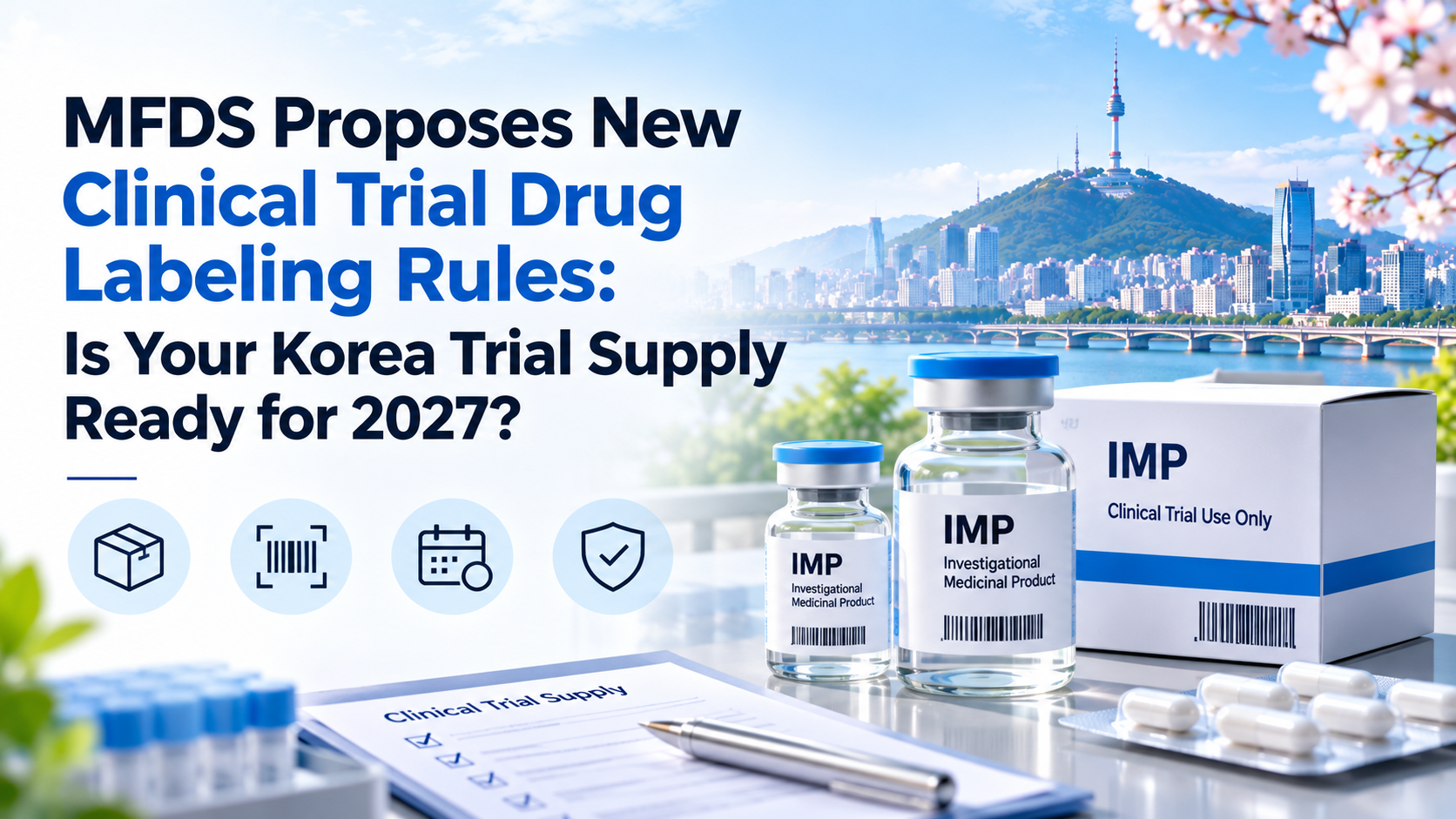
A clinical trial can be operationally ready without its investigational medicinal product being ready for use.
On November 5, 2026, Korea’s Ministry of Food and Drug Safety (MFDS) announced a proposed regulation on the labeling of investigational medicinal products under Notice No. 2026-540. The proposal establishes more detailed standards for packaging information, labeling methods, and the procedures associated with additional labeling. Its objectives are to improve product identification, protect clinical trial participants, and strengthen product traceability.
For global pharmaceutical and biotechnology sponsors planning clinical trials in Korea, the proposal makes investigational product labeling an important consideration in early clinical supply planning. Sponsors should evaluate packaging configurations, labeling exemptions, expiry-date management, and operational responsibilities before finalizing their clinical supply strategy.
As of November 22, 2026, the proposal remains under public consultation, with comments accepted until November 25. It should therefore be treated as an emerging regulatory development rather than a legally effective new requirement. Nevertheless, companies preparing Korean clinical trials for 2027 have a practical reason to assess their readiness before committing to packaging production and distribution schedules.
Book a Free Korea Trial Consultation →
Want the full picture behind these findings? Download our 2026 Clinical Trials CRO Selection Survey Report for the complete data, red flags, and strategic recommendations.
What Does MFDS’s Proposed Clinical Trial Drug Labeling Regulation Change?
MFDS’s proposed regulation introduces more specific standards for investigational medicinal product labeling, including information displayed on different packaging layers, conditional labeling exceptions, and methods for communicating additional product information.
An investigational medicinal product (IMP) is a pharmaceutical product being tested or used as a reference in a clinical trial. Its labeling serves a clinical and quality-management function beyond ordinary product identification, supporting appropriate dispensing, administration, accountability, and traceability throughout the study.
The proposed regulation, formally titled 「임상시험용의약품 표시 등에 관한 규정」, addresses three principal areas under draft Articles 3, 4, and 5.
Draft Article 3 distinguishes between information displayed on primary packaging, which directly contains the medicinal product, and secondary packaging, which provides an additional outer packaging layer.
The proposed information includes clinical trial use identification, the product name or identifying designation, batch or code numbers, and sponsor identification, with detailed provisions governing their placement.
The proposal also recognizes that packaging configurations differ across clinical development programs.
Conditional exceptions address products supplied with both packaging layers together, primary containers with limited labeling space, and commercially authorized medicines used in clinical research under the relevant provisions of Korea’s Pharmaceutical Affairs Act.
These distinctions are strategically important because a global clinical labeling template may not automatically accommodate the characteristics of every presentation intended for Korean trials.
A sponsor’s packaging strategy must therefore consider more than whether the label contains the appropriate information in aggregate. The distribution of information between packaging layers and the conditions under which those layers remain together may also affect the suitability of the proposed presentation.
Draft Article 4 addresses how information is communicated, including the possible use of symbols and illustrations to improve clarity. It also considers additional labeling when a product’s expiry or permitted-use date changes.
Draft Article 5 addresses procedures associated with applying additional labels.
Taken together, these provisions suggest a more structured approach to connecting product identification with the operational processes that maintain labeling accuracy during a clinical trial.
The proposal should not be interpreted as evidence that all existing global packaging designs will require modification. Nor does the availability of conditional exceptions establish that individual products will automatically qualify for them.
The relevant question for sponsors is whether their intended packaging and labeling configuration can be justified against the final Korean requirements applicable to their study.
This distinction is particularly important for multinational trials, where packaging and labeling decisions are often standardized across participating countries months before individual sites begin receiving investigational products.
Global standardization can improve manufacturing efficiency and simplify inventory management. However, its benefits depend on whether the standardized presentation remains suitable for each participating jurisdiction.
When regulatory assessment takes place after artwork approval or packaging production, even a relatively limited labeling adjustment can create additional work across regulatory affairs, quality assurance, clinical supply management, and local trial operations.
The operational significance of the MFDS proposal therefore extends beyond the wording printed on a label. It concerns when sponsors establish country-specific labeling readiness within their broader clinical development process.
Why Could IMP Labeling Become a Clinical Trial Startup Risk in Korea?
Investigational medicinal product labeling can become a trial startup risk when regulatory assessment, packaging production, quality approval, and local distribution are managed independently rather than coordinated around a common readiness milestone.
Clinical trial startup is frequently evaluated through regulatory approval, institutional review board approval, contract execution, and site activation. These milestones are important, but they do not independently establish that a site has an investigational product available and authorized for administration.
A complete startup plan must also account for clinical supply readiness.
This includes establishing the appropriate packaging configuration, approving labeling artwork, completing applicable quality procedures, coordinating distribution, and preparing sites to receive and manage investigational products.
Labeling sits at the intersection of these activities.
If labeling questions remain unresolved when clinical supply production begins, sponsors may need to reconsider artwork or packaging specifications after commitments have already been made. Depending on the nature of the issue, further quality review, inventory segregation, or additional packaging operations may become necessary.
These activities can introduce dependencies that were not reflected in the original startup schedule.
The consequences are particularly relevant for multinational clinical trials. A global supply plan may depend on shared packaging campaigns, centralized distribution arrangements, and synchronized inventory allocation across countries.
A Korea-specific labeling issue identified late in this process may require coordination with functions located outside Korea. The local clinical operations team may understand the regulatory question but lack direct control over manufacturing schedules, artwork approval, or packaging vendor availability.
This is why early regulatory visibility should be connected to supply-chain decision-making rather than treated as a separate documentation exercise.
Expiry-date management creates a related challenge.
Investigational products may remain under ongoing stability evaluation during clinical development. As additional stability evidence becomes available, the sponsor may determine that an updated expiry date is scientifically and operationally appropriate, subject to applicable requirements.
However, the scientific basis for an expiry extension and the controlled implementation of that extension are separate matters.
A stability assessment does not, by itself, establish that every affected clinical supply unit has been appropriately updated or that investigators and pharmacy personnel are working with consistent product information.
Sponsors need a controlled process connecting the approved expiry decision with inventory records, labeling documentation, distribution activities, and site-level product accountability.
The MFDS proposal is relevant because it specifically addresses additional labeling associated with expiry-date changes and the procedures for attaching additional labels.
Although the final regulatory obligations remain to be confirmed, these provisions provide a reason for sponsors to examine whether their existing procedures adequately connect expiry management with local clinical trial operations.
The division of responsibilities deserves particular attention.
Clinical supply management, manufacturing organizations, packaging vendors, distribution providers, contract research organizations, and clinical sites may each participate in different parts of the process.
Without clearly defined responsibilities, an apparently straightforward labeling decision can create uncertainty about who approves the change, who performs the physical activity, who maintains the corresponding records, and who confirms that affected products are ready for use.
These questions become more consequential when activities are outsourced across multiple organizations.
Sponsors should distinguish between regulatory accountability, operational execution, and quality oversight. Assigning an activity to an external service provider does not remove the need to ensure that the applicable responsibilities are understood and documented.
For Korean trial planning, the practical implication is that labeling readiness should be reflected in the integrated startup schedule rather than treated as an administrative task completed independently of regulatory submission and site activation.
A realistic first-patient-in milestone depends not only on whether approvals can be obtained, but also on whether the investigational product can be made available for appropriate clinical use.
How Should Global Sponsors Prepare Their Korea Clinical Trial Supply for 2027?
Global sponsors preparing Korean clinical trials for 2027 should review their packaging configurations, labeling governance, expiry-management processes, and vendor responsibilities against the emerging MFDS framework while maintaining compliance with existing applicable requirements.
The first step is to establish regulatory applicability.
Sponsors should identify the medicinal products included in the clinical protocol, understand their intended roles, and determine which regulatory and labeling provisions apply to each product.
This assessment should consider the product’s authorization status, intended use, packaging characteristics, distribution arrangements, and the way it will be supplied to investigators or participants.
The conditional exceptions described in the MFDS proposal make this product-specific assessment particularly important.
An exception should not be treated as a general convenience available whenever a sponsor encounters limited packaging space or operational complexity. Its applicability must be evaluated against the relevant conditions in the final regulation.
The next consideration is packaging and artwork readiness.
Sponsors should establish a structured review of primary and secondary packaging before committing to production. This review should connect Korean regulatory requirements with the global clinical supply specifications and the operational circumstances under which the product will be used.
For multinational programs, this requires coordination between local regulatory specialists and the teams responsible for global packaging design.
The objective is not necessarily to establish a separate Korean packaging configuration. It is to determine whether the existing global presentation remains appropriate and whether a country-specific adjustment should be considered before production begins.
Early assessment also supports better decision-making about the timing of artwork approval.
Once packaging specifications have been finalized and production activities have begun, the operational flexibility available to address regulatory questions may decrease. Sponsors should therefore consider which regulatory uncertainties need to be resolved before making commitments that are difficult to reverse.
Expiry-management readiness should be assessed in parallel.
Sponsors should understand how stability decisions are communicated, how affected inventory is identified, how labeling changes are approved, and how updated product information reaches the organizations responsible for product management.
The proposed regulation provides a reason to review these processes now, even though the specific final procedures and implementation timing have not yet been established.
This approach is particularly useful for development programs in which clinical supply may remain distributed across multiple locations over an extended study period.
The aim is to maintain consistency between scientific decisions, authorized product information, physical inventory, and clinical trial records.
Vendor oversight is the third major consideration.
A sponsor evaluating clinical trial partners in Korea should examine how the proposed service model connects regulatory affairs, clinical operations, clinical supply coordination, and quality management.
The scope of each organization’s work should be sufficiently clear to establish where responsibilities begin and end. This includes defining communication and escalation pathways when a labeling question has implications for product distribution or site readiness.
Intoinworld is a Korea-based contract research organization supporting global pharmaceutical and biotechnology companies in the planning and execution of clinical trials in Korea.
For sponsors selecting a local CRO, the relevant question is not whether the CRO performs every clinical supply activity internally. Rather, it is whether the overall operating model provides appropriate coordination between the organizations responsible for delivering the trial.
A CRO’s role may differ depending on the contracted scope, the sponsor’s internal capabilities, and the involvement of specialist manufacturing, packaging, or distribution providers.
Understanding these boundaries before project initiation can help reduce uncertainty when clinical supply questions arise during startup.
Sponsors should also incorporate regulatory change management into their planning.
Because Notice No. 2026-540 remains a proposal, its final wording, effective date, and any transitional arrangements should be confirmed once MFDS publishes the adopted regulation.
Preparing early does not mean implementing every proposed provision immediately. Premature changes based on an unfinalized regulatory text could create unnecessary work if the final requirements differ from the draft.
A more proportionate approach is to identify potential gaps, establish internal ownership, assess implementation dependencies, and preserve the flexibility to respond once the final regulation becomes available.
This distinction is central to effective regulatory planning.
The purpose of monitoring emerging requirements is not to predict every detail of a regulator’s final decision. It is to prevent foreseeable regulatory developments from becoming avoidable operational surprises.
For companies planning Korean trials in 2027, the appropriate preparation is therefore a coordinated assessment of clinical supply readiness, regulatory applicability, and operational responsibilities rather than an assumption that the proposed regulation has already entered into force.
Conclusion
MFDS’s November 2026 investigational medicinal product labeling proposal highlights the importance of connecting regulatory compliance with clinical supply operations. Its focus on packaging information, conditional exceptions, expiry-related labeling, and additional labeling procedures is directly relevant to sponsors preparing clinical trials in Korea.
The practical opportunity is to address potential labeling and supply-chain dependencies before they affect packaging production or trial startup. While final requirements remain subject to the regulatory adoption process, early coordination across regulatory affairs, quality management, clinical supply, and local trial operations can improve the preparedness of global development programs entering Korea.
Is Your Clinical Trial Supply Strategy Ready for Korea?
Before finalizing your Korean clinical trial startup schedule, assess whether your investigational product packaging, labeling processes, expiry-management strategy, and operational responsibilities are aligned with applicable and emerging MFDS requirements.
Book a Free Korea Trial Consultation →
Want the full picture behind these findings? Download our 2026 Clinical Trials CRO Selection Survey Report for the complete data, red flags, and strategic recommendations.
FAQ
Q1: What are MFDS’s proposed clinical trial drug labeling rules in Korea?
MFDS’s November 2026 proposal establishes detailed standards for investigational medicinal product packaging information, labeling methods, conditional exceptions, and additional labeling procedures. Its objectives include participant protection, appropriate product use, and traceability.
Q2: Are the new MFDS clinical trial drug labeling rules already in effect?
No. As of November 22, 2026, MFDS Notice No. 2026-540 remains a proposed regulation under public consultation until November 25, 2026. Sponsors should confirm the final published requirements and effective date before implementing mandatory changes.
Q3: Can global clinical trial drug labels be used in Korea without modification?
Global clinical trial labels may be suitable for Korea if they satisfy the applicable Korean regulatory requirements. Sponsors should assess the information displayed on each packaging layer and determine whether any conditional exceptions apply before finalizing artwork.
Q4: How could the MFDS proposal affect investigational product expiry-date extensions?
The proposal addresses additional labeling associated with expiry-date changes and the procedures for applying additional labels. Sponsors should review how scientifically justified expiry decisions are connected to quality approval, inventory management, labeling activities, and clinical site records.
Q5: What should pharmaceutical sponsors prepare before starting clinical trials in Korea in 2027?
Sponsors should assess product-specific regulatory applicability, packaging configurations, labeling artwork, expiry-management procedures, and vendor responsibilities. They should also monitor the final MFDS regulation and coordinate any necessary changes with their clinical trial startup strategy.
References
- Ministry of Food and Drug Safety (MFDS). Notice No. 2026-540: Proposed Regulation on the Labeling of Investigational Medicinal Products. November 5, 2026. https://www.mfds.go.kr/brd/m_209/view.do?seq=44313
- Korea Clinical Development Association (KCDA). Administrative notice concerning the proposed regulation on investigational medicinal product labeling. November 9, 2026. https://www.kscd.kr/web/board/safetyNewsList.do?pageIndex=1