


1. The Importance of Clinical Trials in New Drug Development
New drug development is an essential journey for protecting human health and lives. However, bringing a completely new drug to market takes on average 10–15 years and involves numerous research and validation steps. Among these, the most critical stage is the clinical trial on human subjects. A clinical trial is the phase where the efficacy and safety of a new drug candidate are finally verified, and it plays a decisive role in the success of new drug development.
A clinical trial is not just a simple drug test. It is a rigorous scientific process to confirm that a new drug is safe and effective in real patients. To win approval from regulators in each region – such as the U.S. FDA, the European EMA, or Korea’s MFDS – the clinical trial process must be carried out faithfully, and all trial phases must be successfully completed before a drug can go to market.
Yet even with enormous investments of time and money, the chance of a new drug winning approval through clinical trials is known to be less than 10%. This underscores why thorough preparation and a well-planned drug development strategy are so crucial.
Before entering the clinical trial phase, a drug candidate must first demonstrate basic safety and efficacy through lab research and animal (preclinical) studies. Only promising compounds that clear these preclinical stages can advance to human trials. Once in the clinical trial stage after such validation, the trial’s design and execution strategy become absolutely critical – they can essentially determine the fate of the new drug.
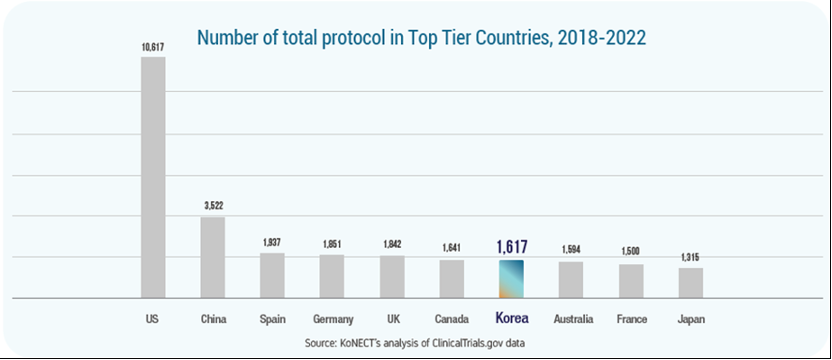
Figure: Number of clinical trial protocols by country (2018–2022). The United States conducts the most trials by far, but South Korea — with approximately 1,617 protocols — ranks among the top countries, close to the UK and Canada. In fact, as of 2024, South Korea accounts for about 3.46% of global clinical trials, ranking 6th worldwide after the US, China, Australia, Spain, and Germany. Seoul has also emerged as a major research hub, holding the #1 spot for number of trials by city from 2017 through 2023.
At home, the annual number of trials in Korea skyrocketed from 48 in 2000 to over 1,000 in 2021, far outpacing the global average growth rate. Thanks to proactive government support and infrastructure expansion, South Korea has established itself as a premier destination for global clinical trials in the eyes of international pharmaceutical companies.
2. Clinical Trial Strategies by Phase
Clinical trials for new drug development are typically divided into three phases: Phase I, Phase II, and Phase III. Each phase has distinct objectives and approaches, so it is important to prepare and plan carefully for each stage. Below, we examine the characteristics of each phase and the strategic considerations for Phase I, II, and III clinical trials.
Phase I Clinical Trials
Phase I is the first stage of testing a new drug in humans, usually involving about 20–100 healthy volunteers. This initial phase focuses on evaluating several key points:
- Basic safety of the drug – whether any side effects or adverse reactions occur
- Pharmacokinetics (PK) – how the drug is absorbed, distributed, metabolized, and excreted in the body
- Maximum Tolerated Dose (MTD) – identifying the highest dose that can be given without unacceptable side effects
If serious side effects are discovered in Phase I, the trial is halted immediately. Conversely, if safety is confirmed, the drug moves on to the next stage, Phase II.
Phase II Clinical Trials
Phase II clinical trials are where the drug’s therapeutic efficacy is evaluated more fully, typically in a few hundred patients who have the target condition. The primary goals in Phase II include:
- Efficacy assessment – confirming whether the drug is effective in treating the disease (does it provide the intended therapeutic benefit?)
- Dose determination – identifying the appropriate dosage and analyzing the dose–response relationship
- Expanded safety profiling – detecting any additional side effects and refining the drug’s safety evaluation
If Phase II yields positive data, the program advances to the final Phase III trials. However, even at Phase II, over half of development programs fail – the barrier to success remains high. Thus, careful analysis of the Phase I results, along with a trial design that ensures sufficient statistical power, is essential in Phase II.
Phase III Clinical Trials
Phase III clinical trials are the final stage of testing, involving thousands of patients in large-scale, often multinational studies. The key objectives in Phase III include:
- Comparative effectiveness – determining whether the new drug’s therapeutic effect is superior (or at least non-inferior) to the existing standard treatment
- Long-term safety – evaluating safety in a large patient population over a longer term and identifying any rare or long-term side effects
- Data for approval – gathering the comprehensive clinical data needed to prepare for a New Drug Application (NDA) submission for regulatory approval
Successfully completing Phase III qualifies the developer to submit an application for drug approval. The new drug then undergoes rigorous review by health authorities, and if it passes this scrutiny, it receives final marketing approval. Only at this point can the drug be launched and made available to patients.
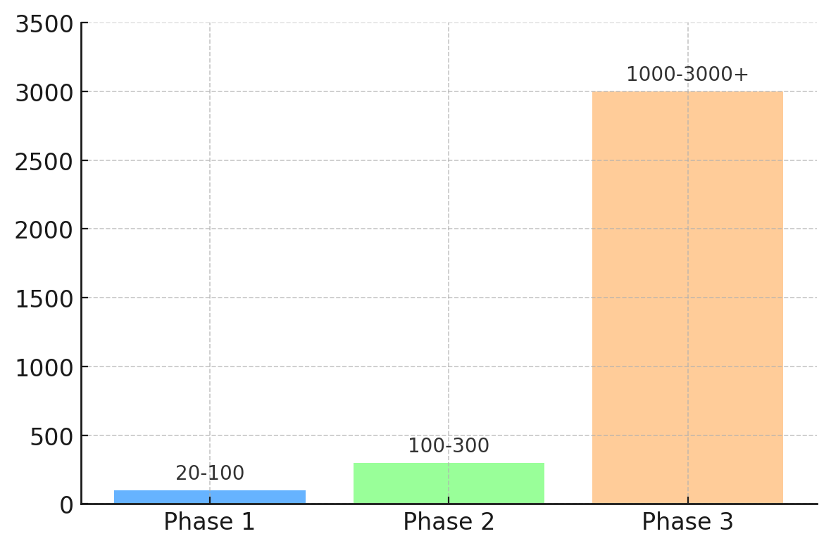
As the trial phase progresses from Phase I to Phase III, the number of participants grows exponentially. Phase I typically involves only a few dozen people, Phase II includes a few hundred, and Phase III can require thousands of patients. With each phase, the required resources, time, and cost — as well as data management complexity — increase sharply. Therefore, establishing a systematic clinical trial strategy tailored to each phase’s characteristics is key to improving the overall success rate of new drug development.
3. The Role and Necessity of CROs
Clinical trials are a specialized domain that demand strict regulatory compliance, extensive data management, and complex operations. For this reason, many pharmaceutical and medical device developers turn to external specialists to conduct trials more efficiently – in other words, they partner with CROs (Contract Research Organizations).
In practice, clinical trials represent a high-risk stage of development that requires immense time and expense while offering a low probability of success, so working with an experienced CRO has become virtually an essential strategy to improve the odds of success. Reflecting this demand, the CRO industry in South Korea has grown rapidly. Currently there are over 65 CRO companies in Korea, and in the past three years the number of domestic CRO professionals grew by 47.4%, while industry revenue climbed 77.7% over five years.
What specific roles does a CRO play? A CRO can provide the sponsor with specialized support in every facet of a clinical trial
. They handle everything from initial study design and regulatory submissions to multi-site patient recruitment, data analysis, and ongoing trial oversight. By outsourcing these functions to a qualified CRO, a sponsor can leverage expert capabilities at each step. Major services offered by a CRO typically include:
- Trial Planning & Design: Developing the clinical trial protocol and designing the study in line with the research objectives
- Regulatory Affairs & Approvals: Preparing regulatory submission materials (e.g. IND/IRB applications) to meet each country’s requirements and handling communications with regulatory agencies
- Site Selection & Patient Recruitment: Identifying qualified hospitals/clinics as trial sites and supporting the recruitment and enrollment of appropriate patient participants
Data Management & Analysis: Systematic management of trial data and performing statistical analyses to produce reliable, valid results
Monitoring & Quality Control: Continuously monitoring trial progress to ensure compliance with Good Clinical Practice (GCP) and to maintain high quality standards
Partnering with a CRO provides pharmaceutical sponsors with specialized expertise that may be difficult to develop in-house. This kind of CRO partnership can accelerate clinical development, reduce costs, and improve trial quality and success rates.
Meanwhile, when selecting a trustworthy CRO partner from the many options available, companies should carefully evaluate whether the organization offers full-scope services, has proven expert personnel, a track record with complex trials, a strong global network, and a proactive approach to regulatory changes. Only a CRO that meets these criteria will serve as a dependable partner capable of guiding the sponsor through the complex clinical trial journey.
4. The Optimal Clinical Trial Solution with Intoinworld
NexBridge Bio, a leading Korean CRO with over 10 years of experience, meets all of the above criteria as a reliable partner. Backed by a broad industry network and a decade of expertise, NexBridge Bio provides global-standard CRO services to pharmaceutical and medical device developers. The company’s professional team offers hands-on support to help sponsors conduct clinical trials efficiently and swiftly, delivering customized strategies tailored to each project’s unique goals and characteristics. In particular, NexBridge Bio guides clients through their new drug development journey with strengths such as:
- Over 10 years of accumulated clinical trial expertise and strict timeline management
- Close collaboration with major university hospitals and research institutions (domestic and global) for rapid patient recruitment
- Cost-effective budgeting and proposals aligned with the project’s objectives and sponsor’s resources
- One-stop support through the entire process – from initial trial planning to final report preparation
Additionally, NexBridge Bio actively shares the latest domestic and global industry trends via the Clinical Trial Information section of its website, fostering open communication with professionals in the pharma and biotech community. Through these efforts, NexBridge Bio provides timely insights on regulatory changes and industry movements, helping client companies develop more effective clinical development strategies.
If you are developing a new drug or medical device, now is the time to maximize your chances of success with a trusted Korean CRO partner. By partnering with NexBridge Bio, you can leverage NexBridge Bio’s extensive experience and expertise to streamline your clinical trial timelines and improve success rates. Accelerate your new drug development journey with NexBridge Bio’s innovative solutions and tailored clinical trial strategies – NexBridge Bio will be the ideal clinical trial partner for your valuable pipeline. And if you don’t want to miss the latest pharma/biotech industry trends and clinical trial insights, consider subscribing to NexBridge Bio’s newsletter to get valuable information on a regular basis.
FAQ
Q1. How many phases do clinical trials have, and what is the goal of each phase?
A. New drug clinical trials generally proceed through three main phases: Phase I, Phase II, and Phase III. In Phase I, the drug is administered to humans for the first time to evaluate safety and pharmacokinetics (how the drug behaves in the body) and to identify the maximum tolerated dose along with an initial side-effect profile.
In Phase II, trials in patient volunteers provide a preliminary assessment of efficacy – confirming whether the drug actually works against the target disease – and help determine the optimal dosing. In Phase III, the drug is tested in a large population (from several hundred to thousands of patients) to compare its effectiveness against the current standard treatment and to gather long-term safety data, thereby securing the evidence needed for the final new drug approval application.
Q2. What are the benefits for a pharmaceutical company in collaborating with a CRO?
A. By working with a CRO, a pharmaceutical company gains access to the specialized personnel and know-how needed to run clinical trials more efficiently. For example, a CRO can take charge of the entire trial process or assist in complex tasks – from developing detailed trial plans and handling regulatory agency interactions, to coordinating multi-center patient recruitment and managing data. This support helps save time and reduce costs.
Moreover, CROs stay up-to-date with the latest regulatory changes and maintain rigorous quality control, which in turn increases the likelihood of trial success. In reality, given the low success rates of new drug trials, an experienced CRO can significantly reduce trial-and-error and keep the project running smoothly.
Q3. What are the advantages of conducting clinical trials in South Korea?
A. South Korea offers an environment that enables clinical trials to be conducted quickly and efficiently, thanks to excellent medical infrastructure and strong government support. The Korean MFDS provides a rapid and transparent approval process, shortening the preparation time needed to launch a trial. With around 200 certified clinical trial institutions (major hospitals, etc.) across the country, patient recruitment can be achieved smoothly.
In particular, Seoul is regarded as one of the world’s most active cities for clinical trials, and the use of EMR (electronic medical records) data makes it easier to identify and enroll suitable participants. In addition, Korean trials are known for strict quality management – notably, since 2008, FDA inspections of trial sites in Korea have found no critical compliance issues, underscoring the high data credibility. Thanks to these factors, conducting a trial in Korea offers the twin benefits of faster trial completion and high-quality, reliable data.