

In April 2026, Intellia Therapeutics reported that lonvo-z (lonvoguran ziclumeran), an in vivo CRISPR gene-editing therapy for hereditary angioedema, reduced swelling-attack rates by 87% against placebo in a pivotal Phase 3 trial. This is the first time an in vivo gene-editing medicine — one that edits a patient’s DNA directly inside the body, rather than editing cells outside the body and infusing them back in — has produced positive late-stage results strong enough to support a marketing application. The company has since begun a rolling Biologics License Application (BLA), the regulatory filing required for approval of biologic therapies in the United States, with a target launch in the first half of 2027.
The result matters beyond one rare disease. It is the first real-world evidence that in vivo gene editing can clear the same efficacy and safety bar as any other modality in a randomized, placebo-controlled trial — which shifts the conversation for regulators, trial sponsors, and contract research organizations (CROs) from “will this technology work in humans” to “how do we build the regulatory and operational infrastructure to run these trials at scale.” For markets like Korea that have spent the past two years building faster, more predictable review pathways for advanced biopharmaceuticals, lonvo-z is the first concrete case study regulators can point to when deciding how those pathways should actually function.
This article looks at what the trial data show, how regulators — including Korea’s Ministry of Food and Drug Safety (MFDS), the country’s national drug and medical device regulatory authority — are likely to respond to the first approved in vivo gene editor, and what sponsors planning gene-editing trials in Korea should understand about the current regulatory environment.
What Does Lonvo-z’s Phase 3 Success Actually Prove?
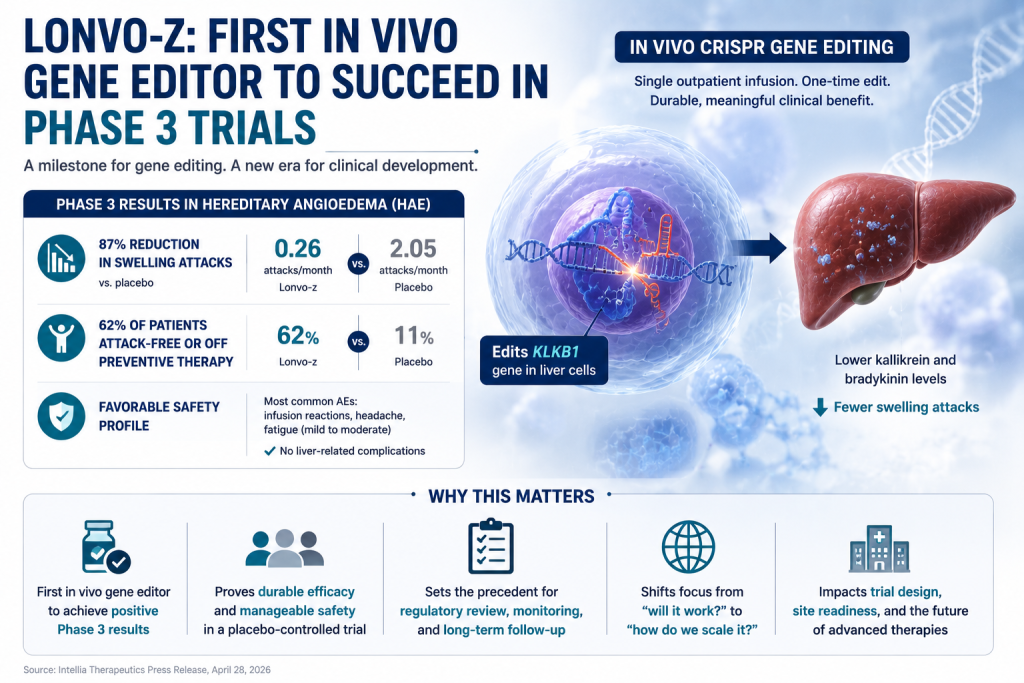
Lonvo-z’s Phase 3 result proves that a single, one-time in vivo edit can produce a durable, clinically meaningful reduction in disease activity without the manufacturing and logistics burden that has defined earlier generations of gene and cell therapy. In the trial, patients treated with lonvo-z averaged roughly 0.26 attacks per month, compared with just over two per month in the placebo group, and 62% of treated patients had zero attacks or no longer required preventive therapy during the roughly six-month observation period, versus 11% of placebo patients. The safety profile was described as favorable, with mild-to-moderate infusion reactions, headache, and fatigue as the most common events, and no liver-related complications reported.
Hereditary angioedema (HAE) is a rare genetic disorder, affecting an estimated 1 in 50,000 people, caused by dysregulation of the kallikrein-kinin pathway that leads to unpredictable, sometimes life-threatening swelling attacks. Lonvo-z works by editing the KLKB1 gene directly inside the patient’s liver cells using CRISPR-based gene editing, permanently lowering the kallikrein and bradykinin levels that drive those attacks. Because the edit happens inside the body rather than in a lab-grown cell product, the therapy is delivered as a single outpatient infusion — a materially different operational model from CAR-T or other ex vivo cell therapies, which require harvesting a patient’s cells, manufacturing them off-site, and reinfusing them under controlled conditions.
That distinction is the reason the trial result is being read as a milestone rather than an incremental data point. Until now, in vivo gene editing had produced encouraging early-phase signals but no Phase 3 success — meaning regulators, payers, and trial sponsors had no precedent for how a one-time in vivo genetic medicine performs against a placebo over a defined follow-up period, or what safety monitoring that follow-up should actually require.
How Will Regulators Respond to the First Approved In Vivo Gene Editor?
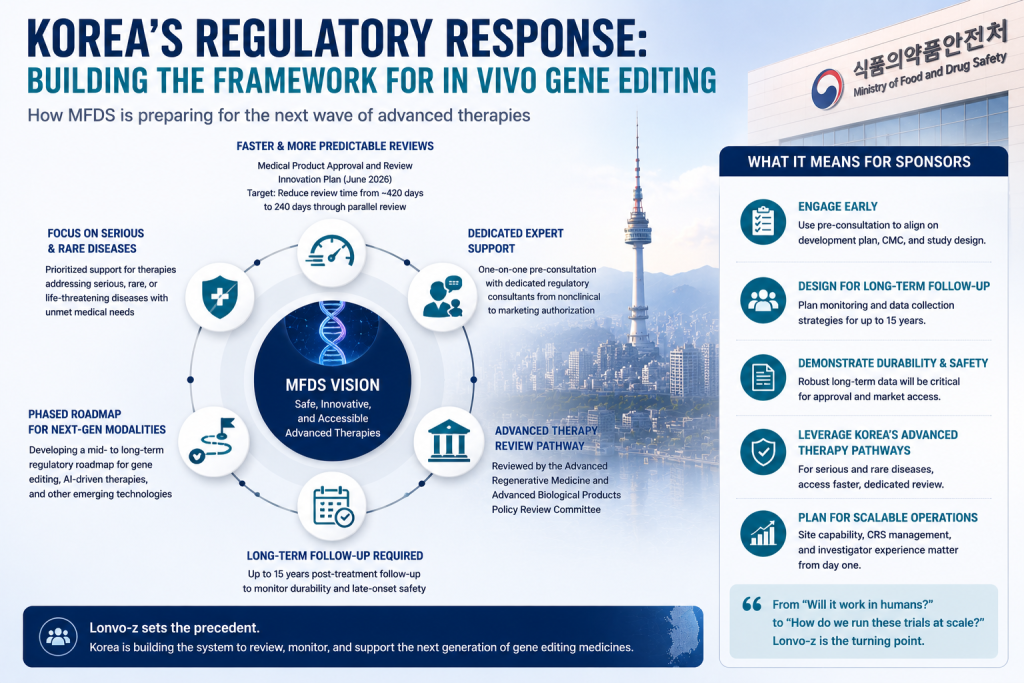
Regulators are likely to treat lonvo-z as the reference case for how in vivo gene-editing therapies should be reviewed, monitored, and followed after approval, and MFDS has already been building the infrastructure to do exactly that. Over the past year, MFDS has expanded pre-consultation services for cell and gene therapy developers, introducing dedicated regulatory consultants who provide end-to-end guidance from nonclinical research through marketing authorization, rather than leaving sponsors to navigate each review stage separately. This sits alongside a broader 2026 initiative — a Medical Product Approval and Review Innovation Plan effective from June 2026 — that is cutting the review timeline for new drugs, biosimilars, and advanced biopharmaceuticals from roughly 420 days toward a 240-day target through parallel review of clinical, non-clinical, and quality data instead of sequential review.
For gene therapies specifically, Korean regulation already requires long-term patient follow-up — up to 15 years post-treatment — reflecting the durability question that any one-time genetic medicine raises: does the effect last, and are there delayed safety signals that only appear years later. Advanced biopharmaceuticals, including gene-editing products, are also evaluated in Korea through a dedicated review structure, the Advanced Regenerative Medicine and Advanced Biological Products Policy Review Committee, which maintains an eligibility list for products treating serious, rare, or life-threatening diseases lacking alternative treatments — the same category HAE falls into.
MFDS has also signaled it will develop a phased, mid-to-long-term regulatory roadmap specifically for next-generation modalities such as AI-enabled gene therapies, suggesting the framework is intended to evolve as more in vivo editing candidates reach late-stage trials rather than being written once and left static.
None of this means Korea’s framework was built in response to lonvo-z specifically. It means that when the first successful in vivo CRISPR trial did arrive, Korea already had a pre-consultation structure, a long-term follow-up requirement, and a faster review pathway in place to apply to it — rather than needing to construct one from scratch.
What Should Sponsors Running Gene-Editing Trials in Korea Expect?
Sponsors planning in vivo gene-editing trials in Korea should expect a regulatory environment that is procedurally faster than it was two years ago, but operationally more demanding than a standard small-molecule trial, particularly around patient identification and long-term follow-up. Rare disease trials of this kind depend on finding a small, dispersed patient population, and Korea’s infrastructure for that is uneven: hereditary angioedema management in Korea has historically relied heavily on older maintenance therapies, and access to newer treatments through channels like the Korea Orphan Drug Center has been limited, which means patient identification for a gene-editing trial cannot rely on assuming an already-diagnosed, treatment-experienced population is easy to find.
Resources such as the Korean Rare Disease Knowledge Base, which consolidates disease summaries, genetic variation data, and a clinic directory, are a starting point for site feasibility work, but sponsors should plan for real investment in diagnosis-rate assessment and site selection rather than treating patient recruitment as a solved problem.
The follow-up obligations that come with gene therapy status in Korea also change what a trial protocol needs to plan for at the outset. A 15-year post-treatment monitoring requirement is not a detail to be resolved after approval — it shapes site selection, data infrastructure, and long-term patient retention strategy from the design stage of the trial. Sponsors that engage MFDS’s expanded pre-consultation pathway early, before finalizing a Korea-specific protocol, are better positioned to align trial design with the follow-up and safety-reporting expectations that apply specifically to this product class, rather than discovering them mid-trial. Intoinworld, a contract research organization focused on clinical trial execution in Korea, works with sponsors navigating exactly this kind of first-in-category regulatory terrain, where the standard playbook for a conventional drug trial does not fully apply.
The Bar Has Moved — Not Just for CRISPR
Lonvo-z’s Phase 3 result closes the question of whether in vivo gene editing can work in a randomized trial and opens a more practical one: which regulatory systems are ready to review, approve, and monitor the next wave of these therapies efficiently. Korea’s combination of expanded pre-consultation for advanced biopharmaceuticals, a faster parallel-review pathway rolling out through 2026, and an existing long-term follow-up framework for gene therapies means the infrastructure question is largely answered — what remains is execution: identifying rare disease patients, designing protocols that account for over a decade of follow-up, and engaging regulators early rather than late.
For global sponsors with in vivo gene-editing or other next-generation modalities in their pipeline, lonvo-z is worth treating as a planning input rather than a headline. It suggests that markets like Korea, which have spent the past year building faster and more consultative pathways specifically for advanced biopharmaceuticals, are positioning themselves to be viable venues for this next generation of trials — provided sponsors approach the operational realities of rare disease recruitment and long-term follow-up with the same seriousness they apply to the science itself.
Planning a Gene-Editing or Rare Disease Trial in Korea?
If your pipeline includes an in vivo gene-editing or other advanced biopharmaceutical candidate, understanding how MFDS’s pre-consultation pathway and follow-up requirements apply to your specific product is worth doing before finalizing a Korea trial design.
Book a Free Korea Trial Consultation →
FAQ
Q1: What is in vivo CRISPR gene editing, and how is it different from CAR-T or other cell therapies?
A: In vivo CRISPR gene editing edits a patient’s DNA directly inside the body using a single administered dose, while CAR-T and other ex vivo cell therapies require removing a patient’s cells, modifying them in a lab, and reinfusing them. This means in vivo gene editing avoids the manufacturing and logistics chain that ex vivo therapies require, but it still needs long-term safety monitoring to confirm the edit’s effects remain durable and predictable over time.
Q2: Has an in vivo CRISPR gene-editing therapy been approved anywhere yet?
A: No therapy has been approved yet; Intellia’s lonvo-z is the first in vivo CRISPR candidate to report positive Phase 3 results, and the company has begun a rolling Biologics License Application (BLA) with the FDA, targeting a potential U.S. launch in the first half of 2027 if approved.
Q3: How does MFDS regulate gene therapies in Korea?
A: MFDS regulates gene therapies as advanced biopharmaceuticals through a dedicated review structure, the Advanced Regenerative Medicine and Advanced Biological Products Policy Review Committee, and requires long-term patient follow-up of up to 15 years post-treatment to monitor durability and delayed safety signals.
Q4: Is Korea a viable location for a rare disease or gene-editing clinical trial?
A: Korea has expanded regulatory infrastructure for advanced biopharmaceuticals, including dedicated pre-consultation services and a faster review pathway rolling out through 2026, but sponsors should plan for real investment in rare disease patient identification, since diagnosis and access to newer treatments for conditions like hereditary angioedema have historically been limited in Korea.
Q5: What should sponsors do differently when planning a gene-editing trial versus a standard drug trial in Korea?
A: Sponsors should engage MFDS’s pre-consultation pathway early in protocol design, since gene therapy status brings requirements — such as multi-year post-treatment follow-up — that need to be built into site selection, data infrastructure, and patient retention planning from the start, rather than addressed after trial initiation.