

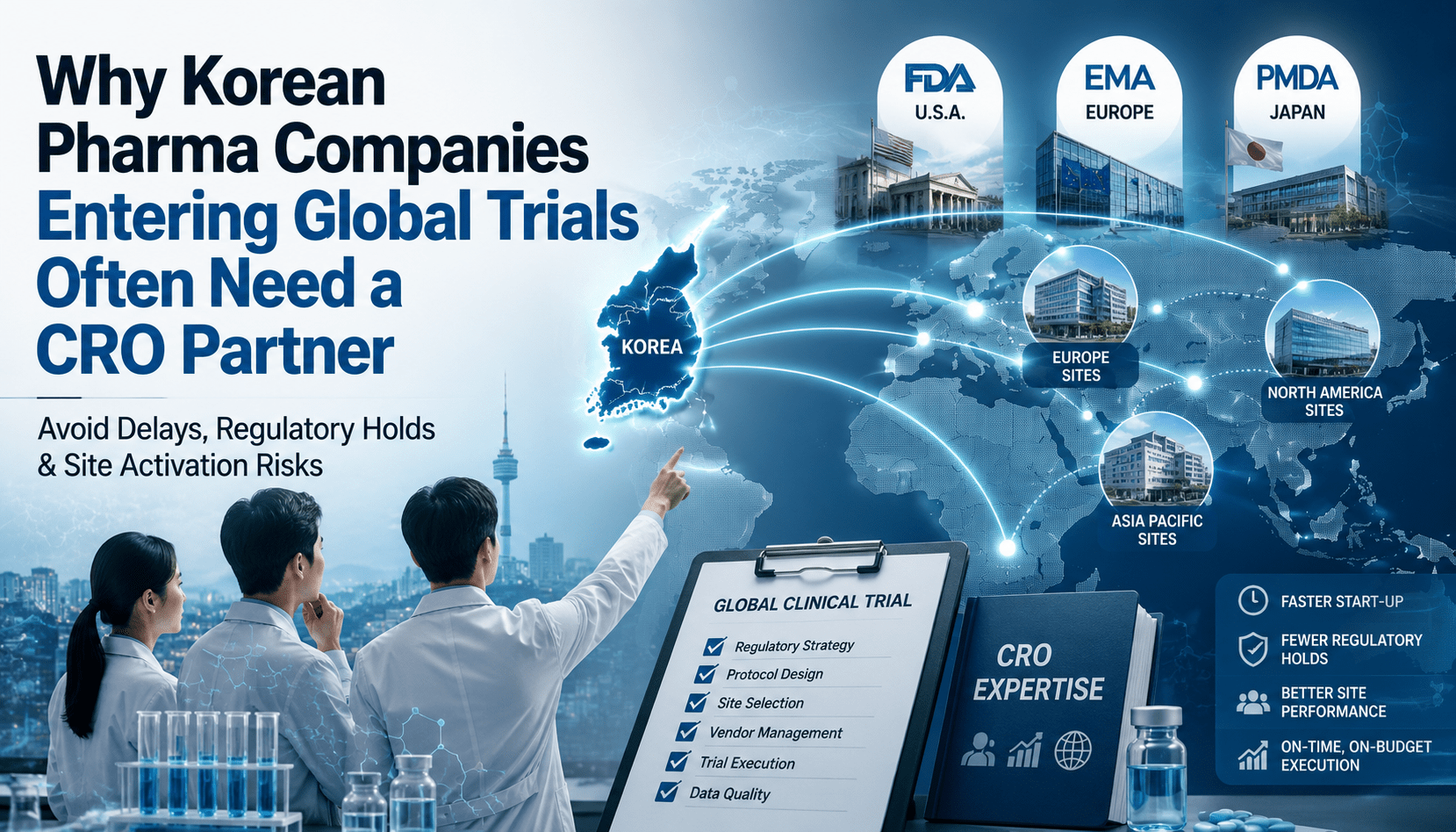
Many Korean pharmaceutical and biotech companies reach a pivotal moment in their pipeline: domestic trials are complete, regulatory data looks solid, and international expansion — an IND filing with the FDA, a CTA submission to the EMA, or a Phase II in Japan — becomes the obvious next move. The science is ready. The ambition is there.
What often follows is a period of unexpected turbulence. Not because the company lacks research capability, but because global clinical trial execution is a fundamentally different operational competency from domestic development. Companies that attempt to navigate this transition independently — without a CRO partner with international experience — consistently encounter the same cluster of avoidable problems.
This article examines what those problems look like in practice, why they arise, and what a structured CRO engagement changes about the outcome.
The Assumption That Makes Global Entry Harder Than It Needs to Be
Korean pharma companies that have successfully completed MFDS-reviewed trials often operate under a reasonable but costly assumption: that familiarity with Korean regulatory processes translates to general regulatory competency. It does not.
The MFDS IND pathway, while rigorous, differs from an FDA IND in ways that go beyond documentation format. The FDA’s expectations around nonclinical pharmacology packages, the structure of investigator brochures, the level of CMC detail required at different phases, and the conventions around risk-benefit framing in the clinical protocol — all of these reflect a distinct regulatory culture that is not intuitive to teams whose entire track record is domestic.
The same applies to the EMA’s IMPD structure, Health Canada’s CTA requirements, and the particularities of PMDA submissions in Japan. Each jurisdiction has its own interpretive conventions, and regulatory guidance documents — however detailed — do not fully capture how reviewers actually assess submissions. That institutional knowledge lives inside experienced CRO teams who have worked these pathways repeatedly.
Companies that underestimate this gap typically discover it at the worst possible moment: after a submission has been filed and a hold or deficiency letter arrives.
Where the First Operational Failures Appear
The earliest visible breakdowns in CRO-independent global trial entry usually fall into one of three areas.
Protocol design misalignment. Clinical protocols developed for Korean trials are optimized for Korean site capabilities, Korean patient populations, and MFDS review expectations. Adapting them for global use requires more than translation. FDA or EMA submissions demand specific endpoint definitions, statistical analysis plan structures, and patient selection criteria that align with international precedent in the relevant therapeutic area. Without regulatory affairs expertise in the target jurisdiction, protocol revisions multiply — and each revision cycle adds weeks.
IRB and ethics committee navigation. Korean companies typically have established relationships with Korean IRBs and understand how to respond to queries. Internationally, IRB structures, turnaround times, and the nature of typical queries vary considerably by country and by institution. Without local knowledge of which ethics committees move faster, what documentation formats they expect, and how to respond to common deficiency patterns, approval timelines stretch unpredictably.
Investigator and site identification. Identifying appropriate investigational sites abroad requires an existing network. Without CRO relationships, companies frequently rely on public databases and cold outreach — an approach that, in competitive therapeutic areas like oncology, yields limited results. Experienced sites receive dozens of site qualification requests. Sponsors without an established relationship with those sites are deprioritized.
The Vendor Coordination Problem Across Borders
In Korea, experienced sponsors have established vendor relationships: local contract labs, imaging vendors, specialty pharmacies, and IVRS providers they have worked with before. These relationships reduce coordination friction and make issue resolution faster.
Internationally, those relationships do not exist. Identifying, qualifying, and contracting vendors in unfamiliar markets — while simultaneously managing the trial itself — requires resources and local knowledge that most Korean pharma companies do not have in-house. The result is a procurement process running in parallel with regulatory activities, both of which generate delays that compound each other.
A CRO with international operational infrastructure brings pre-qualified vendor networks, preferred-provider agreements, and established issue-escalation pathways. The timeline benefit of this alone is significant. The cost of building those relationships from scratch, on a live trial, is rarely anticipated in project budgets.
What the Timeline Cost Actually Looks Like
Global trial entry without CRO support does not usually fail catastrophically. More commonly, it slows — in ways that are difficult to attribute to any single decision.
A submission that could have been filed in four months takes seven. Site activation that should have taken six weeks takes four months. A patient recruitment target that assumed a certain enrollment rate falls behind schedule because site selection was based on available data rather than real operational knowledge. Each of these delays is individually explainable. Cumulatively, they represent a material impact on development timelines and, ultimately, on market entry.
In highly competitive therapeutic areas — oncology, rare disease, CNS — these timeline differences are not merely operational inconveniences. They affect competitive position, partnership terms, and licensing negotiation leverage.
What Changes When a CRO Is Involved from the Start
The most effective CRO engagements in global trial entry are not those where the CRO is brought in to rescue a troubled program. They are ones where the CRO is engaged during protocol finalization — before regulatory strategy is locked, before sites are selected, and before vendor contracts are signed.
At that stage, a CRO with international experience contributes regulatory strategy input that shapes how the protocol is written, not just how it is submitted. It brings site feasibility data that influences which countries are included in the trial. It brings vendor contracts that are already in place. And it brings a project management infrastructure that has handled the same operational complexity before.
The difference in outcome is not primarily about what goes wrong in one scenario versus another. It is about what the team knows before decisions are made, and how much of the learning curve has already been paid for by prior engagements.
Conclusion
Korean pharmaceutical companies entering global clinical trials are not lacking in scientific rigor or regulatory sophistication in their home market. What the global expansion stage requires is a different kind of infrastructure — international regulatory expertise, operational networks across jurisdictions, and site and vendor relationships that take years to build.
Companies that attempt to develop this infrastructure independently, on a live trial, consistently find that the cost of doing so — in time, in protocol revisions, in recruitment delays — exceeds the cost of a CRO engagement by a wide margin. The question is not whether to engage a CRO partner for global entry. It is when, and with how much of the program’s design still open to input.
Are You Planning a Global Clinical Trial from Korea?
If your pipeline is ready for international expansion and you want to understand what a CRO engagement looks like in practice, NexBridge Bio can provide a detailed scope assessment before any commitment is made.
Q1: At what stage should a Korean pharma company engage a CRO for global trial entry?
The optimal point is during protocol development, before the regulatory strategy is finalized. At this stage, CRO input can shape the trial design in ways that reduce downstream revision cycles. Engaging a CRO after submission — or after site activation problems have emerged — is possible but yields a smaller efficiency benefit.
Q2: What is the difference between a Korean CRO and an international CRO for global trials?
Korean CROs with strong domestic networks may not have the international site relationships, foreign regulatory affairs expertise, or vendor infrastructure needed for trials outside Korea. Companies planning multi-country trials benefit most from CROs that have operational experience in the specific target jurisdictions — not just general international capability.
Q3: How does CRO involvement affect the cost of global trial entry?
CRO fees are a defined line item. The costs of going without a CRO — extended regulatory review, site activation delays, protocol amendments, vendor sourcing overhead — are distributed across multiple budget categories and are typically harder to forecast. In practice, companies that have completed both approaches consistently find that CRO-supported programs run closer to original budget and timeline projections.
Q4: Do Korean regulatory submissions provide useful precedent for FDA or EMA applications?
Korean MFDS submissions provide a valuable safety and efficacy evidence base. However, the format, content expectations, and review conventions of FDA INDs and EMA CTAs differ substantially from MFDS requirements. Prior Korean submissions are informative starting points, not transferable templates.
Q5: What happens if a company files an FDA IND without CRO support and receives a clinical hold?
A clinical hold issued by the FDA requires a formal response that addresses each cited deficiency. Preparing that response — and understanding what the FDA’s underlying concern actually is — requires FDA regulatory expertise. Companies without that expertise in-house typically require CRO or regulatory consulting support at that point anyway, with the added cost of the hold period already embedded in the timeline.