

Introduction
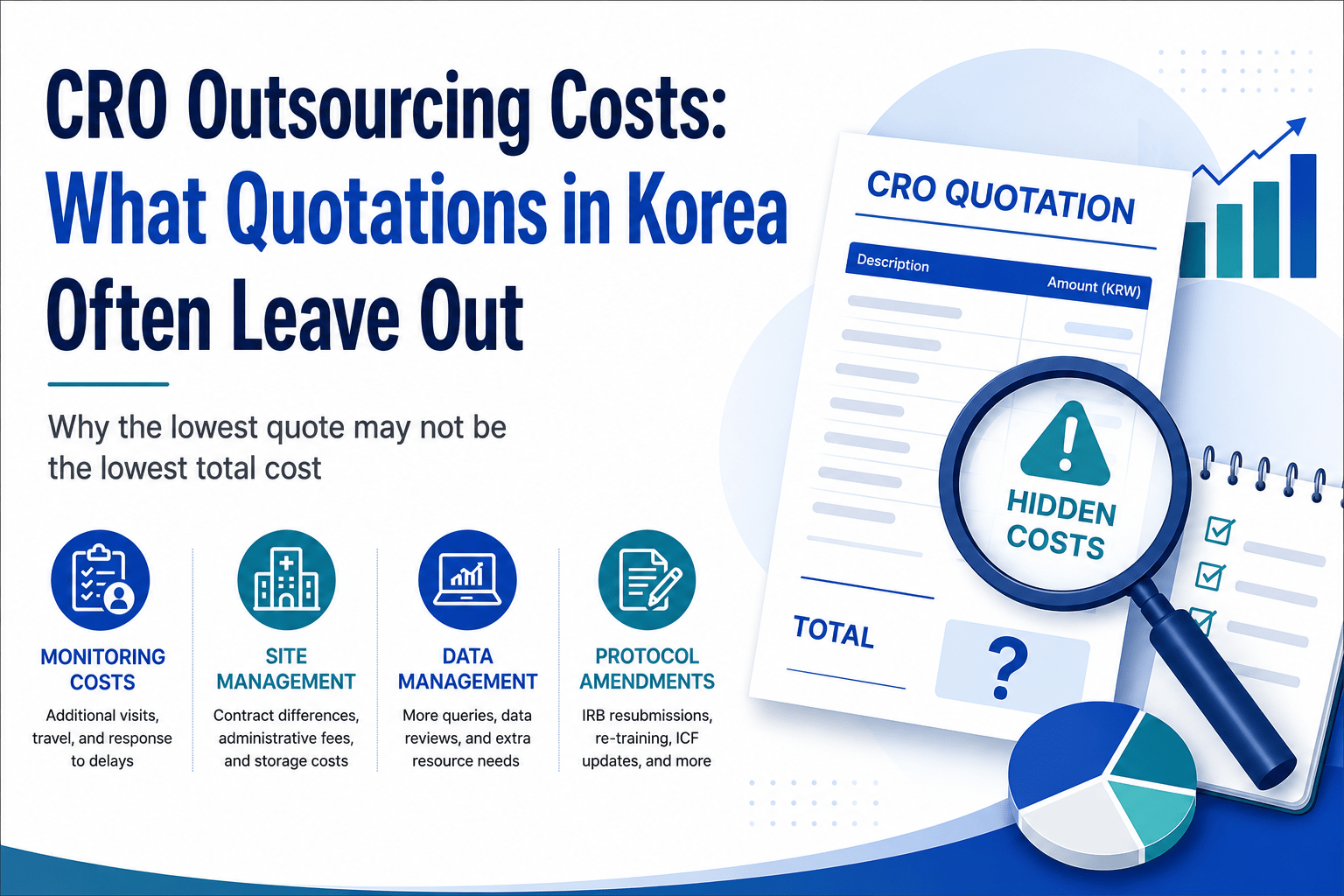
When a sponsor decides to outsource a clinical trial in Korea, the first concrete step is usually collecting quotations from several CRO candidates and lining them up side by side. The natural instinct is to rank these proposals by their bottom-line total and treat the lowest or most reasonable figure as the strongest contender.
Experience across multiple trials tells a different story. The total on a quotation rarely matches the actual cost incurred once a study is underway. Items that were not fully captured at the proposal stage tend to surface only after the CRO has been selected and the contract signed — at which point there is little room left to renegotiate.
This is not usually a matter of deliberate omission. It reflects a structural reality: several cost drivers cannot be finalized until specific variables are known, and those variables are often undetermined at the time a quotation is prepared. For sponsors, the more useful exercise is not comparing totals, but understanding the assumptions behind each number. This article looks at which cost categories are most often underrepresented in Korea CRO quotations, why that happens, and what sponsors can do to evaluate proposals more accurately.
Where Quotations Tend to Fall Short
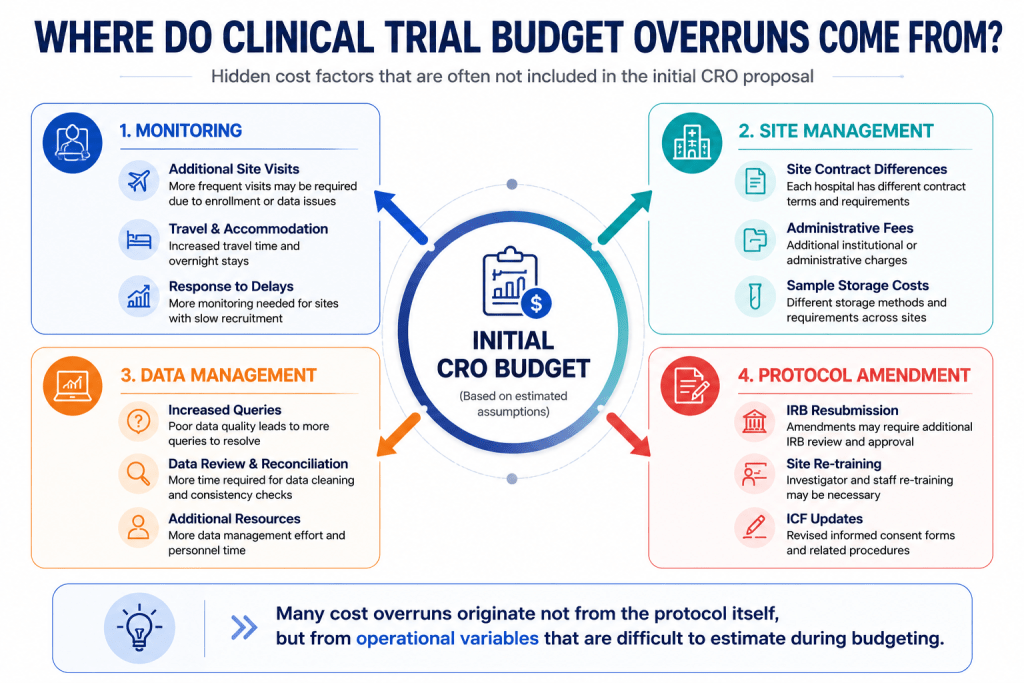
The most common gap appears in monitoring-related costs. Quotations typically present a standardized visit frequency and unit rate, but actual visit cadence depends on enrollment pace, data entry quality, and protocol adherence at each site. A site that enrolls more slowly than projected may require adjusted monitoring frequency, generating travel costs that were not built into the original estimate. Sites located farther from major metropolitan areas can also introduce travel time and overnight stays that shift the underlying cost structure.
A second frequently overlooked area is the variation in site-level contract terms. Hospitals in Korea differ in their administrative procedures, sample storage requirements, and internal approval processes. Some sites move through standard contracting quickly, while others require additional administrative steps or separate storage arrangements. Because the final site list is often not confirmed when quotations are prepared, these site-specific differences are difficult to reflect accurately at the proposal stage.
A third category involves data management and downstream work. The volume of queries generated during data consistency checks — and the time required to resolve them — varies considerably depending on the data entry quality at each site. When query volume runs higher than anticipated, the data management workload increases beyond what a standardized cost assumption can absorb.
Finally, the cost structure around protocol amendments is often underspecified in initial quotations. Amendments are not an unusual occurrence during a trial, but whether the associated costs — IRB re-review, site retraining, informed consent updates — are partially built into the base quotation or billed separately when they occur varies by CRO. Without clarity on this point upfront, amendment-driven cost discussions tend to surface unexpectedly mid-study.
Why These Gaps Persist
The underlying reason these items go unaddressed is that many sponsors evaluate CRO proposals primarily on price. Lining up several quotations and comparing totals simplifies the decision, but it also tends to skip over the step of examining what assumptions sit behind each figure. Even for the same scope of work, CROs differ in the monitoring frequency, staffing level, and contingency margin they assume — which means a simple total-to-total comparison often provides less comparable information than it appears to.
There is also a structural timing issue. Feasibility-stage quotations are frequently prepared before the final site list is confirmed, which forces CROs to rely on average assumptions rather than site-specific data. Only once sites are selected and contracted do the concrete cost variables become visible. Sponsors should keep in mind that a quotation, by its nature, carries a degree of estimation built in.
The frequency and depth of communication between sponsor and CRO also affects estimation accuracy. When detailed requirements and constraints are not shared early, the CRO is left to build a quotation on limited information, which can skew toward either conservative or optimistic assumptions. Conversely, the more specific information a sponsor provides upfront, the more accurate the resulting estimate tends to be.
It is also worth noting that some CROs deliberately submit conservative initial figures to remain competitive in the bidding process. This is less a case of intentional omission and more a reflection of common market practice — and sponsors benefit from recognizing this pattern when interpreting quotations.
What Sponsors Should Check to Get an Accurate Picture
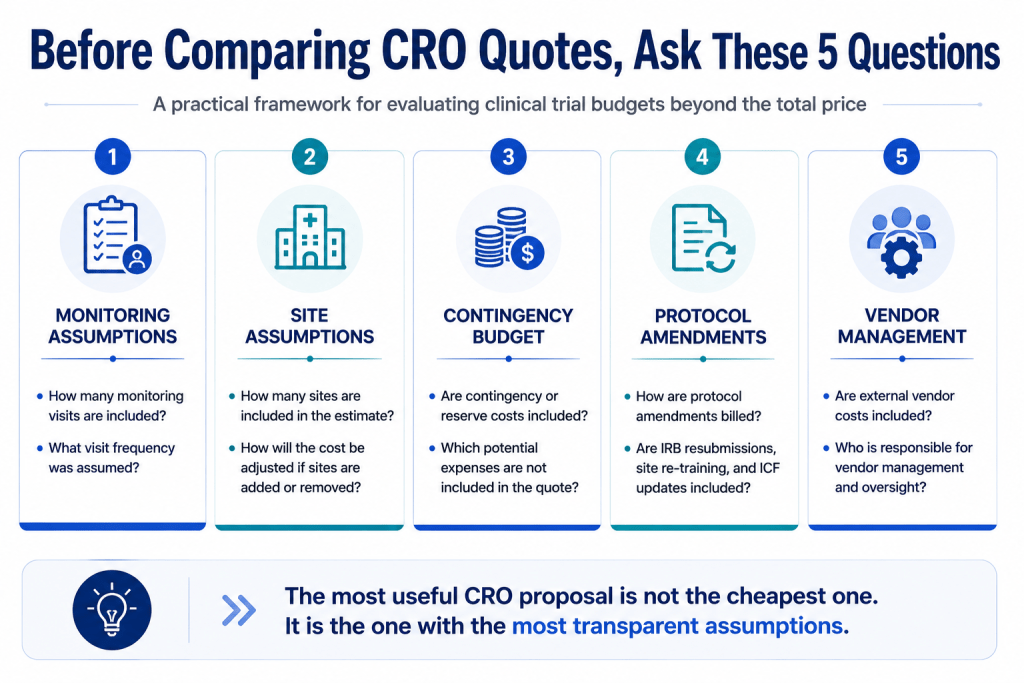
Given these structural limitations, the most practical step a sponsor can take is to ask each CRO to clarify the basis for every line item. Understanding what visit frequency a monitoring estimate assumes, how costs adjust if the number of sites changes, and whether contingency is built into the figure provides far more useful information than comparing totals alone.
Discussing potential cost variation scenarios before signing is equally important. Agreeing in advance on how costs will be handled if a protocol amendment occurs, sites are added, or monitoring frequency needs adjustment due to enrollment delays reduces the likelihood of friction or delay when these scenarios materialize.
Perhaps the most useful evaluation criterion is how transparently a CRO communicates about budget in the first place. A CRO that can clearly explain the basis for its cost estimates tends to carry that same openness into broader project communication. A CRO that struggles to explain the detail behind its quotation is more likely to show similar difficulty when changes need to be communicated mid-study.
Ultimately, evaluating a quotation is less about finding the lowest number and more about identifying the CRO that provides the most reliable information. Sponsors who make this shift tend to encounter fewer unexpected budget conversations later in the project and maintain more stable overall cost control.
Conclusion
Comparing CRO quotations is an unavoidable step in outsourcing a clinical trial, but comparing totals alone rarely predicts the actual cost of execution. Monitoring frequency, site-level contract variation, data management workload, and protocol amendment costs are all categories that structural timing makes difficult to fully capture at the proposal stage.
Reviewing these categories in advance — and assessing how transparently a CRO can explain its cost assumptions — is a more reliable starting point for budget planning than ranking by total alone. Moving past price comparison to ask about underlying assumptions meaningfully reduces budget-related risk later in the project.
Planning a Clinical Trial in Korea?
If you have questions about Korea clinical trial cost structures or how to evaluate CRO proposals, a consultation can help clarify the right next step.
FAQ
Q1. What should sponsors check first when comparing CRO quotations?
Before comparing totals, ask each CRO to explain the assumptions behind their line items — monitoring visit frequency, assumed number of sites, and whether contingency is included. This makes meaningful comparison possible across proposals.
Q2. How are costs adjusted when a protocol amendment occurs?
This varies by CRO. Some build a margin for amendment-related work into the base quotation, while others bill it separately as it arises. Clarifying this during contracting avoids surprises later.
Q3. Why does monitoring cost vary from site to site?
Visit frequency and travel cost depend on a site’s location, enrollment pace, and data entry quality. Slower-enrolling sites may require additional visits, and sites farther from major cities can add travel and accommodation costs.
Q4. What happens when a quotation is prepared without complete information?
At the feasibility stage, when the final site list isn’t yet confirmed, CROs must rely on average assumptions. Once specific sites are selected, concrete cost variables emerge — which can create a gap between the initial estimate and actual cost.
Q5. How can sponsors judge whether a CRO is transparent about budget?
Look at whether a CRO can clearly explain the basis for each cost item and whether it’s willing to discuss potential cost variation scenarios upfront. This communication style tends to carry over into how the CRO handles other decisions during the project.