

Why Operational Alignment Matters More Than Ever in 2026
As global clinical trials become increasingly complex, successful execution depends on much more than regulatory approval and site activation.
In the past, many sponsors viewed vendor management as a secondary operational function that could be addressed after key milestones had been achieved. Today, however, vendor coordination has become one of the most important factors influencing clinical trial startup, study execution, and overall project success.
This trend is particularly visible in Korea, where hospitals, sponsors, CROs, and multiple external vendors often need to work together within highly structured operational environments.
As oncology, ADC, cell and gene therapy, and rare disease studies continue to grow in complexity, effective vendor coordination is becoming a critical component of Korea clinical trial strategy.
Understanding how vendor coordination impacts trial execution can help sponsors build more realistic operational plans and reduce avoidable delays throughout the study lifecycle.
Why Vendor Coordination Has Become Increasingly Important
Modern clinical trials involve significantly more stakeholders than they did a decade ago.
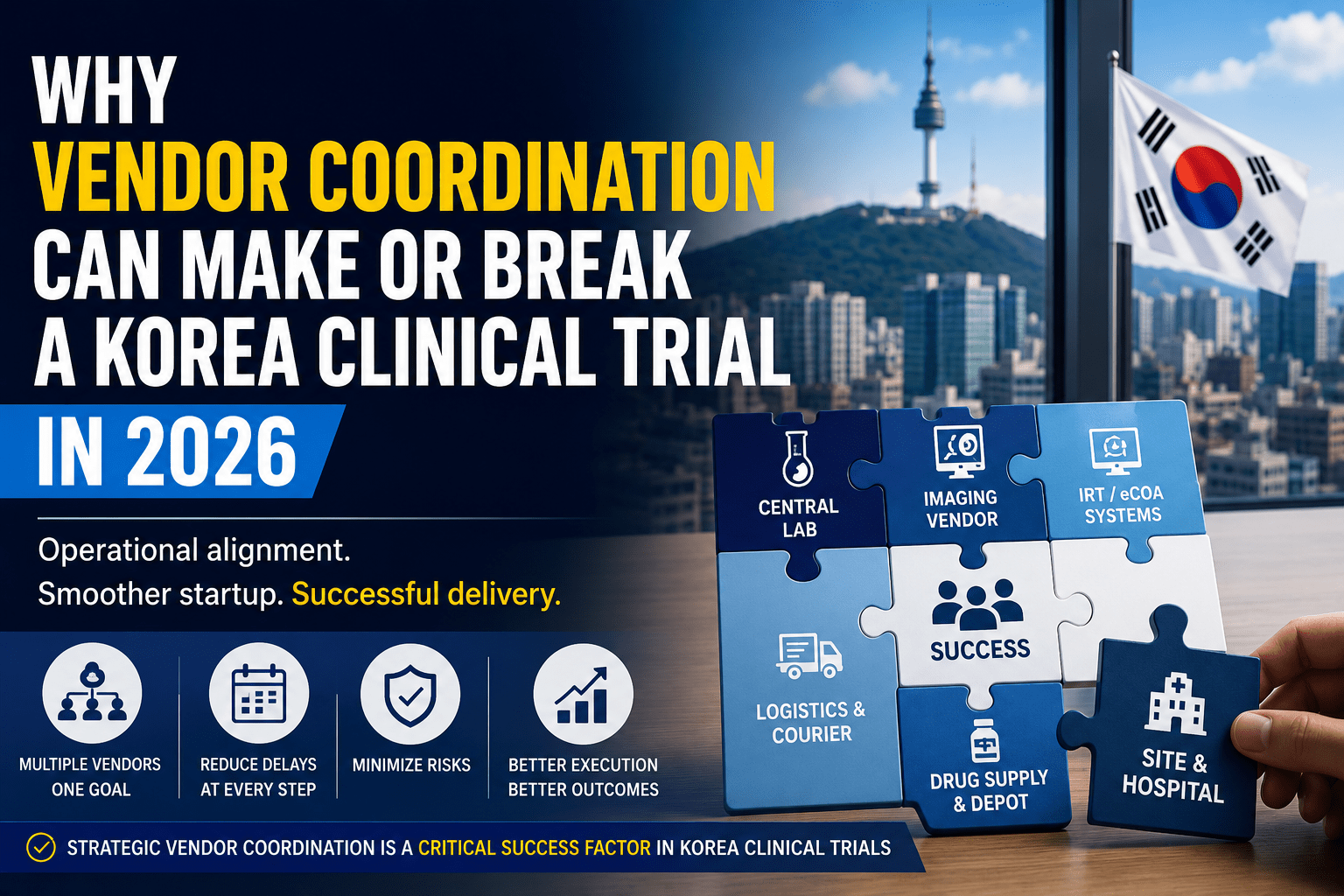
A typical global study may require support from central laboratories, imaging providers, electronic data systems, drug supply partners, biological sample logistics providers, and various specialized service vendors.
While each vendor may be responsible for a specific function, successful trial execution depends on all parties operating in alignment.
When communication gaps occur between vendors, sites, hospitals, and sponsors, even small operational issues can quickly create broader project delays.
As protocol complexity increases, the importance of coordination between multiple operational partners continues to grow.
For many global sponsors, vendor management is no longer simply an administrative task—it has become a strategic execution function.
What Types of Vendors Are Commonly Involved in Korea Clinical Trials?
Many sponsors are surprised by the number of vendors that may be involved in a single study.
Depending on the protocol, a Korea clinical trial may require coordination among central laboratories, local laboratories, imaging review providers, interactive response technology systems, electronic patient-reported outcome platforms, electronic clinical outcome assessment systems, drug depots, temperature-controlled logistics providers, biological sample shipping partners, and other specialized vendors.
In more complex studies, particularly in oncology and precision medicine programs, the number of participating vendors can increase significantly.
Each vendor plays an important role within the overall study ecosystem.
However, because these vendors often operate independently from one another, effective communication and coordination become essential for maintaining study timelines.
The challenge is not simply managing individual vendors, but ensuring that all operational activities remain synchronized throughout the project.
Why Vendor Coordination Is Particularly Important in Korea
Vendor coordination can be challenging in any country, but Korea presents several unique operational considerations.
Korean hospitals typically operate within highly structured administrative environments. Clinical trial activities often involve multiple departments, including clinical trial centers, pharmacy teams, investigators, study coordinators, laboratories, and hospital administration.
As a result, vendors are rarely working directly with sponsors alone.
Instead, operational activities frequently require coordination among sponsors, CROs, hospitals, investigators, coordinators, and multiple external service providers simultaneously.
This creates a more interconnected operational ecosystem where communication efficiency becomes increasingly important.
When one operational component falls behind schedule, multiple downstream activities may also be affected.
For this reason, successful vendor coordination often plays a larger role in Korea trial execution than many sponsors initially expect.
How Vendor Coordination Can Impact Trial Startup
Many startup delays occur not because of regulatory issues, but because critical operational components are not fully aligned.
For example, a site may be ready to begin patient screening, but central laboratory kits have not yet arrived.
In another scenario, site activation may be completed, but an electronic data collection system is not fully configured.
Drug supply logistics, laboratory readiness, imaging setup, and system implementation all require precise timing to support startup activities.
When one vendor experiences delays, the impact can extend far beyond a single operational task.
Because startup activities are interconnected, vendor-related delays can affect site activation, patient screening, first patient enrollment, and overall project timelines.
As a result, many sponsors are beginning to view vendor coordination as a startup-critical activity rather than a support function.
Why Oncology and ADC Studies Require More Complex Vendor Coordination
The importance of vendor coordination becomes even more apparent in oncology and ADC studies.
These programs often involve extensive biomarker testing, imaging assessments, pharmacokinetic sample collection, specialized laboratory analysis, temperature-controlled logistics, and complex safety monitoring procedures.
Each of these activities may involve different vendors operating across multiple locations.
As study complexity increases, the number of required operational interactions increases as well.
For example, a single patient visit may depend on successful coordination among hospitals, laboratories, imaging providers, courier services, and electronic systems.
Any disruption within this network can potentially impact study timelines and data collection activities.
This is one reason why oncology and ADC studies frequently require more proactive vendor oversight than traditional clinical programs.
Why Successful Trial Execution Depends on More Than Regulatory Strategy
Historically, many sponsors focused heavily on regulatory approvals, ethics committee submissions, and site activation milestones.
While these activities remain important, they represent only part of the overall execution process.
Increasingly, successful trial delivery depends on operational consistency across multiple stakeholders.
Sponsors are recognizing that study success is often determined by how effectively different operational partners work together after approvals have been obtained.
In many projects, execution challenges arise not from regulations themselves, but from communication gaps, workflow misalignment, and coordination inefficiencies among participating organizations.
As global studies become more sophisticated, operational alignment is becoming just as important as regulatory readiness.
How Sponsors Can Build Stronger Vendor Coordination Strategies
Sponsors that achieve successful execution in Korea often begin vendor planning earlier than expected.
Rather than managing vendors individually, they focus on understanding how different operational activities connect throughout the study lifecycle.
Early planning can help identify potential dependencies between vendors, hospitals, and study milestones before problems emerge.
Clear communication pathways, defined responsibilities, and proactive risk identification can also help improve operational visibility throughout the project.
Most importantly, successful sponsors increasingly view vendor coordination as an integrated component of study strategy rather than a separate operational activity.
As Korea clinical trials continue to grow in complexity, this integrated approach is becoming increasingly valuable.
Conclusion: Vendor Coordination Is Becoming a Critical Success Factor in Korea Clinical Trials
Korea remains one of the most attractive clinical trial markets in Asia, offering strong research infrastructure, experienced investigators, advanced hospitals, and high-quality clinical data.
However, as study complexity continues to increase, successful execution depends on more than regulatory approvals and site activation alone.
Vendor coordination is emerging as a major factor influencing startup efficiency, operational stability, and overall project success.
For global sponsors planning studies in Korea, understanding how multiple vendors interact within the broader clinical trial ecosystem is becoming increasingly important.
In many cases, the difference between a smooth study and a delayed study is not regulatory speed—it is operational alignment.
Planning a Clinical Trial in Korea?
NexBridge Bio supports global sponsors with Korea clinical trial feasibility assessment, startup planning, vendor coordination strategy, hospital communication, and local operational execution.
If you are evaluating Korea as part of your global development program, feel free to connect with the NexBridge Bio team to discuss your clinical trial planning needs.
Frequently Asked Questions (FAQ)
Q1: Why is vendor coordination becoming more important in Korea clinical trials?
As clinical trials become more complex, sponsors increasingly rely on multiple vendors to support different aspects of study execution. In Korea, these vendors often need to coordinate closely with hospitals, investigators, study coordinators, and CRO teams. Effective vendor alignment helps reduce operational disruptions and supports smoother study execution.
Q2: What types of vendors are typically involved in a Korea clinical trial?
Depending on the study design, vendors may include central laboratories, local laboratories, imaging review providers, electronic data collection system providers, electronic patient-reported outcome platforms, drug supply partners, temperature-controlled logistics companies, and biological sample transportation providers. More complex studies often require a larger vendor network.
Q3: Can vendor-related issues delay trial startup in Korea?
Yes. In many cases, startup delays occur when critical operational activities are not fully aligned. Delays involving laboratory kits, electronic systems, drug supply logistics, imaging setup, or vendor readiness can affect site activation, patient screening, and enrollment timelines.
Q4: Why do oncology and ADC studies require more vendor coordination?
Oncology and ADC studies often involve biomarker testing, imaging assessments, pharmacokinetic sample collection, specialized laboratory analysis, and temperature-controlled logistics. These activities typically require support from multiple vendors, making operational coordination significantly more complex than in many traditional clinical studies.
Q5: How can sponsors improve vendor coordination during Korea clinical trial execution?
Sponsors can improve coordination by identifying vendor dependencies early, establishing clear communication channels, defining responsibilities across stakeholders, and monitoring operational milestones proactively. Early planning and continuous alignment between vendors, hospitals, CROs, and sponsor teams can help reduce execution risks throughout the study lifecycle.