
This is Vol.72 Newsletter for February 2026.
In this issue, we cover the approaching patent cliff driving a new wave of biosimilar competition, the regulator’s shift toward full-cycle support for rare disease drug development, and how Alzheimer’s R&D and dealmaking are moving from single assets to platform-led strategies (including BBB delivery). We also highlight practical lessons from a hospital pilot on scalable medical AI (sLLMs and shared infrastructure), the growing role of depression digital therapeutics as prescription-based RWE accumulates, and the 2026–2030 national cancer plan’s push for liquid biopsy, multimodal data, and cancer AI to accelerate translation into care.
Korean biosimilars gear up for wave of blockbuster patent expiries
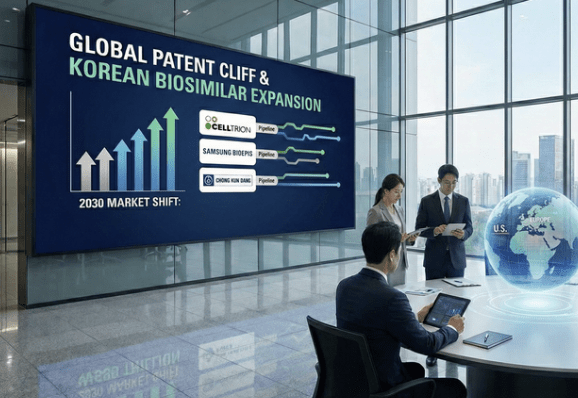
~200 drugs lose exclusivity by 2030, including ~70 blockbusters, fueling a Korean biosimilar race. Developers ускорate trials and patent settlements for first-mover launches, while originators use evergreening and new formulations (e.g., subcutaneous switches) to delay competition.
MFDS bets on early intervention to cut rare disease drug delays

MFDS is rolling out a full-cycle framework for rare disease drugs, linking early regulatory alignment, more flexible orphan designation, and expedited/priority reviews. The aim is to cut trial-and-error with limited patient data, speed approvals (sometimes on phase 2 evidence with post-approval data), and shift regulators from gatekeepers to development partners.
In the Alzheimer’s market, Big Pharma’s focus shifts from drugs to technological value.

Alzheimer’s R&D is shifting to disease-modifying therapies and multi-target approaches, with BBB delivery platforms becoming a core battleground. Dealmaking is moving from late-stage assets to early-stage platforms and package deals, with more milestone-based payments to share risk.
Medical AI adoption blocked by high-efficiency systems…
A national, low-cost model is the answer.

A report urges scalable AI platforms, low-cost small language models, and national cloud/GPU infrastructure to speed adoption. A pilot using on-premise sLLMs cut discharge documentation time 66% and burden 37%. Government will fund AI treatment systems across 17 hospitals nationwide.
Depression Treatment with ‘Electro-Pills’…
The Customized Treatment Market Grows

Korea’s depression digital therapeutics market is expanding as approvals and prescription-based RWE grow. A new app was designated an innovative device, joining two existing options. Adoption is rising, with large prescription volumes and trial data suggesting meaningful symptom improvement, supporting non-drug, home-based, personalized care alongside medication.
Strengthening early precancerous screening and precision diagnosis…Expanding AI-based cancer research.

Korea’s 2026–2030 cancer plan will boost research on precancerous biomarkers and liquid biopsy, while supporting advanced targeted therapies like CGT/CAR-T. It also aims to build response/resistance prediction platforms, expand multimodal cancer data, develop a cancer AI foundation model, and strengthen clinical research networks to speed translation into care.

