

Why Patient Recruitment Matters More Than Ever
Patient recruitment remains one of the most critical factors influencing clinical trial success.
A study may receive regulatory approval, activate sites on schedule, and have experienced investigators in place. However, if patient enrollment falls behind expectations, timelines quickly begin to slip.
For global sponsors, delayed recruitment often leads to:
- Extended study timelines
- Increased operational costs
- Additional site activation
- Protocol amendments
- Delayed development milestones
While regulatory and operational challenges receive significant attention, patient recruitment is often the factor that ultimately determines whether a study succeeds or struggles.
In Korea’s highly competitive clinical research environment, understanding recruitment realities is essential for building realistic development plans.
The Common Assumption: “The Patients Exist, Therefore Recruitment Will Be Easy”
One of the most common mistakes in clinical trial planning is assuming that a large patient population automatically translates into successful enrollment.
In reality, patient availability and patient eligibility are not the same thing.
A disease may affect thousands of patients, but only a small proportion may qualify for a specific clinical trial.
For example:
- Patients may not meet inclusion criteria.
- Patients may be receiving alternative therapies.
- Patients may be participating in competing studies.
- Patients may decline trial participation.
- Patients may fail screening assessments.
This is why recruitment forecasts based solely on disease prevalence frequently overestimate actual enrollment potential.
Patient Recruitment Funnel
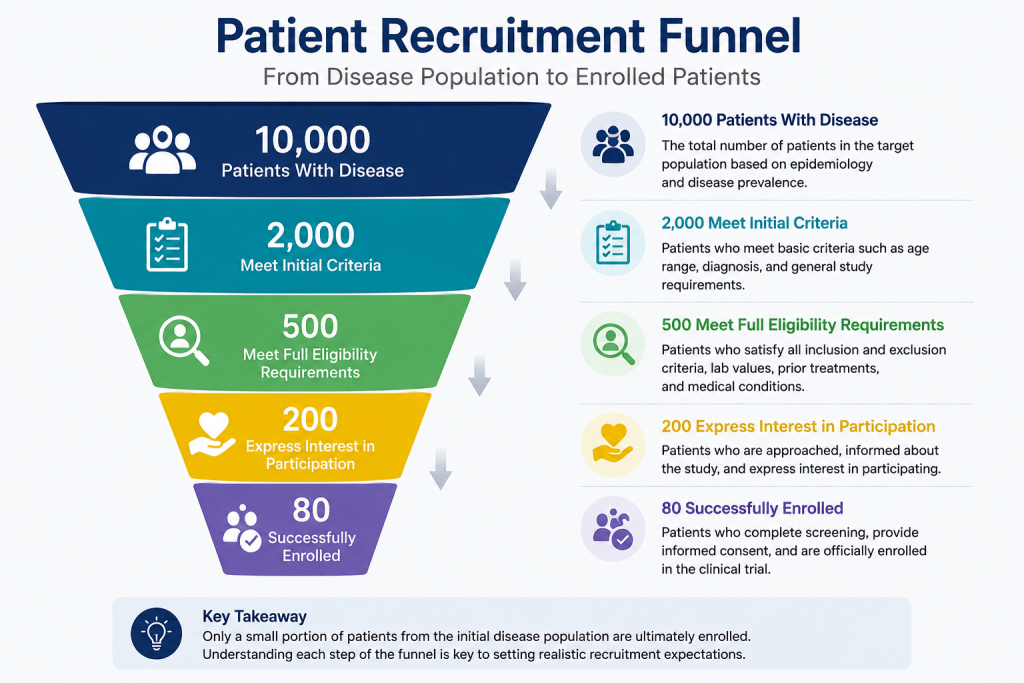
10,000 Patients With Disease → 2,000 Meet Initial Criteria → 500 Meet Full Eligibility Requirements
→ 200 Express Interest in Participation80 Successfully Enrolled
This gap between theoretical patient populations and actual enrolled participants is often much larger than sponsors initially expect.
Why Recruitment Assumptions Often Fail in Korea
Competition Between Clinical Trials
South Korea is one of Asia’s leading clinical research markets.
Major hospitals frequently participate in multiple global clinical trials at the same time.
As a result:
- Similar studies often compete for the same patients.
- Enrollment opportunities can become limited.
- Recruitment forecasts may become outdated quickly.
A feasibility assessment conducted several months earlier may not accurately reflect the competitive landscape at study startup.
Sponsors should recognize that patient availability is constantly changing.
Investigator Optimism
Investigators are generally enthusiastic about supporting new research opportunities.
During feasibility discussions, projected enrollment numbers may represent best-case scenarios rather than real-world recruitment performance.
While investigator input remains valuable, sponsors should also consider:
- Historical enrollment performance
- Current competing studies
- Site workload
- Available recruitment resources
Enrollment estimates should always be validated using objective data whenever possible.
Overly Restrictive Eligibility Criteria
Modern clinical trials continue to introduce increasingly complex eligibility requirements.
Common limitations include:
- Biomarker requirements
- Previous treatment restrictions
- Comorbidity exclusions
- Washout period requirements
- Laboratory value thresholds
Although a disease may be common, the number of patients who satisfy all protocol requirements can be surprisingly small.
This challenge is particularly common in oncology, rare disease, and precision medicine studies.
Changes in Standard of Care
Treatment landscapes can change rapidly.
New therapies, reimbursement decisions, and updated treatment guidelines may significantly affect patient availability.
A protocol designed one or two years ago may face a completely different treatment environment by the time recruitment begins.
This is especially relevant in therapeutic areas such as:
- Oncology
- Immunology
- Rare disease
- Cell and gene therapy
Sponsors should continuously reassess recruitment assumptions throughout study planning.
Site Capacity Limitations
Even when eligible patients exist, recruitment may still be limited by site capacity.
Common operational constraints include:
- Limited study coordinator availability
- High investigator workload
- Multiple competing trials
- Resource limitations
Patient recruitment success depends not only on patient availability but also on a site’s ability to identify, screen, and enroll participants efficiently.
The Gap Between Feasibility and Recruitment Reality
One of the most common causes of recruitment delays is the difference between projected enrollment and actual enrollment.
Feasibility Projection
“We expect to recruit 10 patients per month.”
Recruitment Reality
“Only 2–3 patients per month meet all eligibility criteria and agree to participate.”
This gap is often responsible for substantial timeline extensions.
Feasibility assessments are important planning tools, but they should never be treated as enrollment guarantees.
Sponsors who recognize this distinction are better positioned to manage recruitment risks proactively.
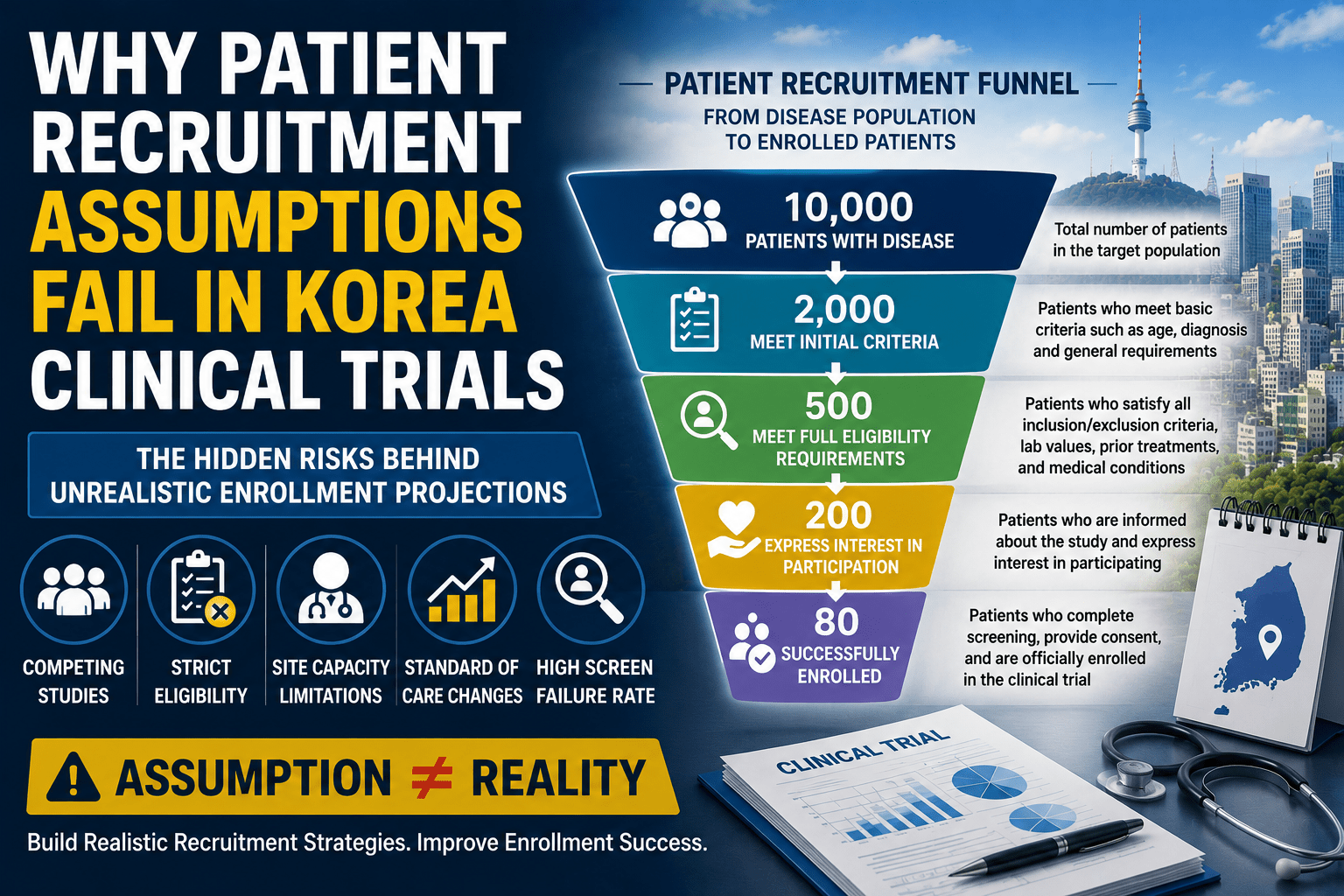
Top Recruitment Risk Factors in Korea
Several factors consistently contribute to recruitment challenges in Korean clinical trials.
Competition From Similar Studies
Multiple global studies may target the same patient population simultaneously.
Restrictive Eligibility Criteria
Complex inclusion and exclusion requirements reduce the eligible patient pool.
Site Operational Capacity
Limited staff and competing priorities can affect recruitment performance.
Changes in Standard Treatment Practices
Evolving treatment options may reduce patient availability.
High Screening Failure Rates
Many patients who initially appear eligible may ultimately fail screening procedures.
Understanding these risk factors can significantly improve enrollment planning and forecasting accuracy.
How Sponsors Can Improve Recruitment Predictability
Conduct Detailed Feasibility Assessments
Sponsors should evaluate:
- Current patient flow
- Competing studies
- Site capacity
- Historical enrollment performance
- Screening failure rates
rather than relying solely on disease prevalence data.
Validate Enrollment Assumptions
Historical recruitment performance often provides more reliable insight than projected estimates.
Sites that consistently deliver strong enrollment results are generally more predictable partners.
Engage Sites Early
Early communication helps identify recruitment challenges before startup activities begin.
Sponsors can gain valuable insights regarding patient availability, competing studies, and operational constraints.
Monitor the Competitive Landscape
Recruitment conditions can change rapidly.
Regular market and site reassessments help maintain realistic enrollment expectations throughout the study lifecycle.
Build Conservative Recruitment Forecasts
Aggressive enrollment assumptions often create unnecessary project risk.
Conservative projections may appear less ambitious, but they typically result in more realistic planning and execution.
Recruitment Success Starts Long Before First Patient In
Patient recruitment challenges rarely begin after study activation.
In most cases, the underlying risks are already visible during feasibility assessments and startup planning.
Successful sponsors understand that recruitment is not simply about finding patients.
It is about accurately evaluating:
- Patient availability
- Site capacity
- Protocol complexity
- Competitive pressures
- Real-world enrollment behavior
In Korea’s highly competitive clinical trial environment, recruitment success depends on realistic assumptions, careful planning, and continuous reassessment.
Sponsors that address recruitment risks early are often better positioned to achieve enrollment goals and maintain development timelines.
Planning a Clinical Trial in Korea?
Patient recruitment performance can significantly influence study timelines, costs, and overall project success.
Understanding recruitment realities early can help sponsors avoid costly delays and improve enrollment predictability.
Book a Free Korea Trial Consultation
Discuss your recruitment strategy, feasibility assumptions, and study startup plans with our Korea clinical trial team.
Frequently Asked Questions (FAQ)
Q1. Why do patient recruitment forecasts often fail?
Recruitment forecasts often fail because they are based on disease prevalence rather than actual patient eligibility, competing studies, and site capacity.
Q2. How do competing clinical trials affect recruitment in Korea?
Multiple studies may compete for the same patient population, reducing the number of participants available for each study.
Q3. Why is disease prevalence not enough to predict enrollment?
Many patients do not meet protocol requirements, fail screening, receive alternative treatments, or decline participation.
Q4. How can sponsors improve recruitment forecasting?
Detailed feasibility assessments, historical enrollment analysis, competitive landscape reviews, and conservative forecasting can improve prediction accuracy.
Q5. What role does feasibility assessment play in recruitment success?
Feasibility assessment helps sponsors evaluate patient availability, site capacity, competing studies, and recruitment risks before study startup.