
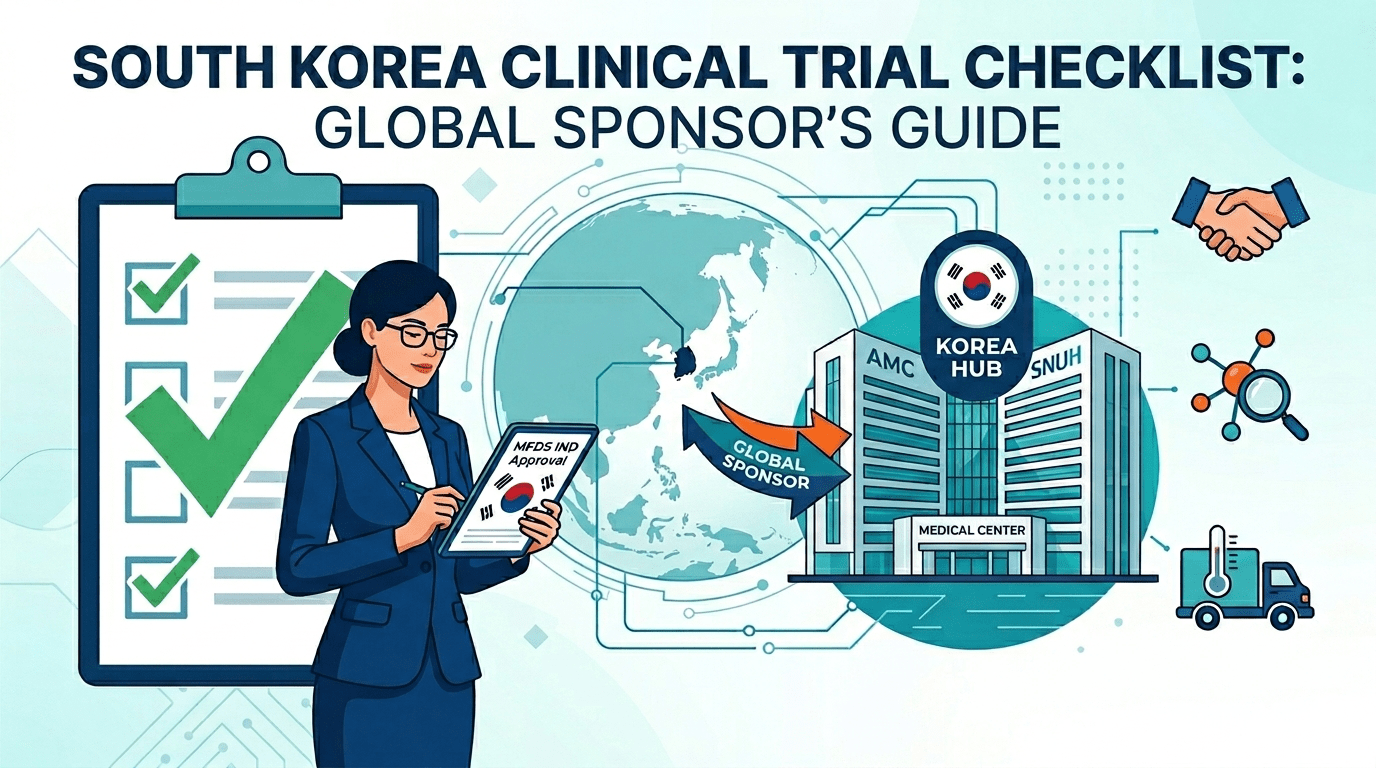
As the global pharmaceutical landscape shifts toward more rapid and data-driven drug development, South Korea has solidified its position as a premier destination for multi-regional clinical trials (MRCTs). With Seoul consistently leading global rankings for clinical trial density, the nation offers an unparalleled combination of world-class medical infrastructure and a highly concentrated patient population. However, for global sponsors, the road to a successful First Patient In (FPI) requires navigating a sophisticated regulatory framework and a unique local healthcare ecosystem.
At NexBridge Bio, we understand that a “checklist” is not just a list of tasks—it is a strategic roadmap. This guide outlines the critical pillars that global sponsors must address to ensure a seamless entry into the Korean clinical market in 2026.


The Regulatory Bedrock: MFDS and Local Representation
The journey begins with the Ministry of Food and Drug Safety (MFDS). Unlike many other jurisdictions, the South Korean Pharmaceutical Affairs Act mandates that a foreign sponsor without a local legal entity must appoint a Local Sponsor Representative (LSR). This is not a mere administrative requirement; the LSR carries the legal responsibility for the trial’s conduct, safety reporting, and quality management.
Beyond representation, sponsors must evaluate the necessity of an Ethnic Sensitivity Assessment (ESA). As Korea adheres strictly to ICH E5 guidelines, determining whether a bridging study is required for your specific molecule—based on existing global pharmacokinetic and pharmacodynamic data—is the first critical “go/no-go” decision. Early consultation with the MFDS (Pre-IND meeting) is highly recommended to align on these expectations before formal submission.
Streamlining the Timeline: Parallel Review and Documentation
Efficiency in Korea is largely driven by the ability to execute the IND (Investigational New Drug) application and IRB (Institutional Review Board) review in parallel. The MFDS typically operates on a 30-working-day review cycle, but the true timeline is often dictated by the quality of the submission dossier.
Localization is where many global sponsors encounter friction. A common misconception is that standard English dossiers are sufficient. At NexBridge Bio, we emphasize that medical translation is not just language conversion; it is regulatory adaptation. The Informed Consent Form (ICF), Investigator’s Brochure (IB), and Protocol must be localized to reflect Korean medical terminology and cultural nuances, ensuring they meet the high scrutiny of local ethics committees while maintaining global data integrity.
Site Selection: Leveraging World-Class Research Powerhouses
South Korea’s clinical research is anchored by a network of elite medical centers, often referred to as the “Big 5.” These institutions boast some of the world’s highest patient throughputs and most advanced Electronic Medical Record (EMR) systems, making them ideal for complex, data-heavy global trials.
For instance, Asan Medical Center (AMC) in Seoul is consistently recognized as one of the world’s best hospitals and a global leader in clinical trial volume, particularly in oncology and organ transplantation. Similarly, Seoul National University Hospital (SNUH) offers a sophisticated Clinical Trials Center that has pioneered early-phase drug development and medical device testing in Asia.
While these centers offer immense recruitment potential, a strategic sponsor must look at investigator engagement. The selection process should prioritize Principal Investigators (PIs) who not only have therapeutic expertise at institutions like AMC or SNUH but also have a proven track record in global multi-regional clinical trials (MRCTs). In the 2026 clinical environment, the ability of a site to utilize decentralized clinical trial (DCT) elements—such as remote monitoring or digital recruitment—is becoming a key differentiator in site feasibility assessments.
Operational Logistics and IMP Management
The logistical “last mile” of a clinical trial in Korea often involves complex Investigational Medicinal Product (IMP) management. Sponsors must secure an MFDS import recommendation letter to facilitate customs clearance.
Furthermore, Korea’s strict requirements for labeling and cold chain maintenance—especially for advanced biologics and cell therapies—demand a robust local logistics partner. Ensuring that your IMP reaches the site with full temperature-traceability and compliant labeling is paramount to avoiding protocol deviations before the trial even begins.
The Readiness Checklist for Global Success
To ensure your clinical program is “Korea-ready,” we have synthesized the essential steps into a strategic summary:
- Legal Compliance: Ensure a qualified LSR is in place and clinical trial insurance is secured under Korean law.
- Regulatory Alignment: Complete the ESA and engage in pre-IND consultations to mitigate the risk of bridging study requirements.
- Quality Localization: Invest in high-fidelity, compliant translations of all patient-facing and investigator-facing documents.
- Institutional Ethics: Leverage the Central IRB system where applicable to synchronize timelines across multi-center sites.
- Operational Integrity: Validate local cold chain logistics and IMP import pathways well in advance of the SIV (Site Initiation Visit).
Conclusion: Partnering for Precision
Navigating the Korean clinical trial landscape is a high-stakes endeavor where regulatory precision meets operational speed. For global sponsors, the key to success lies in bridging the gap between global headquarters’ expectations and the local regulatory reality on the ground.
At NexBridge Bio, we specialize in providing the local expertise and strategic oversight necessary to turn these complex requirements into a competitive advantage. By aligning your global strategy with Korea’s unique strengths, you can accelerate your development timelines and bring life-changing therapies to patients faster.
Frequently Asked Questions (FAQ)
Q1: What is the typical timeline for MFDS IND approval in South Korea?
A: Under the current regulatory framework, the standard review period for a clinical trial application (IND) is 30 working days. However, sponsors should factor in an additional 4–8 weeks for the preparation of the dossier and potential Requests for Information (RFI) cycles. At NexBridge Bio, we recommend a “parallel submission” strategy—submitting to the MFDS and the Institutional Review Board (IRB) simultaneously—to achieve First Patient In (FPI) within 4–6 months.
Q2: Is a Local Sponsor Representative (LSR) mandatory for foreign biopharma companies?
A: Yes. According to the South Korean Pharmaceutical Affairs Act, any foreign sponsor that does not have a registered legal entity in South Korea must appoint a qualified Local Sponsor Representative (LSR). The LSR is legally responsible for ensuring the trial’s compliance with local GPC standards, safety reporting (Pharmacovigilance), and acting as the official liaison with the MFDS.
Q3: Does the MFDS require all clinical trial documents to be translated into Korean?
A: Not all, but core documents must be localized. While the MFDS accepts some technical dossiers in English (such as certain CMC data), the Clinical Trial Protocol, Investigator’s Brochure (IB), and Informed Consent Form (ICF) must be submitted in professional medical Korean. High-quality translation is critical, as any ambiguity in the ICF can lead to IRB rejection or delays in site activation.
Q4: Are clinical data generated at South Korean sites, such as Asan Medical Center or SNUH, accepted by the FDA and EMA?
A: Absolutely. South Korea is a member of the ICH (International Council for Harmonisation) and strictly adheres to ICH-GCP guidelines. Data from top-tier institutions like Asan Medical Center (AMC) and Seoul National University Hospital (SNUH) are routinely used in global regulatory submissions for FDA and EMA approvals.
Q5: What is a “Bridging Study,” and how do I know if my drug needs one?
A: A bridging study is a local clinical trial (usually Phase 1 or 2) conducted to demonstrate that the safety and efficacy data from a foreign population can be extrapolated to the Korean population (Ethnic Sensitivity). Whether your drug requires one depends on its pharmacological properties and existing data. We recommend an MFDS Pre-IND Consultation to clarify these requirements early in the planning stage.